. 1999 May 11;96(10):5746-51.
doi: 10.1073/pnas.96.10.5746.

Megacystis, mydriasis, and ion channel defect in mice lacking the alpha3 neuronal nicotinic acetylcholine receptor

Affiliations

Megacystis, mydriasis, and ion channel defect in mice lacking the alpha3 neuronal nicotinic acetylcholine receptor

W Xu et al. Proc Natl Acad Sci U S A. .

Abstract

The alpha3 subunit of the neuronal nicotinic acetylcholine receptor is widely expressed in autonomic ganglia and in some parts of the brain. The alpha3 subunit can form heteromultimeric ion channels with other alpha subunits and with beta2 and beta4 subunits, but its function in vivo is poorly understood. We prepared a null mutation for the alpha3 gene by deletion of exon 5 and found that homozygous (-/-) mice lacked detectable mRNA on Northern blotting. The -/- mice survive to birth but have impaired growth and increased mortality before and after weaning. The -/- mice have extreme bladder enlargement, dribbling urination, bladder infection, urinary stones, and widely dilated ocular pupils that do not contract in response to light. Detailed histological studies of -/- mice revealed no significant abnormalities in brain or peripheral tissues except urinary bladder, where inflammation was prominent. Ganglion cells and axons were present in bladder and bowel. Bladder strips from -/- mice failed to contract in response to 0.1 mM nicotine, but did contract in response to electrical field stimulation or carbamoylcholine. The number of acetylcholine-activated single-channel currents was severely reduced in the neurons of superior cervical ganglia in -/- mice with five physiologically distinguishable nicotinic acetylcholine receptor subtypes with different conductance and kinetic properties in wild-type mice, all of which were reduced in -/- mice. The findings in the alpha3-null mice suggest that this subunit is an essential component of the nicotinic receptors mediating normal function of the autonomic nervous system. The phenotype in -/- mice may be similar to the rare human genetic disorder of megacystis-microcolon-intestinal hypoperistalsis syndrome.


Figures
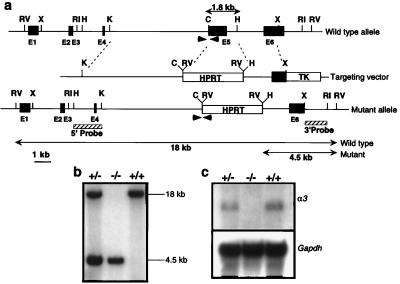
Figure 1
Figure 1
Generation of α3-null mice. (a) Wild-type allele, targeting vector, and mutant allele are depicted with restriction enzyme sites, exons (solid rectangles), and 5′ and 3′ probes for Southern blotting. Restriction enzymes: RI, EcoRI; RV, EcoRV; C, ClaI; H, HindIII; K, KpnI; and X, XhoI. TK, thymidine kinase; HPRT, hypoxanthine phosphoribosyltransferase. The 1.8-kb deleted region is indicated above the wild type allele. (b) Southern blot analysis of tail DNA from +/−, −/−, and +/+ littermates with the 3′ probe. (c) Northern blot analysis of expression of α3 in the brain of +/−, −/−, and +/+ littermates, using hybridization with a rat α3 cDNA (20) as a probe and a glyceraldehyde-3-phosphate dehydrogenase (Gapdh) probe as a control.
Figure 2
Figure 2
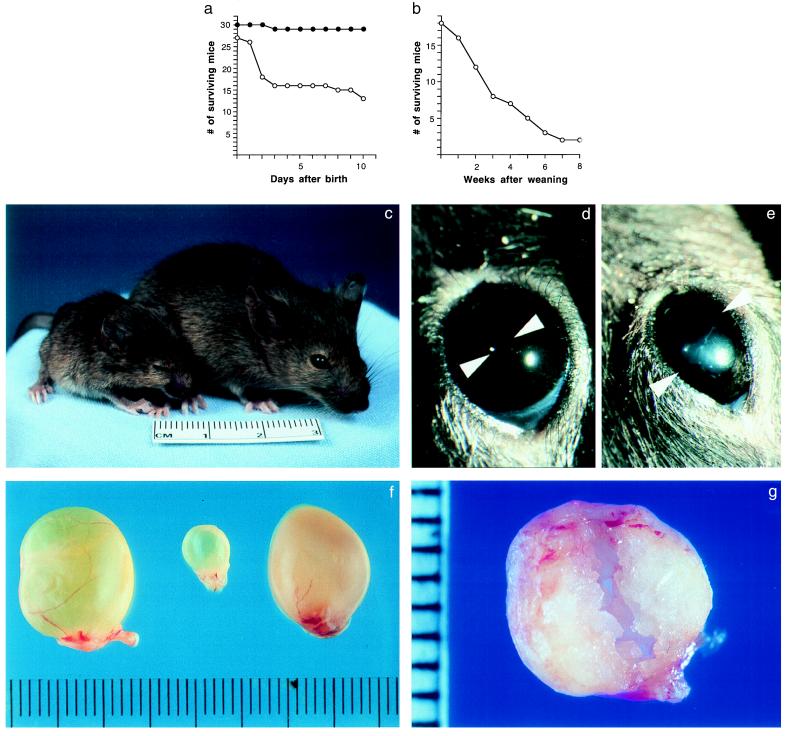
Phenotypic findings in mice lacking the α3 nAChR subunit. Mice were bred on a mixed 129/SvEv and C57BL/6 background. (a) Survival of 27 −/− (○) and 30 +/+ (●) littermate mice in the 10 days after birth. (b) Survival of 18 −/− mice in the 8 weeks after weaning. (c) Comparison of typical +/+ (right) and −/− (left) littermates at 7 weeks of age. Note smaller size and closed eyes in −/− mouse. (d and e) Comparison of the eye in a +/+ mouse (d) demonstrating larger globe and tiny pupil compared with the smaller eye and very widely dilated pupil in the −/− mouse (e). The margins of the pupils are indicated by white arrowheads. (f) The bladder from a normal mouse (center) is compared with two bladders from −/− mice, the left containing clear urine and the right containing cloudy urine. (g) A −/− mouse bladder that has been partially cut to demonstrate the dense stone formation filling the bladder.
Figure 3
Figure 3
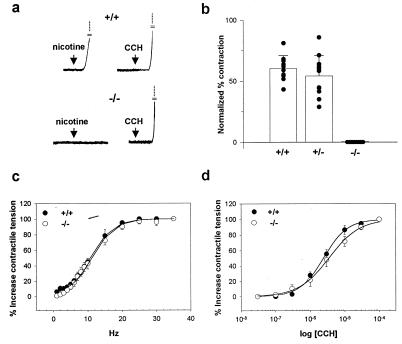
Absence of bladder contraction in response to nicotine in α3-deficient mice. (a) Typical tracings of the response to nicotine and CCH in +/+ and −/− mice. (b) Response to nicotine in +/+ (n = 10), +/− (n = 11), and −/− (n = 8) mice. Data are presented as the contraction in response to nicotine as a percentage of that in response to CCH, ±SEM. (c) Bladder contraction in response to electric field simulation, showing indistinguishable response in +/+ and −/− mice. (d) Bladder contraction in response to CCH in +/+ and −/− mice, indicating comparable responses in the two groups.
Figure 4
Figure 4
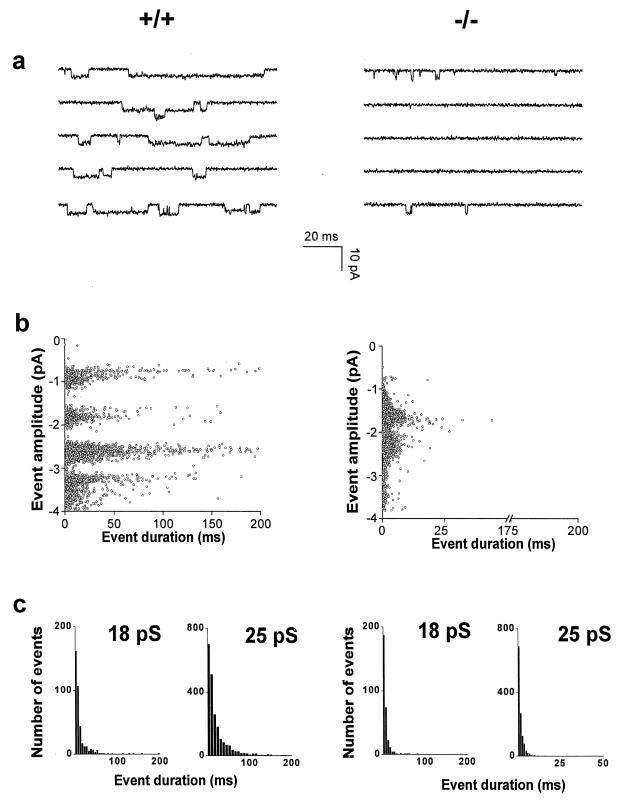
Altered profile of ACh-elicited single-channel currents in SCG neurons in α3-deficient mice. The SCG neurons from +/+ mice express five conductance classes of nAChRs. In contrast, the SCG neurons from −/− mice display many fewer channel openings which contribute to only two well-defined conductance classes. (a) Sample traces of ACh-gated single-channel currents in cell attached patches (membrane holding potential +50 mV) demonstrated that the +/+ mice expressed both more channel openings and openings of longer duration than the −/− mice. (b) Amplitude analysis of +/+ SCG neurons indicated that there were five amplitude classes (γ1+/+ ≈ 9 pS, γ2+/+ ≈ 18 pS, γ3+/+ ≈ 25 pS, γ4+/+ ≈ 35 pS, and γ5+/+ ≈ 41 pS; 3,148 events pooled from four cells). In contrast, amplitude analysis of −/− SCG neurons revealed only two well defined conductance classes (γ1−/− ≈ 18 pS and γ2−/− ≈ 25 pS; 2,185 events pooled from nine cells). (c) Kinetic analysis of the 18-pS and 25-pS channel classes from both +/+ and −/− mice showed that the fast components of both classes were similar in the +/+ and −/− mice. However, the +/+ channels each contained two longer-duration components that were missing from the −/− classes. Mean τ values ± SEM are reported in the text.

References

    1. Sargent P B. Annu Rev Neurosci. 1993;16:403–443. - PubMed
    1. McGehee D S, Role L W. Annu Rev Physiol. 1995;57:521–546. - PubMed
    1. Le Novere N, Changeux J-P. J Mol Evol. 1995;40:155–172. - PubMed
    1. Colquhoun L M, Patrick J W. J Neurochem. 1997;69:2355–2362. - PubMed
    1. Lindstrom J, Anand R, Gerzanich V, Peng X, Wang F, Wells G. Prog Brain Res. 1996;109:125–137. - PubMed

Publication types

MeSH terms