. 1999 May;181(10):3069-75.
doi: 10.1128/JB.181.10.3069-3075.1999.

Role of quinolinate phosphoribosyl transferase in degradation of phthalate by Burkholderia cepacia DBO1

Affiliations

Role of quinolinate phosphoribosyl transferase in degradation of phthalate by Burkholderia cepacia DBO1

H K Chang et al. J Bacteriol. 1999 May.

Abstract

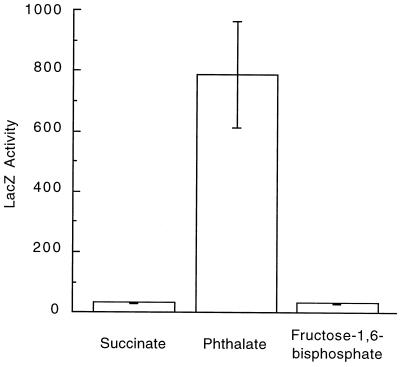
Two distinct regions of DNA encode the enzymes needed for phthalate degradation by Burkholderia cepacia DBO1. A gene coding for an enzyme (quinolinate phosphoribosyl transferase) involved in the biosynthesis of NAD+ was identified between these two regions by sequence analysis and functional assays. Southern hybridization experiments indicate that DBO1 and other phthalate-degrading B. cepacia strains have two dissimilar genes for this enzyme, while non-phthalate-degrading B. cepacia strains have only a single gene. The sequenced gene was labeled ophE, due to the fact that it is specifically induced by phthalate as shown by lacZ gene fusions. Insertional knockout mutants lacking ophE grow noticeably slower on phthalate while exhibiting normal rates of growth on other substrates. The fact that elevated levels of quinolinate phosphoribosyl transferase enhance growth on phthalate stems from the structural similarities between phthalate and quinolinate: phthalate is a competitive inhibitor of this enzyme and the phthalate catabolic pathway cometabolizes quinolinate. The recruitment of this gene for growth on phthalate thus gives B. cepacia an advantage over other phthalate-degrading bacteria in the environment.


Figures
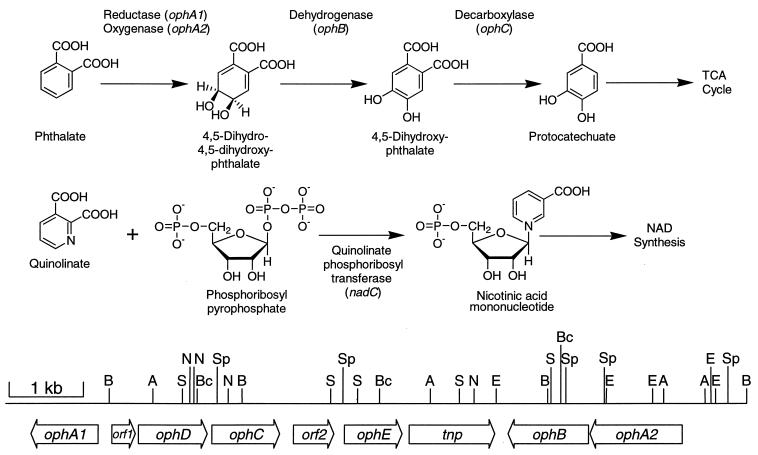
FIG. 1
FIG. 1
Metabolic pathways for the degradation of phthalate and the synthesis of nicotinic acid mononucleotide from quinolinate and phosphoribosyl pyrophosphate. A restriction map and diagram of the cloned and sequenced genes for phthalate degradation (including the nadC analogue ophE reported here) from B. cepacia DBO1 are shown at the bottom. A, AatII; B, BamHI; Bc, BclI; E, EcoRI; N, NotI; S, SalI; Sp, SphI. TCA, tricarboxylic acid.
FIG. 2
FIG. 2
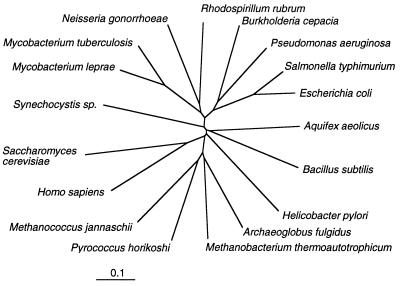
Dendrogram showing the phylogenetic relationship of different genes coding for quinolinate phosphoribosyl transferase (nadC or ophE). The nucleotide sequences were aligned with the pileup program of the Genetics Computer Group package (16), the alignment was confirmed by visual inspection and comparison with the deduced amino acid sequence alignments, and the phylogenetic tree was calculated with the PAUP program by using the minimal distance method. The nucleotide sequences were obtained from the following sources: Aquifex aeolicus (13), Archaeoglobus fulgidus (34), Bacillus subtilis, (58), E. coli (68), Helicobacter pylori (61), Homo sapiens, (20), Methanococcus jannaschii (8), Mycobacterium leprae (unpublished data; GenBank accession no. U00010), Methanobacterium thermoautotrophicum (56), Mycobacterium tuberculosis (12), N. gonorrhoeae (51a), P. aeruginosa (47a), Pyrococcus horikoshi (28), Rhodospirillum rubrum, (55), Saccharomyces cerevisiae (41), S. typhimurium (24), and Synechocystis sp. (27).
FIG. 3
FIG. 3
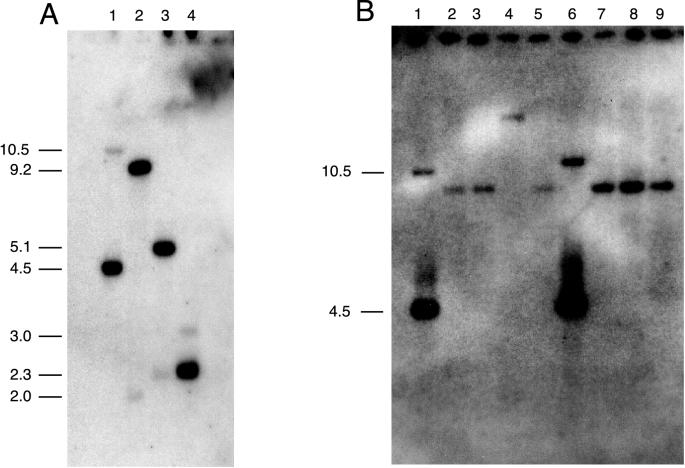
Southern hybridization of total genomic DNA from B. cepacia DBO1 (A) and from different B. cepacia strains (B) with the 0.9-kb PCR-amplified ophE gene probe from DBO1. (A) Total DNA from B. cepacia was digested with BamHI (lane 1), EcoRI (lane 2), PstI (lane 3), and XhoI (lane 4). The migration distances of the size standards are indicated on the left. (B) Total DNA from different B. cepacia strains was digested with BamHI. Lanes 1 through 9 contain DNA from strains DBO1, 382, D1, M53, ATCC 25416, ATCC 17616, k56-2, k63-3, and 715j, respectively. Only DBO1 and ATCC 17616 are phthalate degraders. The deduced size of each band is indicated.
FIG. 4
FIG. 4
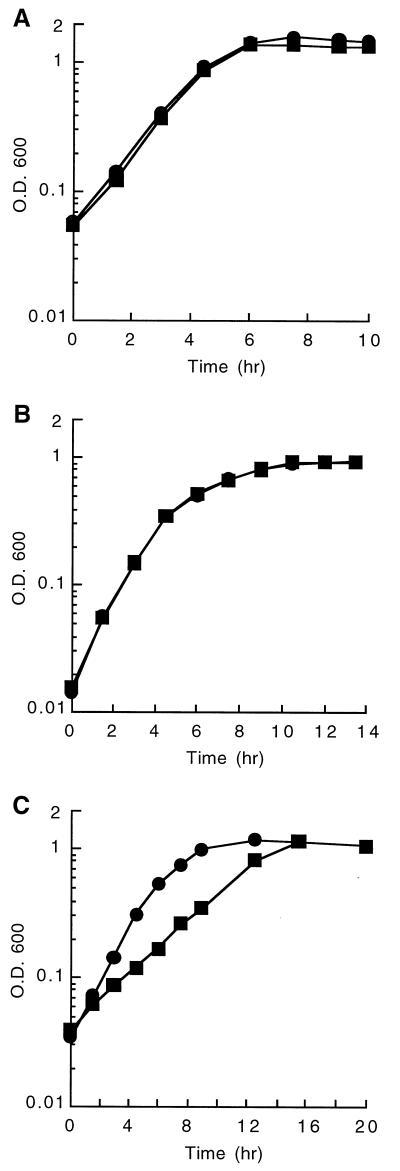
Growth of DBO302 (ophE knockout) (■) and DBO303 (spontaneously kanamycin-resistant mutant of DBO1) (●) in a minimal medium with succinate (A), p-hydroxybenzoate (B), or phthalate (C) as the sole carbon source. OD600, optical density at 600 nm.
FIG. 5
FIG. 5
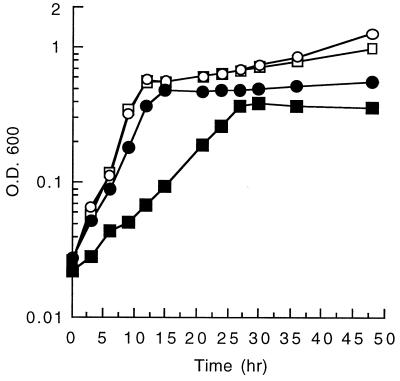
Growth of wild-type DBO1 (circles) and the ophE knockout mutant DBO302 (squares) in a minimal medium containing phthalate with either the vector (pRK415) (black) or the cloned ophE gene (pGJZ1333) (white). Growth is slower than that shown in Fig. 4 due to the incorporation of tetracycline in the medium.
FIG. 6
FIG. 6
Induction of ophE by phthalate. Comparison of the β-galactosidase activities produced by B. cepacia DBO1 containing the promoter-probe construct pGJZ1334 following growth on succinate, phthalate, or succinate plus fructose 1,6-bisphosphate. LacZ activity is reported in nanomoles per minute per milligram of protein in crude cell extracts. The standard deviation (error bar) is the average of three independent assays.

References

    1. Ballard R W, Palleroni N J, Doudoroff M, Stainer R Y, Mandel M. Taxonomy of the aerobic pseudomonads: P. cepacia, P. marginata, P. alliicola and P. caryophylli. J Gen Microbiol. 1970;60:199–214. - PubMed
    1. Batie C J, LaHaie E, Ballou D P. Purification and characterization of phthalate oxygenase and phthalate oxygenase reductase from Pseudomonas cepacia. J Biol Chem. 1987;262:1510–1518. - PubMed
    1. Beliles R, Salinas J A, Kluwe W M. A review of di(2-ethylhexyl)phthalate (DEHP) risk assessments. Drug archives of environmental contamination and toxicology. NY Metab Rev. 1989;21:3–12. - PubMed
    1. Bhatia R, Calvo K C. The sequencing, expression, purification, and steady-state kinetic analysis of quinolinate phosphoribosyl transferase from Escherichia coli. Arch Biochem Biophys. 1996;325:270–278. - PubMed
    1. Birnboim H C, Doly J. A rapid alkaline extraction procedure for screening recombinant plasmid DNA. Nucleic Acids Res. 1979;7:1513–1523. - PMC - PubMed

Publication types

MeSH terms

Associated data

LinkOut - more resources