


Development of a simple and highly sensitive enzyme immunoassay for hepatitis C virus core antigen
- PMID: 10325327
- PMCID: PMC84955
- DOI: 10.1128/JCM.37.6.1802-1808.1999
Development of a simple and highly sensitive enzyme immunoassay for hepatitis C virus core antigen
Abstract
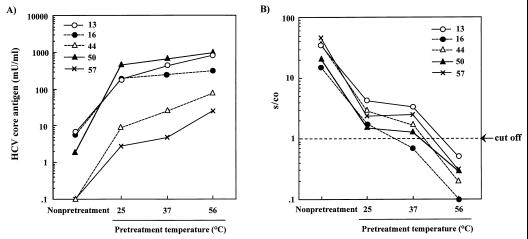
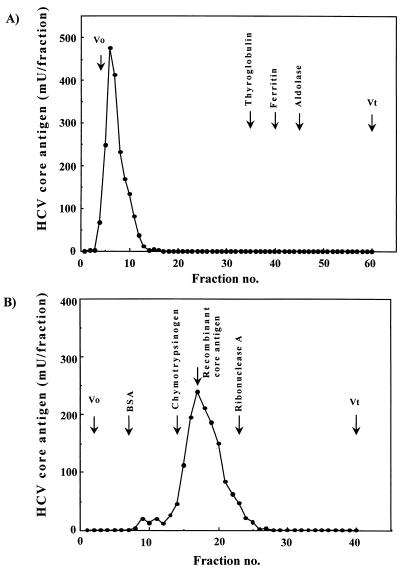
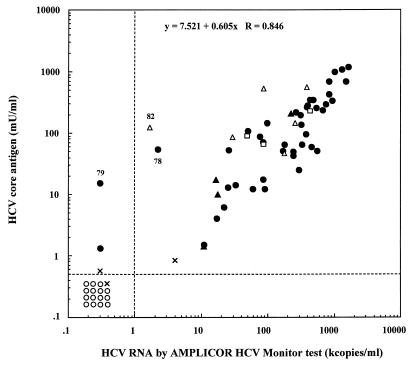
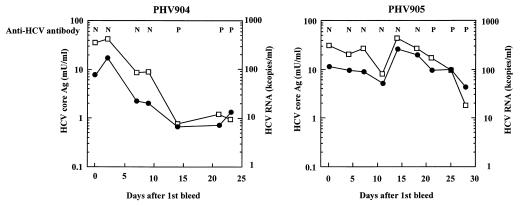
A highly sensitive enzyme immunoassay (EIA) for the hepatitis C virus (HCV) core antigen (HCVcAg) was developed, and its performance was compared with that of the AMPLICOR HCV test (Roche Molecular Systems). The developed one-step pretreatment method, 30-min incubation of the specimen with a solution containing three different types of detergents (Triton X-100, 3-[(3-cholamidopropyl)-dimethylammonio]-1-propanesulfonate [CHAPS], and sodium dodecyl sulfate), does not require any special device. Because the interfering anti-core antibody in the sample was sufficiently inactivated by the pretreatment, HCVcAg in the sample could be detected. The immunoreactivity on gel filtration was shifted from void fractions to those corresponding to the molecular mass range from 20 to 25 kDa, which is equal to the estimated molecular mass of HCVcAg, after the pretreatment. By the recovery test with HCVcAg-positive serum, the recovery rate was 93.5 to 106. 5%. There was no interference with the EIA by anticoagulants or blood components in the serum. When the cutoff value was tentatively set at 0.5 mU/ml based on the distribution of healthy subjects' sera, the sera of all healthy subjects (n = 125) and patients with hepatitis B (n = 50) were negative. HCVcAg was detected in sera from 57 of 73 individuals (78.1%) with anti-HCV antibody. Similarly, HCV RNA was detected in sera from 59 individuals (80.8%) with the AMPLICOR HCV as the qualitative test (AMPLICOR HCV test) and in sera from 54 individuals (74.0%) by the AMPLICOR HCV Monitor as the quantitative test (AMPLICOR Monitor test). Concentrations of HCVcAg and HCV RNA (measured by the AMPLICOR Monitor test) correlated significantly (r = 0.8, P < 0.001). On seroconversion panels, HCVcAg was detected during the early stage of infection, when anti-HCV antibodies had not been produced. This assay for HCVcAg is simpler than assays for HCV RNA based on gene technology and shows specificity and sensitivity equivalent to those of the AMPLICOR HCV test.
Figures
References
-
- Aoyagi, K., C. Ohue, K. Iida, and S. Yagi. Unpublished data.
-
- Beutler E, Gelbart T, Kuhl W. Interference of heparin with the polymerase chain reaction. BioTechniques. 1990;9:166. - PubMed
-
- Busch M P, Korelitz J J, Kleinman S H, Lee S R, AuBuchon J P, Schreiber G B. Declining value of alanine aminotransferase in screening of blood donors to prevent posttransfusion hepatitis B and C virus infection. The Retrovirus Epidemiology Donor Study. Transfusion. 1995;35:903–910. - PubMed
-
- Choo Q-L, Kuo G, Weiner A J, Overby L R, Bradley D W, Houghton M. Isolation of a cDNA clone derived from a blood-borne non-A, non-B viral hepatitis genome. Science. 1989;244:359–362. - PubMed
Publication types
MeSH terms
Substances
LinkOut - more resources
Full Text Sources
Other Literature Sources
Medical
Research Materials
