. 1999 Jun 1;517 ( Pt 2)(Pt 2):407-20.
doi: 10.1111/j.1469-7793.1999.0407t.x.

Molecular correlates of the calcium-independent, depolarization-activated K+ currents in rat atrial myocytes

Affiliations

Molecular correlates of the calcium-independent, depolarization-activated K+ currents in rat atrial myocytes

E Bou-Abboud et al. J Physiol. .

Abstract

1. In adult rat atrial myocytes, three kinetically distinct Ca2+-independent depolarization-activated outward K+ currents, IK, fast, IK,slow and Iss, have been separated and characterized. 2. To test directly the hypothesis that different voltage-dependent K+ channel (Kv channel) alpha subunits underlie rat atrial IK,fast, IK, slow and Iss, the effects of antisense oligodeoxynucleotides (AsODNs) targeted against the translation start sites of the Kv alpha subunits Kv1.2, Kv1.5, Kv4.2, Kv4.3, Kv2.1 and KvLQT1 were examined. 3. Control experiments on heterologously expressed Kv alpha subunits revealed that each AsODN is selective for the subunit against which it was targeted. 4. Peak outward K+ currents were attenuated significantly in rat atrial myocytes exposed to AsODNs targeted against Kv4.2, Kv1.2 and Kv1.5, whereas AsODNs targeted against Kv2.1, Kv4.3 and KvLQT1 were without effects. 5. No measurable effects on inwardly rectifying K+ currents (IK1) were observed in atrial cells exposed to any of the Kv alpha subunit AsODNs. 6. Kinetic analysis of the currents evoked during long (10 s) depolarizing voltage steps revealed that AsODNs targeted against Kv4.2, Kv1.2 and Kv1.5 selectively attenuate rat atrial IK,fast, IK, slow and Iss, respectively, thus demonstrating that the molecular correlates of rat atrial IK,fast, IK,slow and Iss are distinct. 7. The lack of effect of the Kv4.3 AsODNs on peak outward K+ currents reveals that Kv4.2 and Kv4.3 do not heteromultimerize in rat atria in vivo. In addition, the finding that Kv1.2 and Kv1.5 contribute to distinct K+ currents in rat atrial myocytes demonstrates that Kv1.2 and Kv1.5 also do not associate in rat atria in vivo.


Figures
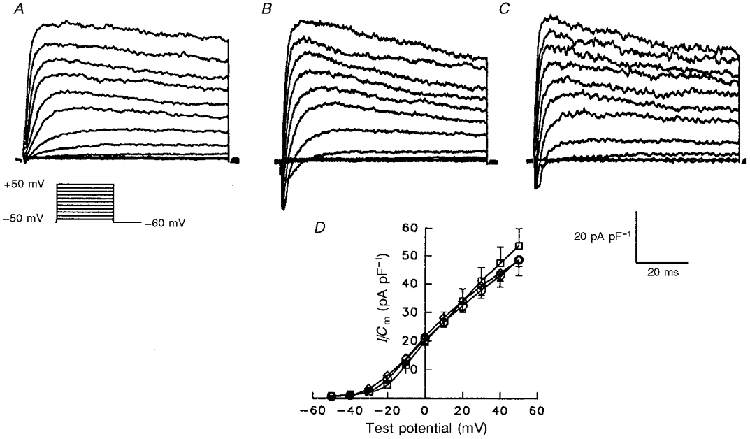
Figure 1
Figure 1. Current-voltage relations of peak outward K+ currents in isolated adult and postnatal day 28 (P28) rat atrial myocytes are indistinguishable
Outward currents, evoked during 100 ms depolarizing voltage steps to potentials from -50 to +50 mV from a holding potential of -60 mV, were recorded in individual cells and normalized to the whole-cell membrane capacitance, Cm (determined in the same cell). Representative current waveforms, normalized for difference in cell sizes, recorded in adult (A) and in postnatal day 28 rod-shaped (P28R) (B) and spherical (P28S) (C) rat atrial myocytes are displayed. D, mean ±s.e.m. peak outward current density for the currents recorded in P28S (n = 25), P28R (n = 9) and adult (n = 11) cells are plotted as a function of test potential. One-way analysis of variance (ANOVA) revealed no significant differences in peak current-voltage relations in adult (○), P28S (⋄) and P28R (□) atrial myocytes.
Figure 2
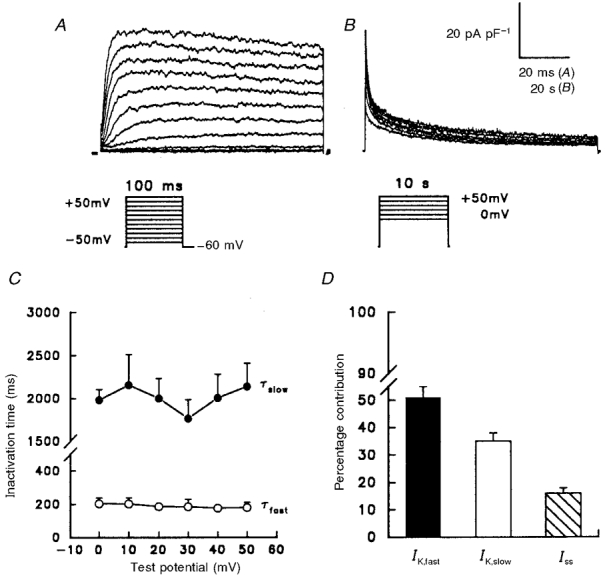
Figure 2. Three components of the peak outward currents in P28 rat atrial myocytes
Outward currents were evoked as described in the legend of Fig. 1 during 100 ms (A) and 10 s (B) depolarizing voltage steps; for the records presented in B, the interpulse interval was 60 s. The records in A and B were obtained from the same cell; note also that, in B, the data are plotted as points and the continuous lines reflect double exponential fits to the decay phases of the currents (see text). C, mean ±s.e.m. (n = 6) time constants for the fast (○) and slow (•) components of peak outward decay, determined from double exponential fits (as in B) to the decay phases of the outward currents evoked during 10 s depolarizations to potentials between 0 and +50 mV. D, mean ±s.e.m. (n = 22) percentage contribution of IK,fast, IK,slow and Iss to the peak outward K+ currents in P28 rat atrial myocytes at +30 mV (see text).
Figure 3
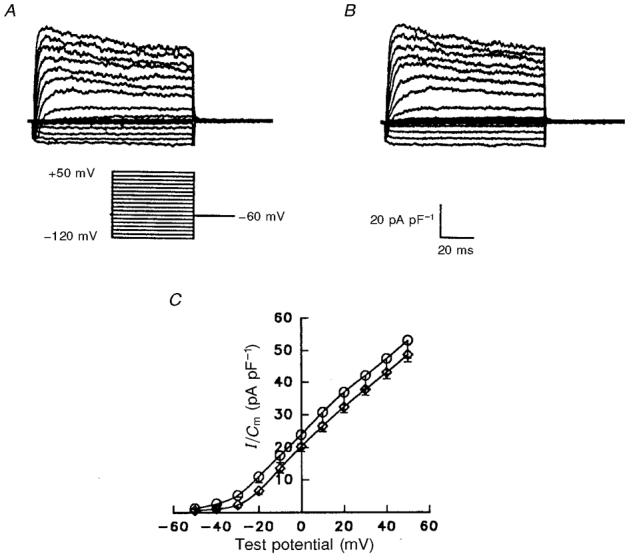
Figure 3. Lipofectamine alone has no effects on outward or inward K+ currents in rat atrial myocytes
Representative normalized K+ currents recorded from P28 rat atrial cells in the absence (A) and presence (B) of lipofectamine are displayed. Currents were recorded as described in the legend to Fig. 1, except that the test potential range was -120 to +50 mV. C, mean ±s.e.m. peak current density-voltage relations in the absence (○, n = 23) and presence (⋄, n = 25) of lipofectamine are not significantly different (Student's t test).
Figure 4
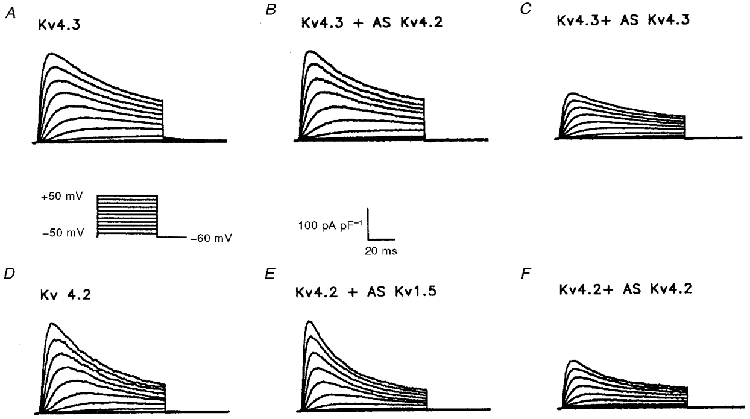
Figure 4. Effects of AsODNs targeted against Kv4.3 and Kv4.2 are specific
Representative normalized K+ currents recorded from HEK-293 cells expressing Kv4.3 (A) or Kv4.2 (D) are displayed; currents were recorded as described in the legend to Fig. 1. The Kv4.3-induced K+ currents (A) were decreased following incubation with the Kv4.3 AsODN (C), but not after exposure to the Kv4.2 AsODN (B). Similarly, the currents produced on expression of Kv4.2 (D) were significantly attenuated by the Kv4.2 AsODN (F), whereas the Kv1.5 AsODN did not have any measurable effects (E).
Figure 5
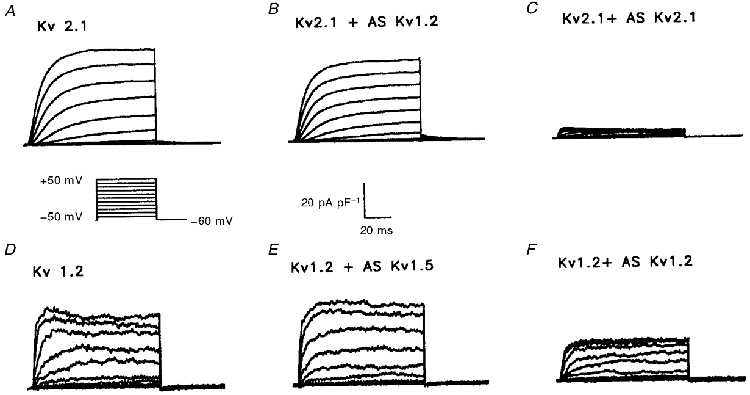
Figure 5. The effects of AsODNs targeted against Kv2.1 and Kv1.2 are also subunit specific
Representative normalized currents recorded from HEK-293 cells expressing Kv2.1 (A) and Kv1.2 (D) are shown. Currents were recorded as described in the legend to Fig. 1. The Kv2.1-induced K+ currents (A) were decreased following incubation with the Kv2.1 AsODN (C), but not after exposure to the Kv1.2 AsODN (B). The Kv1.2-induced currents (D) were significantly attenuated by the Kv1.2 AsODN (F), whereas the Kv1.5 AsODN did not have any measurable effect (E).
Figure 6
Figure 6. Peak outward K+ currents in atrial myocytes are reduced following exposure to Kv1.2, Kv4.2 and Kv1.5 AsODNs
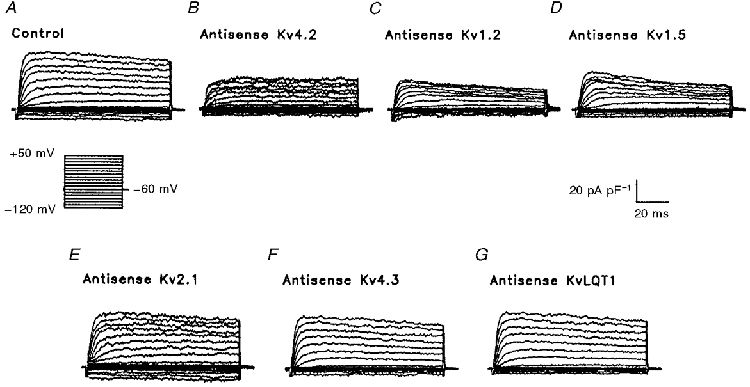
Representative normalized K+ currents, recorded from atrial myocytes following exposure to lipofectamine alone (A) or lipofectamine and one of the Kv α subunit AsODNs (B-G), are displayed. Currents were recorded as described in the legend to Fig. 2; the voltage clamp protocol is illustrated under record A. When compared with control records (A), peak outward K+ currents were decreased significantly in the presence of AsODNs targeted against Kv4.2 (B), Kv1.2 (C) and Kv1.5 (D), whereas the AsODNs targeted against Kv2.1 (E), Kv4.3 (F) and KvLQT1 (G) were without effect. No measurable effects of any of the AsODNs on IK1 were evident (see also Table 1).
Figure 7
Figure 7. Effect of AsODNs on the peak atrial outward K+ current density-voltage relations
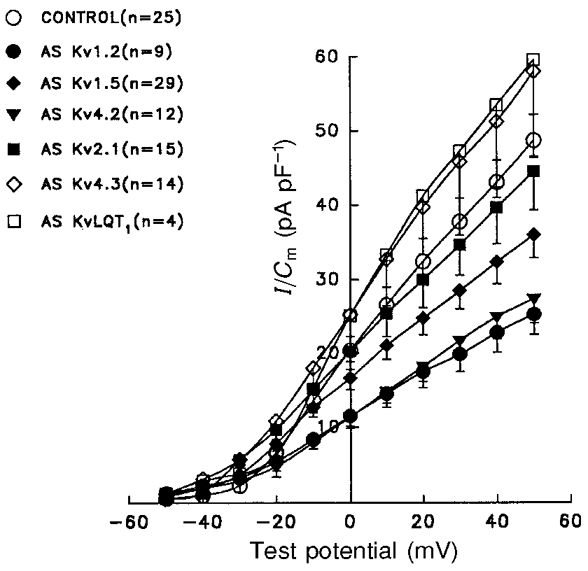
Outward currents, evoked during 100 ms depolarizing voltage steps to potentials from -50 to +50 mV from a holding potential of -60 mV, were recorded in P28 rat atrial myocytes under control conditions or following exposure to Kv α subunit AsODNs (see Fig. 5). Peak outward currents were measured in individual cells and normalized to the whole-cell membrane capacitance, Cm (determined in the same cell). Mean ±s.e.m. peak outward K+ currents densities are plotted here as a function of test potential. Peak outward K+ current densities were reduced significantly (P < 0.01) in cells exposed to the Kv1.2, Kv1.5 and Kv4.2 AsODNS, whereas no significant effects on the currents were evident in cells treated with Kv2.1, Kv4.3 or KvLQT1 AsODNs.
Figure 8
Figure 8. AsODNs targeted against Kv4.2, Kv1.2 and Kv1.5 attenuate different components of the outward K+ currents in atrial cells
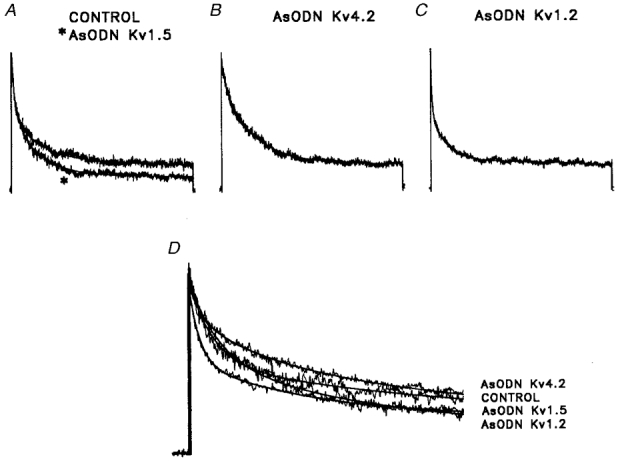
A-C, outward K+ currents, evoked during 10 s depolarizing voltage steps to +30 mV from a holding potential of -60 mV, were recorded from control atrial myocytes (A) and from cells exposed to the Kv1.5 (A, asterisk), Kv4.2 (B) and Kv1.2 (C) AsODNs. The records obtained from cells exposed to AsODNs (in A-C) were scaled to the peak amplitude of the current in the control cell (A) to facilitate comparison of the current waveforms. As is evident, the waveforms of the outward currents evoked during 10 s voltage steps in the presence of the Kv1.5 (A), Kv4.2 (B) and Kv1.2 (C) AsODNs are distinct from the control (A). To determine the amplitudes of the fast (IK,fast), the slow (IK,slow) and the steady-state (Iss) current components, the decay phases of the currents were fitted to the sum of two exponentials (see Methods). Representative fits (plotted as lines) to the decay phases of the currents in a control P28 atrial myocyte and in P28 atrial cells exposed to the Kv1.5, the Kv4.2 or the Kv1.2 AsODN are illustrated in D. Note that only the first 2 s of the (10 s) depolarizing voltage steps are illustrated for clarity, and (as in A-C) that the peak outward currents are scaled (to the control cell). The Kv1.5, Kv4.2 and Kv1.2 AsODNs did not affect the time constants of IK,fast or IK,slow decay; only the amplitudes of the currents were reduced. Similar experiments were completed on many cells, and mean ±s.e.m. normalized data are presented in Table 3.

References

    1. Apkon M, Nerbonne JM. Characterization of two distinct depolarization-activated K+currents in isolated adult rat ventricular myocytes. Journal of General Physiology. 1991;97:973–1011. . - DOI - PMC - PubMed
    1. Barhanin J, Lesage F, Guillemare E, Fink M, Lazdunski M, Romey G. K(v)LQT1 and IsK (minK) proteins associate to form the I-Ks cardiac potassium current. Nature. 1996;384:78–80. - PubMed
    1. Barry DM, Nerbonne JM. Myocardial potassium channels: Electrophysiological and molecular diversity. Annual Review of Physiology. 1996;58:363–394. - PubMed
    1. Barry DM, Trimmer JS, Merlie JP, Nerbonne JM. Differential expression of voltage-gated potassium channel subunits in adult rat heart: relation to functional potassium channels? Circulation Research. 1995;77:361–369. - PubMed
    1. Barry DM, Xu H, Schuessler RB, Nerbonne JM. Functional knockout of the transient outward current, Long QT syndrome and cardiac remodelling in mice expressing a dominant negative Kv4 α subunit. Circulation Research. 1998;83:560–567. - PubMed

Publication types

MeSH terms

LinkOut - more resources