


Environmental factors modulating antibiotic and siderophore biosynthesis by Pseudomonas fluorescens biocontrol strains
- PMID: 10347023
- PMCID: PMC91358
- DOI: 10.1128/AEM.65.6.2429-2438.1999
Environmental factors modulating antibiotic and siderophore biosynthesis by Pseudomonas fluorescens biocontrol strains
Abstract
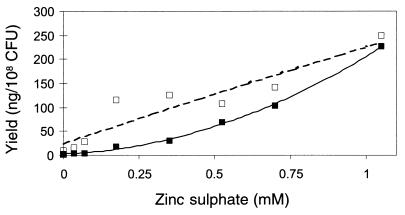
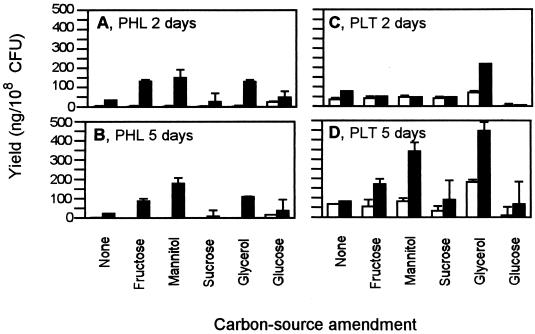
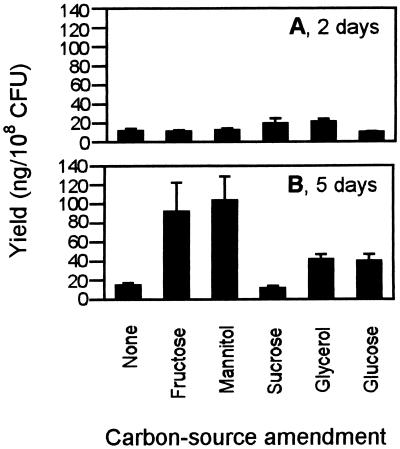
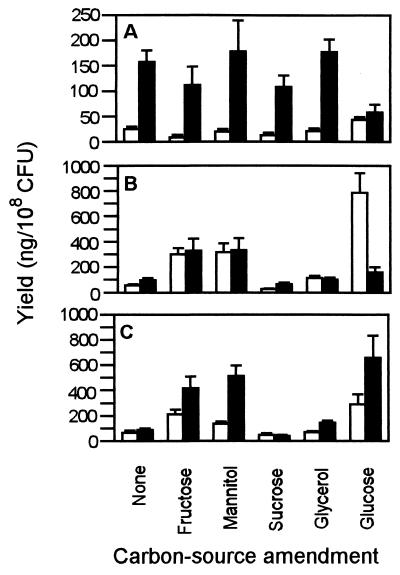
Understanding the environmental factors that regulate the biosynthesis of antimicrobial compounds by disease-suppressive strains of Pseudomonas fluorescens is an essential step toward improving the level and reliability of their biocontrol activity. We used liquid culture assays to identify several minerals and carbon sources which had a differential influence on the production of the antibiotics 2,4-diacetylphloroglucinol (PHL), pyoluteorin (PLT), and pyrrolnitrin and the siderophores salicylic acid and pyochelin by the model strain CHA0, which was isolated from a natural disease-suppressive soil in Switzerland. Production of PHL was stimulated by Zn2+, NH4Mo2+, and glucose; the precursor compound mono-acetylphloroglucinol was stimulated by the same factors as PHL. Production of PLT was stimulated by Zn2+, Co2+, and glycerol but was repressed by glucose. Pyrrolnitrin production was increased by fructose, mannitol, and a mixture of Zn2+ and NH4Mo2+. Pyochelin production was increased by Co2+, fructose, mannitol, and glucose. Interestingly, production of its precursor salicylic acid was increased by different factors, i.e., NH4Mo2+, glycerol, and glucose. The mixture of Zn2+ and NH4Mo2+ with fructose, mannitol, or glycerol further enhanced the production of PHL and PLT compared with either the minerals or the carbon sources used alone, but it did not improve siderophore production. Extending fermentation time from 2 to 5 days increased the accumulation of PLT, pyrrolnitrin, and pyochelin but not of PHL. When findings with CHA0 were extended to an ecologically and genetically diverse collection of 41 P. fluorescens biocontrol strains, the effect of certain factors was strain dependent, while others had a general effect. Stimulation of PHL by Zn2+ and glucose was strain dependent, whereas PLT production by all strains that can produce this compound was stimulated by Zn2+ and transiently repressed by glucose. Inorganic phosphate reduced PHL production by CHA0 and seven other strains tested but to various degrees. Production of PLT but not pyrrolnitrin by CHA0 was also reduced by 100 mM phosphate. The use of 1/10-strength nutrient broth-yeast extract, compared with standard nutrient broth-yeast extract, amended with glucose and/or glycerol resulted in dramatically increased accumulations of PHL (but not PLT), pyochelin, and salicylic acid, indicating that the ratio of carbon source to nutrient concentration played a key role in the metabolic flow. The results of this study (i) provide insight into the biosynthetic regulation of antimicrobial compounds, (ii) limit the number of factors for intensive study in situ, and (iii) indicate factors that can be manipulated to improve bacterial inoculants.
Figures
References
-
- Bangera M G, Thomashow L S. Characterization of a genomic locus required for synthesis of the antibiotic 2,4-diacetylphloroglucinol by the biological control agent Pseudomonas fluorescens Q2-87. Mol Plant-Microbe Interact. 1996;9:83–90. - PubMed
-
- Behal V, Hunter I S. Tetracyclines. In: Vining L C, Stuttard C, editors. Genetics and biochemistry of antibiotic production. Boston, Mass: Butterworth-Heinemann; 1995. pp. 359–384.
-
- Cook R J. Making greater use of introduced microorganisms for biological control of plant pathogens. Annu Rev Phytopathol. 1993;31:53–80. - PubMed
-
- Cousins R J. Metal elements and gene expression. Annu Rev Nutr. 1994;14:449–469. - PubMed
Publication types
MeSH terms
Substances
LinkOut - more resources
Full Text Sources
Other Literature Sources
Medical
