. 1999 Jun;65(6):2478-84.
doi: 10.1128/AEM.65.6.2478-2484.1999.

Detritus-dependent development of the microbial community in an experimental system: qualitative analysis by denaturing gradient gel electrophoresis

Affiliations

Detritus-dependent development of the microbial community in an experimental system: qualitative analysis by denaturing gradient gel electrophoresis

E J van Hannen et al. Appl Environ Microbiol. 1999 Jun.

Abstract

Correlations between the biomass of phytoplankton and the biomass of bacteria and between the biomass of bacteria and the biomass of protozoans suggest that there is coupling between these compartments of the "microbial loop." To investigate this coupling on the species level, bacteria and protozoans from untreated lake water inocula were allowed to grow on detritus of the green alga Ankistrodesmus falcatus or the cyanobacterium Oscillatoria limnetica in continuous-flow systems for 1 month. Denaturing gradient gel electrophoresis (DGGE) of the 16S and 18S rRNA genes was used to monitor the development of the bacterial community structure and the eukaryotic community structure, respectively. Nonmetric multidimensional scaling of the DGGE profiles revealed the changes in the microbial community structure. This analysis showed that significantly different bacterial communities developed on the green algal detritus and on the cyanobacterial detritus. Although similar results were obtained for the eukaryotic communities, the differences were not significant. Hence, our findings indicate that the origin of detritus can affect the structure of at least the bacterial community. A phylogenetic analysis of 20 18S ribosomal DNA clones that were isolated from the continuous cultures revealed that many sequences were related to the sequences of bacterivorous protozoans (members of the Ciliophora, Rhizopoda, Amoeba, and Kinetoplastida). One clone grouped in a recently established clade whose previously described members are all parasites. The affiliations of about 20% of the clones could not be determined.


Figures
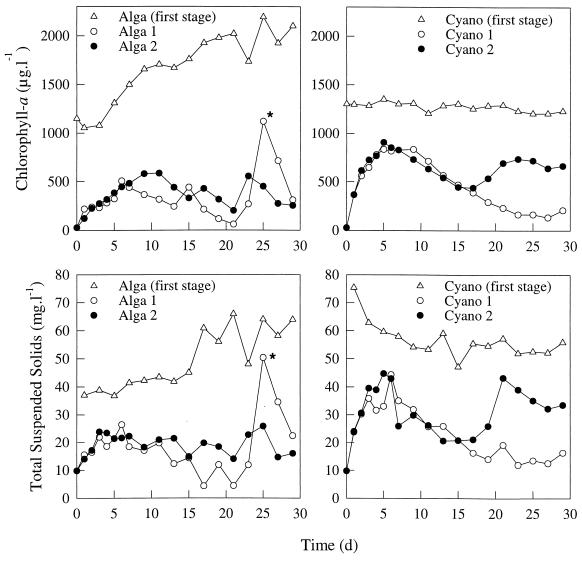
FIG. 1
FIG. 1
Concentrations of Chla and TSS in the two continuous-flow systems (Alga and Cyano systems). The asterisks indicate increases in the Chla and TSS concentrations that were caused by a pump defect. l, liter; d, day.
FIG. 2
FIG. 2
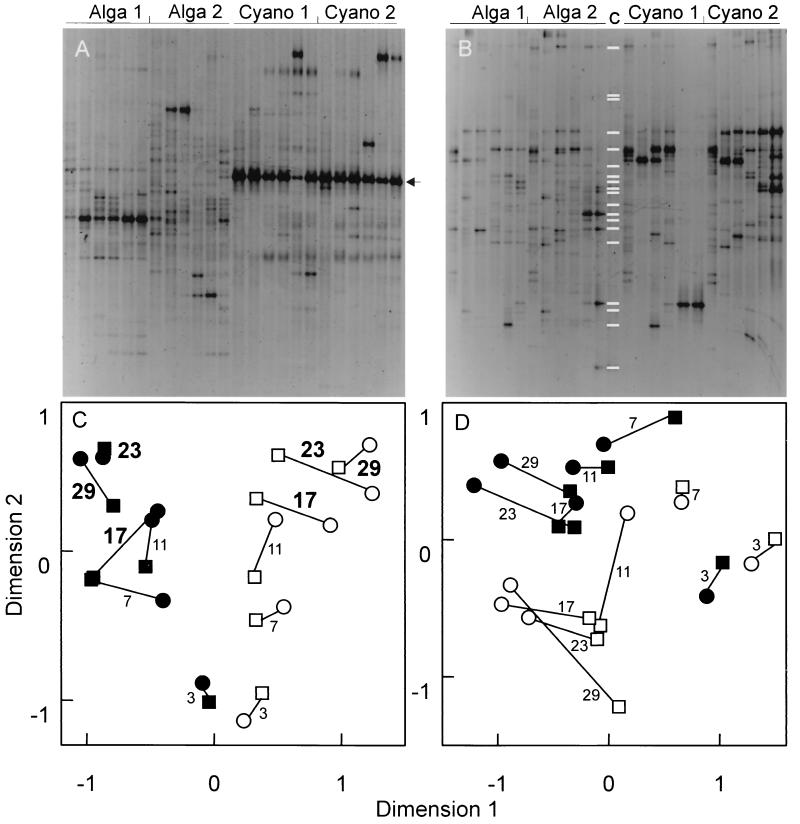
Structures of the microbial communities depending on the source of detritus (green algae or cyanobacteria). (A) 16S rDNA-defined (bacterial) community, as revealed by DGGE. (B) 18S rDNA-defined (eukaryotic) community, as revealed by DGGE. (C) NMDS map of the bacterial communities grown on different types of detritus. (D) NMDS map of the eukaryotic communities grown on different types of detritus. Symbols: ○, Alga 1 stage; □, Alga 2 stage; ●, Cyano 1 stage; ■, Cyano 2 stage. The lines connect the community structures of replicate stages. The numbers indicate the numbers of days from the beginning of the experiment. Boldface numbers indicate significant differences (P < 0.05) in community structures between different sources of detritus. The white bands in panel B, lane c, indicate the band positions for the 18S rDNA clones (Table 1). For each of block of lanes, data for the six times when samples were obtained are shown in consecutive lanes. The arrow in panel A indicates the band belonging to O. limnetica; this band was not included in the Nei-Li distance calculation.
FIG. 3
FIG. 3
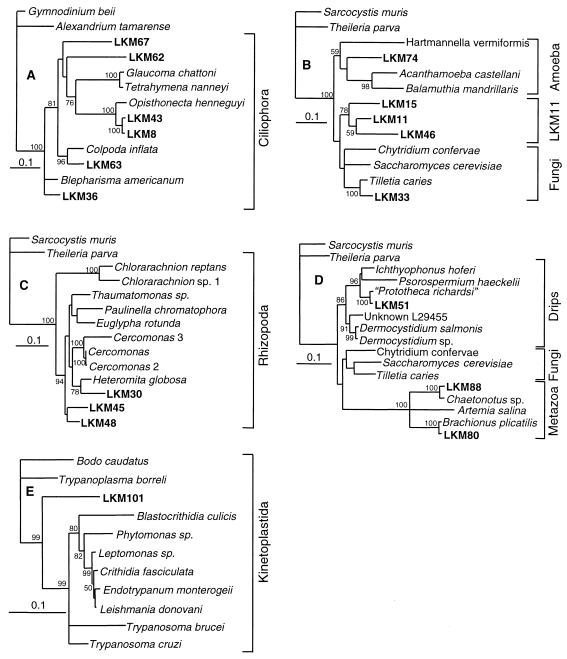
Maximum-likelihood trees showing the phylogenetic positions of the 18S rDNA clones. The trees are rooted. The numbers indicate the levels of bootstrap support (percentages of 1,000 replicates) obtained in a parsimony analysis. (A) Tree constructed by using S. cerevisiae sequence positions 22 to 641 and 744 to 1643. (B) Tree constructed by using S. cerevisiae sequence positions 50 to 641 and 744 to 1643. (C) Tree constructed by using S. cerevisiae sequence positions 25 to 641 and 744 to 1643. (D) Tree constructed by using S. cerevisiae sequence positions 50 to 641 and 744 to 1643. (E) Tree constructed by using Leishmania donovani sequence positions 25 to 993, 1102 to 1300, and 1399 to 2067. Within the order Kinetoplastida, Bodo caudatus can be used as an outgroup (14). The EMBL accession numbers for the sequences are as follows: Gymnodinium beii, U37365; Alexandrium tamarense, X54946; Sarcocystis muris, M64244; Theileria parva, L02366; Glaucoma chattoni, X56533; Tetrahymena nanneyi, X56169; Opisthonecta henneguyi, X56531; Colpoda inflata, M97908; Blepharisma americanum, M97909; Hartmanella vermiformis, M95168; Acanthamoeba castellanii, M13435; Balamuthia mandrillaris, AF019071; Chytridium confervae, M59758; Saccharomyces cerevisiae, Z75578; Tilletia caries, U00972; Chlorarachnion reptans, X70809; Chlorarachnion sp. 1, U02075; Thaumatomonas sp., U42446; Paulinella chromatophora, X81811; Euglypha rotunda, X77692; Cercomonas 3, U42449; Cercomonas, U42450; Cercomonas 2, U42451; Heteromita globosa, U42447; Ichthyophonus hoferi, U25637; Psorospermium haeckelii, U33180; “Prototheca richardsi,” AF07445; Unknown L29455, L29455; Dermocystidium salmonis, U21337; Dermocystidium sp., U21336; Chaetonotus sp., AJ001735; Artemia salina, X01723; Brachionus plicatilis, U49911; Bodo caudatus, X53910; Trypanoplasma borreli, L14840; Blastocrithidia culicis, L29265; Phytomonas sp., L35076; Leptomonas sp., X53914; Crithidia fasciculata, X03450; Endotrypanum monterogeii, X53911; Leishmania donovani, X07773; Trypanosoma brucei, M12676; and Trypanosoma cruzi, X53917.

References

    1. Altschul S F, Gish W, Miller W, Myers E W, Lipman D J. Basic local alignment search tool. J Mol Biol. 1990;215:403–410. - PubMed
    1. Amon R M W, Benner R. Rapid cycling of high-molecular weight dissolved organic matter in the ocean. Nature. 1994;369:549–552.
    1. Arndt H. Rotifers as predators on components of the microbial web (bacteria, heterotrophic flagellates, ciliates)—a review. Hydrobiologia. 1993;255/256:231–246.
    1. Azam F, Fenchel T, Field J G, Gray J S, Meyer-Reil L-A, Thingstad F. The ecological role of water column microbes in the sea. Mar Ecol Prog Ser. 1983;10:257–263.
    1. Beebee, T. Personal communication.

MeSH terms

LinkOut - more resources