. 1999 Jun;65(6):2497-502.
doi: 10.1128/AEM.65.6.2497-2502.1999.

Hyperproduction of tryptophan by Corynebacterium glutamicum with the modified pentose phosphate pathway

Affiliations

Hyperproduction of tryptophan by Corynebacterium glutamicum with the modified pentose phosphate pathway

M Ikeda et al. Appl Environ Microbiol. 1999 Jun.

Abstract

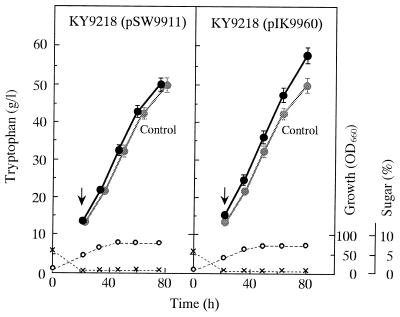
A classically derived tryptophan-producing Corynebacterium glutamicum strain was recently significantly improved both by plasmid-mediated amplification of the genes for the rate-limiting enzymes in the terminal pathways and by construction of a plasmid stabilization system so that it produced more tryptophan. This engineered strain, KY9218 carrying pKW9901, produced 50 g of tryptophan per liter from sucrose after 80 h in fed-batch cultivation without antibiotic pressure. Analysis of carbon balances showed that at the late stage of the fermentation, tryptophan yield decreased with a concomitant increase in CO2 yield, suggesting a transition in the distribution of carbon flow from aromatic biosynthesis toward the tricarboxylic acid cycle via glycolysis. To circumvent this transition by increasing the supply of erythrose 4-phosphate, a direct precursor of aromatic biosynthesis, the transketolase gene of C. glutamicum was coamplified in the engineered strain by using low- and high-copy-number plasmids which were compatible with the resident plasmid pKW9901. The presence of the gene in low copy numbers contributed to improvement of tryptophan yield, especially at the late stage, and led to accumulation of more tryptophan (57 g/liter) than did its absence, while high-copy-number amplification of the gene resulted in a tryptophan production level even lower than that resulting from the absence of the gene due to reduced growth and sugar consumption. In order to assemble all the cloned genes onto a low-copy-number plasmid, the high-copy-number origin of pKW9901 was replaced with the low-copy-number one, generating low-copy-number plasmid pSW9911, and the transketolase gene was inserted to yield pIK9960. The pSW9911-carrying producer showed almost the same fermentation profiles as the pKW9901 carrier in fed-batch cultivation without antibiotic pressure. Under the same culture conditions, however, the pIK9960 carrier achieved a final tryptophan titer of 58 g/liter, which represented a 15% enhancement over the titers achieved by the pKW9901 and pSW9911 carriers.


Figures
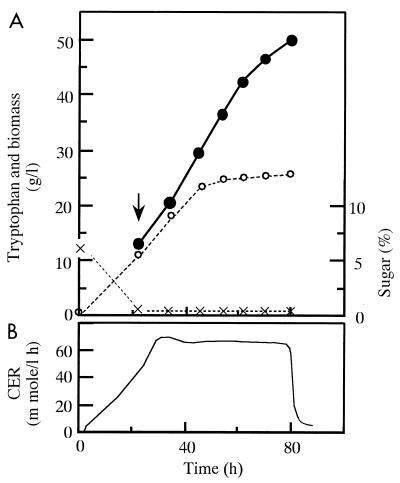
FIG. 1
FIG. 1
Tryptophan fermentation by strain KY9218 carrying pKW9901 in fed-batch jar-fermentor cultivation. (A) Profiles of tryptophan (●), biomass (○), and sugar (×). The arrow indicates the point at which feeding with a 60% sucrose solution began. (B) Carbon dioxide evolution rate (CER) during the culture. All data represent mean values from three independent cultures.
FIG. 2
FIG. 2
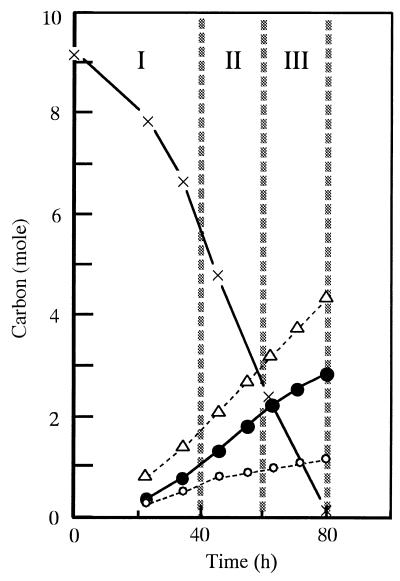
Consumption of total supplied carbon in sucrose (×) and recovery of carbon in tryptophan (●), biomass (○), and CO2 (▵) during the course of the tryptophan fermentation shown in Fig. 1. The roman numerals represent three stages of tryptophan production (I, 0 to 40 h, II, 40 to 60 h, and III, 60 to 80 h).
FIG. 3
FIG. 3
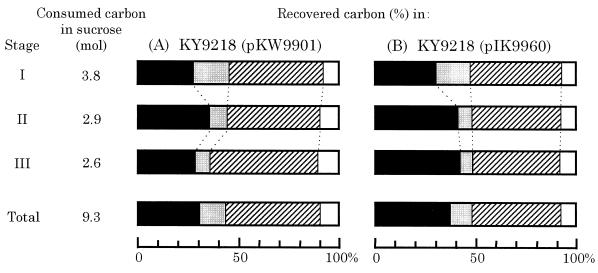
Carbon balances during the three stages of the tryptophan fermentation by KY9218 carrying pKW9901 (A) and KY9218 carrying pIK9960 (B). Stages correspond to those in Fig. 2. Recovered carbon in tryptophan (solid areas), biomass (shaded areas), CO2 (hatched areas), and by-products (open areas) indicates the relative carbon balances for each stage, expressed as conversion of carbon from sucrose to each metabolite (moles percent).
FIG. 4
FIG. 4
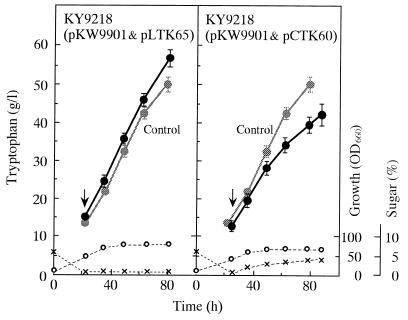
Tryptophan fermentation by strain KY9218 carrying pLTK65 or pCTK60 together with pKW9901 in fed-batch jar-fermentor cultivation. Symbols: ●, tryptophan; ○, biomass; ×, sugar. For comparison, the profiles of tryptophan production by strain KY9218 carrying pKW9901 are shown as controls. Arrows indicate the points at which feeding with a 60% sucrose solution began. Data represent mean values from three independent cultures. The standard deviations from the means are indicated as error bars only for tryptophan titers. The absence of error bars indicates that the error was smaller than the symbol size. OD660, optical density at 660 nm.
FIG. 5
FIG. 5
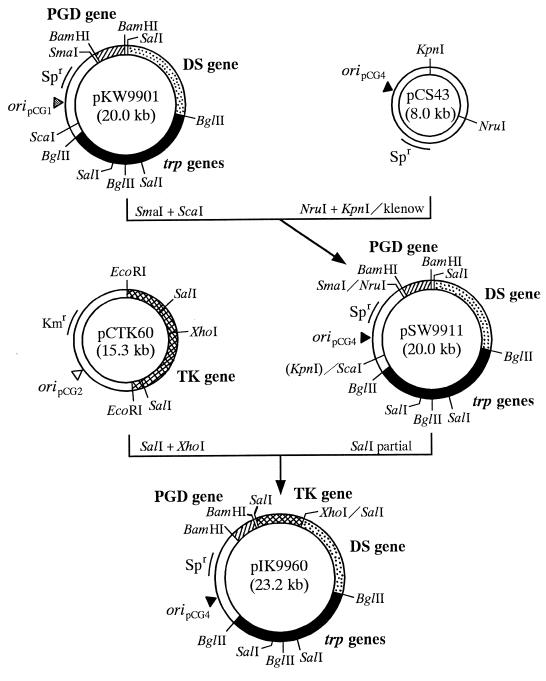
Construction of low-copy-number plasmid pIK9960 containing the transketolase gene as well as the DS gene, the PGD gene, and the tryptophan-biosynthetic gene cluster. Symbols: stippled bars, C. glutamicum KY10694 chromosomal DNA fragment containing the DS gene; solid bars, C. glutamicum KY10894 chromosomal DNA fragment containing the tryptophan-biosynthetic gene cluster (trp genes); hatched bars, C. glutamicum ATCC 31833 chromosomal DNA fragment containing the PGD gene; cross-hatched bar, C. glutamicum ATCC 31833 chromosomal DNA fragment containing the transketolase (TK) gene; open bars, vector pCG116 (pCG1 origin), pCSEK20 (pCG2 origin), or pCS43 (pCG4 origin). Spr, spectinomycin resistance; Kmr, kanamycin resistance; Ori, origin.
FIG. 6
FIG. 6
Tryptophan fermentation by strain KY9218 carrying pSW9911 or pIK9960 in fed-batch jar-fermentor cultivation. Symbols: ●, tryptophan; ○, biomass; ×, sugar. For comparison, the profiles of tryptophan production by strain KY9218 carrying pKW9901 are shown as controls. Arrows indicate the points at which feeding with a 60% sucrose solution began. Data represent mean values from three independent cultures. The standard deviations from the means are indicated as error bars only for tryptophan titers. The absence of error bars indicates that the error was smaller than the symbol size. OD660, optical density at 660 nm.

References

    1. An G, Friesen J D. Plasmid vehicles for direct cloning of Escherichia coli promoters. J Bacteriol. 1979;140:400–407. - PMC - PubMed
    1. Bradford M M. A rapid and sensitive method for the quantitation of microgram quantities of protein utilizing the principle of protein-dye binding. Anal Biochem. 1976;72:248–254. - PubMed
    1. Flores N, Xiao J, Berry A, Bolivar F, Valle F. Pathway engineering for the production of aromatic compounds in Escherichia coli. Nat Biotechnol. 1996;14:620–623. - PubMed
    1. Ihnen E D, Demain A L. Glucose-6-phosphate dehydrogenase and its deficiency in mutants of Corynebacterium glutamicum. J Bacteriol. 1969;98:1151–1158. - PMC - PubMed
    1. Ikeda M, Katsumata R. Metabolic engineering to produce tyrosine or phenylalanine in a tryptophan-producing Corynebacterium glutamicum strain. Appl Environ Microbiol. 1992;58:781–785. - PMC - PubMed

LinkOut - more resources