. 1999 Jun;65(6):2674-8.
doi: 10.1128/AEM.65.6.2674-2678.1999.

PCR-based genotyping of epidemic and preepidemic Trichoderma isolates associated with green mold of Agaricus bisporus

Affiliations

PCR-based genotyping of epidemic and preepidemic Trichoderma isolates associated with green mold of Agaricus bisporus

X Chen et al. Appl Environ Microbiol. 1999 Jun.

Abstract

We used randomly amplified polymorphic DNA (RAPD)-PCR to estimate genetic variation among isolates of Trichoderma associated with green mold on the cultivated mushroom Agaricus bisporus. Of 83 isolates examined, 66 were sampled during the recent green mold epidemic, while the remaining 17 isolates were collected just prior to the epidemic and date back to the 1950s. Trichoderma harzianum biotype 4 was identified by RAPD analysis as the cause of almost 90% of the epidemic-related episodes of green mold occurring in the major commercial mushroom-growing region in North America. Biotype 4 was more closely allied to T. harzianum biotype 2, the predominant pathogenic genotype in Europe, than to the less pathogenic biotype 1 and Trichoderma atroviride (formerly T. harzianum biotype 3). No variation in the RAPD patterns was observed among the isolates within biotype 2 or 4, suggesting that the two pathogenic biotypes were populations containing single clones. Considerable genetic variation, however, was noted among isolates of biotype 1 and T. atroviride from Europe. Biotype 4 was not represented by the preepidemic isolates of Trichoderma as determined by RAPD markers and PCR amplification of an arbitrary DNA sequence unique to the genomes of biotypes 2 and 4. Our findings suggest that the onset of the green mold epidemic in North America resulted from the recent introduction of a highly virulent genotype of the pathogen into cultivated mushrooms.


Figures
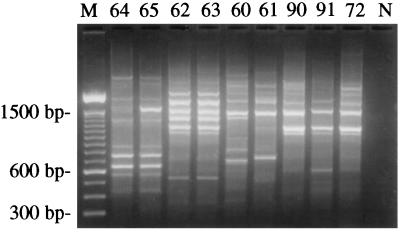
FIG. 1
FIG. 1
Identification of the predominant epidemic-associated genotype of Trichoderma by RAPD-PCR with primer 230. Shown are the gel electrophoretic profiles of isolates 64 and 65 (biotype 1), isolates 62 and 63 (biotype 2), isolates 60 and 61 (T. atroviride), isolates 90 and 91 (biotype 4), and isolate 72 (representing the predominant genotype in Pennsylvania). M, 100-bp DNA ladder. N, negative control in which sterile water was substituted for the DNA template.
FIG. 2
FIG. 2
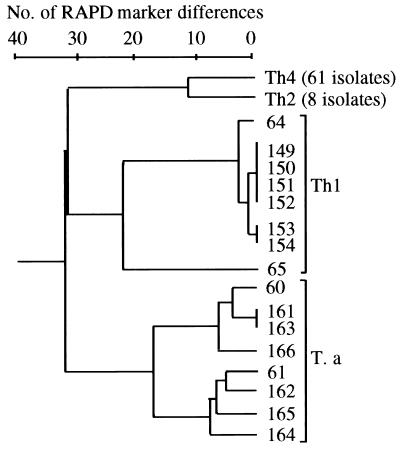
Dendrogram based on the number of differences in a total of 75 scored RAPD markers among the three biotypes of T. harzianum and T. atroviride. Numbers on the dendrogram refer to PSU accession numbers for the isolates. No genetic variation was observed among isolates within the biotype 2 and 4 clusters (Th2 and Th4). The biotype 1 and 2 and T. atroviride (T. a) clusters each contained eight isolates from Europe, whereas the biotype 4 cluster contained 58 isolates from Pennsylvania and three tester isolates from Canada.
FIG. 3
FIG. 3
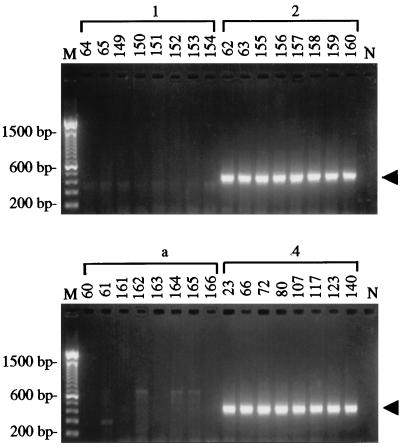
Specificity of the PCR for biotypes 2 and 4 of T. harzianum from cultivated mushrooms. Shown are the amplification products resolved by agarose gel electrophoresis that were generated with primer pair Th-F and Th-R by using genomic DNA templates of eight isolates of T. harzianum biotypes 1, 2, and 4 and T. atroviride (a). Numbers above the lanes refer to PSU accession numbers for the isolates. The arrowheads indicate the position of the predicted 444-bp amplicon. M, 100-bp DNA ladder. N, negative control in which sterile water was substituted for the DNA template.
FIG. 4
FIG. 4
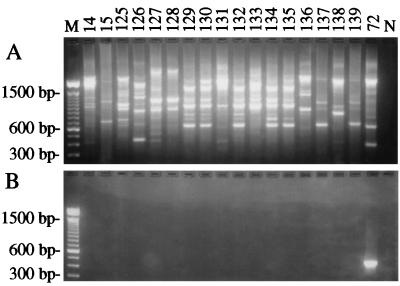
PCR analysis of 17 isolates of Trichoderma collected from mushroom cultures prior to the epidemic between the 1950s and 1990. Shown are the amplification products resolved by gel electrophoresis after RAPD-PCR with primer OPA13 (A) and PCR with the Th-F and Th-R primer set targeting a unique genomic sequence in biotypes 2 and 4 (B). Numbers above the lanes refer to the isolates by their PSU accession numbers. M, 100-bp DNA ladder. Isolates 14, 15, and 125 to 139 are preepidemic isolates. Isolate 72 is a positive control for the DNA template of biotype 4. N, negative control in which sterile water was substituted for the DNA template.

References

    1. Castle A, Speranzini D, Rghel N, Alm G, Rinker D, Bissett J. Morphological and molecular identification of Trichoderma isolates on North American farms. Appl Environ Microbiol. 1998;61:133–137. - PMC - PubMed
    1. Chen X, Romaine C P, Ospina-Giraldo M D, Royse D J. A PCR-based test for the identification of Trichoderma harzianum biotypes 2 and 4 inciting the world-wide green mold epidemic in cultivated Agaricus bisporus. 1999. Appl. Microbiol. Biotechnol., in press.
    1. Chen, X., C. P. Romaine, M. D. Ospina-Giraldo, and D. J. Royse. Unpublished data.
    1. Excoffier L, Smouse P E, Quattro J M. Analysis of molecular variance inferred from metric distances among DNA haplotypes: application to human mitochondrial DNA restriction sites. Genetics. 1992;131:479–491. - PMC - PubMed
    1. Gams W, Meyer W. What exactly is Trichoderma harzianum? Mycologia. 1998;90:904–915.

Publication types

LinkOut - more resources