. 1999 Jun;43(6):1334-9.
doi: 10.1128/AAC.43.6.1334.

A mechanism for the synergistic antimalarial action of atovaquone and proguanil

Affiliations

A mechanism for the synergistic antimalarial action of atovaquone and proguanil

I K Srivastava et al. Antimicrob Agents Chemother. 1999 Jun.

Abstract

A combination of atovaquone and proguanil has been found to be quite effective in treating malaria, with little evidence of the emergence of resistance when atovaquone was used as a single agent. We have examined possible mechanisms for the synergy between these two drugs. While proguanil by itself had no effect on electron transport or mitochondrial membrane potential (DeltaPsim), it significantly enhanced the ability of atovaquone to collapse DeltaPsim when used in combination. This enhancement was observed at pharmacologically achievable doses. Proguanil acted as a biguanide rather than as its metabolite cycloguanil (a parasite dihydrofolate reductase [DHFR] inhibitor) to enhance the atovaquone effect; another DHFR inhibitor, pyrimethamine, also had no enhancing effect. Proguanil-mediated enhancement was specific for atovaquone, since the effects of other mitochondrial electron transport inhibitors, such as myxothiazole and antimycin, were not altered by inclusion of proguanil. Surprisingly, proguanil did not enhance the ability of atovaquone to inhibit mitochondrial electron transport in malaria parasites. These results suggest that proguanil in its prodrug form acts in synergy with atovaquone by lowering the effective concentration at which atovaquone collapses DeltaPsim in malaria parasites. This could explain the paradoxical success of the atovaquone-proguanil combination even in regions where proguanil alone is ineffective due to resistance. The results also suggest that the atovaquone-proguanil combination may act as a site-specific uncoupler of parasite mitochondria in a selective manner.


Figures

FIG. 1
FIG. 1
Concentration-dependent effect of atovaquone and proguanil on ΔΨm and respiration. (A) Concentration-dependent effect of atovaquone and proguanil on ΔΨm. Fluorescence intensity was quantitated by FACS analysis in the presence of various concentrations of atovaquone (■) and proguanil (●). The results are presented as percent inhibition of fluorescence intensity, using CCCP-mediated inhibition as 100%. (B) Concentration-dependent effect of atovaquone and proguanil on parasite respiration. The rate of O2 consumption by P. yoelii-infected erythrocytes was measured in the presence of various concentrations of proguanil (○) and atovaquone (□) independently. The results are plotted as percent inhibition of respiration. The error bars indicate standard deviations.
FIG. 2
FIG. 2
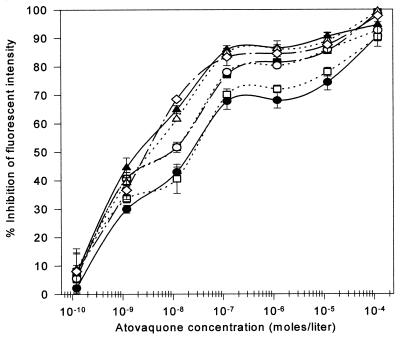
Potentiation of atovaquone-mediated collapse of ΔΨm by proguanil. Fluorescence intensity was quantitated by FACS analysis in the presence of various concentrations of atovaquone either alone (●) or in combination with proguanil at various concentrations (3.5 × 10⁻⁷ M [□], 7.0 × 10⁻⁷ M [■], 1.3 × 10⁻⁶ M [○], 3.5 × 10⁻⁶ M [▴], 7.0 × 10⁻⁶ M [▵], and 1.3 × 10⁻⁵ M [◊]). Proguanil concentrations below 3.5 × 10⁻⁷ M were also tested but had no effect on ΔΨm collapse by atovaquone. Therefore, the results are not included in the figure for clarity. The error bars indicate standard deviations.
FIG. 3
FIG. 3
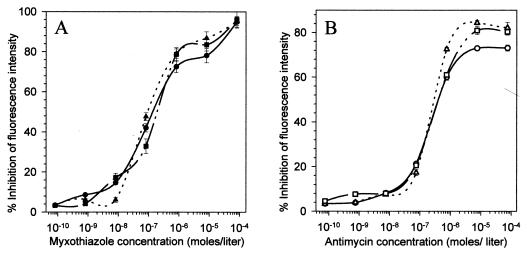
Effect of standard mitochondrial inhibitors in combination with proguanil on ΔΨm. (A) Fluorescence intensity was quantitated by FACS analysis in the presence of various concentrations of myxothiazole either alone (●) or in combination with the two highest concentrations of proguanil, i.e., 1.3 × 10⁻⁶ (■) and 1.3 × 10⁻⁵ M (▴). (B) The effect of antimycin on ΔΨm was determined either alone (○) or in combination with 1.3 × 10⁻⁶ (□) and 1.3 × 10⁻⁵ (▵) M proguanil. The error bars indicate standard deviations.
FIG. 4
FIG. 4
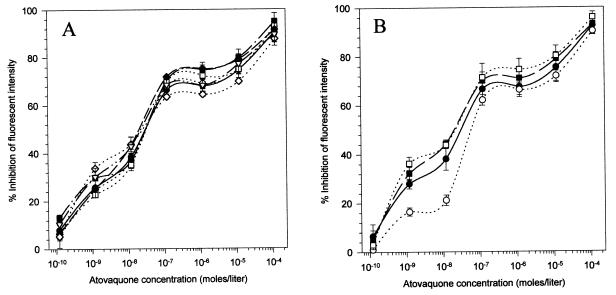
Effect of parasite DHFR inhibitors on atovaquone-mediated collapse of ΔΨm. (A) Concentration-dependent effect of cycloguanil-atovaquone combination on ΔΨm. Fluorescence intensities were quantitated by FACS analysis in the presence of atovaquone, either alone (●) or in combination with a series of cycloguanil concentrations (1.6 × 10⁻¹⁰ M [○], 1.6 × 10⁻⁹ M [■] 1.6 × 10⁻⁸ M [□], 1.6 × 10⁻⁷ M [◊], 1.6 × 10⁻⁶ M [◊], and 1.6 × 10⁻⁵ M [▵]). (B) Concentration-dependent effect of pyrimethamine-atovaquone combination on ΔΨm. The effect of atovaquone on ΔΨm was determined either alone (●) or in combination with three concentrations of pyrimethamine, i.e., 1.6 × 10⁻⁷ M (○), 1.6 × 10⁻⁶ M (■), and 1.6 × 10⁻⁵ M (□). The error bars indicate standard deviations.
FIG. 5
FIG. 5
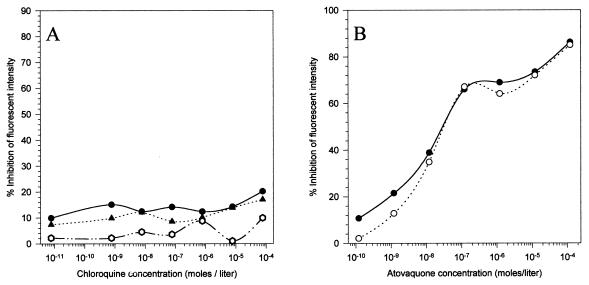
Effect of chloroquine-proguanil and chloroquine-atovaquone combinations on ΔΨm. (A) Fluorescence intensity was quantitated by FACS analysis in the presence of various concentrations of chloroquine either alone (●) or in combination with the two highest concentrations of proguanil, i.e., 1.3 × 10⁻⁶ M (○) and 1.3 × 10⁻⁵ M (▴). (B) Effects of various concentrations of atovaquone on ΔΨm either alone (●) or in combination with the highest concentration of chloroquine (1.25 × 10⁻⁵ M [○]).
FIG. 6
FIG. 6
Concentration-dependent effect of atovaquone-proguanil combination on parasite respiration. The rate of O2 consumption was measured in the presence of various concentrations of atovaquone either alone (○) or in combination with the two highest concentrations of proguanil (2.3 × 10⁻⁶ M [■] and 2.3 × 10⁻⁵ M [□]). The error bars indicate standard deviations.

References

    1. Araujo F G, Huskinson J, Remington J S. Remarkable in vitro and in vivo activities of 566C80 against tachyzoites and tissue cysts of Toxoplasma gondii. Antimicrob Agents Chemother. 1991;35:293–299. - PMC - PubMed
    1. Birkett D J, Rees D, Andersson T, Gonzalez F J, Miners J O, Veronese M E. In vitro activation of proguanil to cycloguanil by human liver microsomes is mediated by CYP3A isoforms as well as by S-mephenytoin hydrokylase. Br J Clin Pharmacol. 1994;37:413–420. - PMC - PubMed
    1. Brasseur G, Saribas A S, Daldal F. A composition of mutations located in the cytochrome b subunit of the bacterial and mitochondrial bc1 complex. Biochim Biophys Acta. 1996;1275:61–69. - PubMed
    1. Canfield C J, Pudney M, Gutteridge W E. Interactions of atovaquone with other antimalarial drugs against Plasmodium falciparum in vitro. Exp Parasitol. 1995;80:373–381. - PubMed
    1. Carrington H C, Crowther A F, Davey D G, Levi A A, Rose F L. A metabolite of “Paludrine” with high antimalarial activity. Nature. 1951;168:1080. - PubMed

Publication types

LinkOut - more resources