


Growth phase-regulated induction of Salmonella-induced macrophage apoptosis correlates with transient expression of SPI-1 genes
- PMID: 10348855
- PMCID: PMC93810
- DOI: 10.1128/JB.181.11.3433-3437.1999
Growth phase-regulated induction of Salmonella-induced macrophage apoptosis correlates with transient expression of SPI-1 genes
Abstract
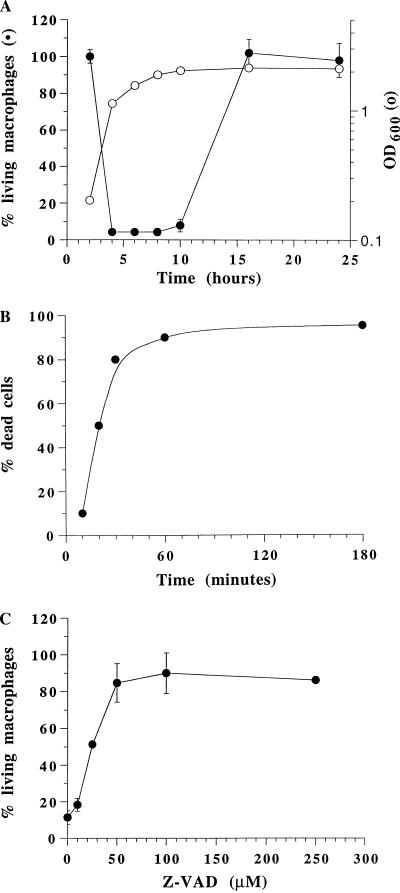
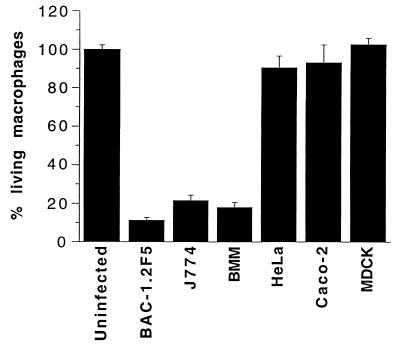
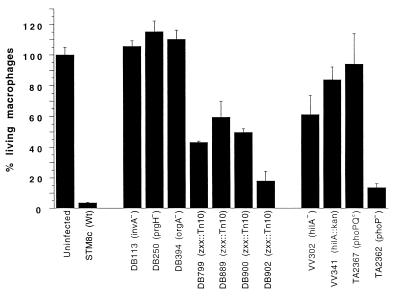
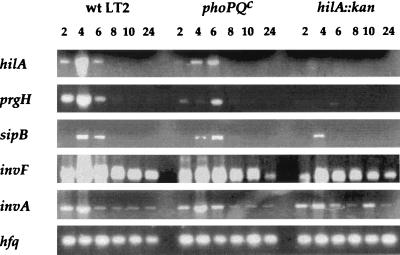
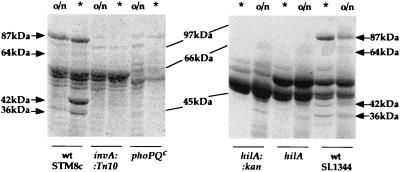
Invasive Salmonella has been reported to induce apoptosis in a fraction of infected macrophages within 2 to 14 h from the time of infection by a mechanism involving the type III secretion machinery encoded by the Salmonella pathogenicity island 1 (SPI-1). Here, we show that bacteria in the transition from logarithmic to stationary phase cause 90% of the macrophages to undergo phagocytosis-independent, caspase-mediated apoptosis within 30 to 60 min of infection. The ability of Salmonella to induce this rapid apoptosis was growth phase regulated and cell type restricted, with epithelial cells being resistant. Apoptosis induction was also abrogated by disruption of the hilA gene (encoding a regulator of SPI-1 genes) and by the expression of a constitutively active PhoPQ. hilA itself and a subset of SPI-1 genes were transiently expressed during aerobic growth in liquid medium. Interestingly, however, hilA was found to be required only for the expression of the prgH gene, while sipB, invA, and invF were expressed in a hilA-independent manner. The expression of SPI-1 genes and the secretion of invasion-associated proteins correlated temporally with the induction of apoptosis and are likely to represent its molecular basis. Thus, growth phase transition regulates the expression and secretion of virulence determinants and represents the most efficient environmental cue for apoptosis induction reported to date.
Figures
References
-
- Bajaj V, Lucas R L, Hwang C, Lee C A. Coordinate regulation of Salmonella typhimurium invasion genes by environmental and regulatory factors is mediated by control of hilA expression. Mol Microbiol. 1996;22:703–714. - PubMed
-
- Bajaj V, Hwang C, Lee C A. hilA is a novel ompR/toxR family member that activates the expression of Salmonella typhimurium invasion genes. Mol Microbiol. 1995;18:715–727. - PubMed
-
- Chen L M, Kaniga K, Galán J E. Salmonella spp. are cytotoxic for cultured macrophages. Mol Microbiol. 1996;21:1101–1115. - PubMed
Publication types
MeSH terms
Substances
LinkOut - more resources
Full Text Sources
Other Literature Sources
