


doi: 10.1073/pnas.96.12.6787.
Mitochondrial Lon of Saccharomyces cerevisiae is a ring-shaped protease with seven flexible subunits
Affiliations
- PMID: 10359790
- PMCID: PMC21993
- DOI: 10.1073/pnas.96.12.6787
Item in Clipboard
Mitochondrial Lon of Saccharomyces cerevisiae is a ring-shaped protease with seven flexible subunits
Proc Natl Acad Sci U S A.
.
Abstract
Lon (or La) is a soluble, homooligomeric ATP-dependent protease. Mass determination and cryoelectron microscopy of pure mitochondrial Lon from Saccharomyces cerevisiae identify Lon as a flexible ring-shaped heptamer. In the presence of ATP or 5'-adenylylimidodiphosphate, most of the rings are symmetric and resemble other ATP-driven machines that mediate folding and degradation of proteins. In the absence of nucleotides, most of the rings are distorted, with two adjacent subunits forming leg-like protrusions. These results suggest that asymmetric conformational changes serve to power processive unfolding and translocation of substrates to the active site of the Lon protease.
Figures
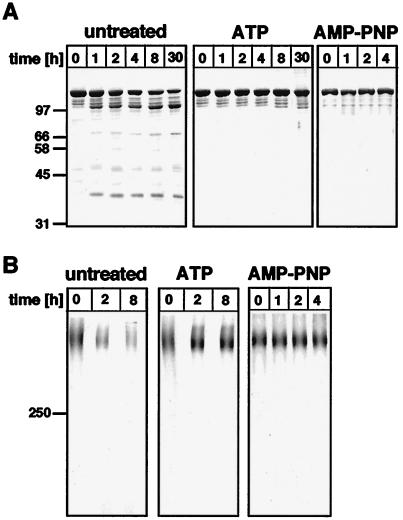
Lon is stabilized by ATP or AMP-PNP. (A) Stability of the Lon subunit. Lon (2–5 μg) purified and kept in the absence (untreated) or in the presence of 1 mM ATP or 1 mM AMP-PNP was incubated at 30°C for the indicated times and then was analyzed by 10% SDS/PAGE and staining with Coomassie blue. Shown at left are molecular weight standards in kDa. (B) Stability of the Lon oligomer. Lon (5–8 μg) purified and kept in the absence (untreated) or the presence of 1 mM ATP or 1 mM AMP-PNP was incubated at 30°C for the indicated times, was crosslinked with 0.1% glutaraldehyde for 30 min on ice, and was analyzed by 3.3% SDS/PAGE and Coomassie blue staining (34). At left is a recombinant 250-kDa molecular weight marker provided by Amersham Pharmacia.
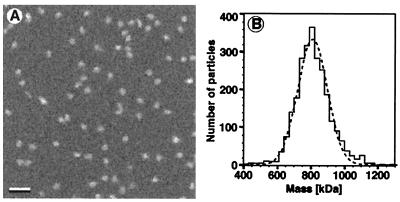
Mass of Lon determined by STEM. (A) Crosslinked, freeze-dried, and unstained Lon, purified in the presence of ATP, was recorded in the dark-field mode at a dose of 200–400 electrons/nm2 with a Vacuum Generator STEM HB5 operated at 80 kV. (Bar = 50 nm.) (B) Mass evaluation of 2,641 particles yielded a histogram with a Gaussian envelope. After correction for the electron dose-associated mass loss (17), the Gauss peak was centered at 804 kDa and had a standard deviation of 76 kDa. The standard mean error was 3 kDa, which, together with the absolute calibration error of 5%, yielded a total error of 43 kDa.
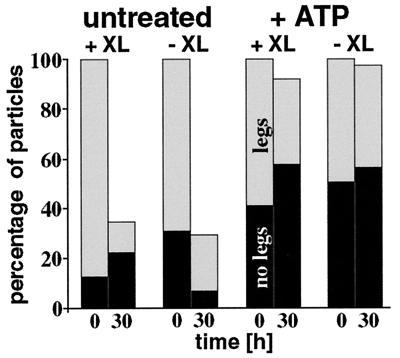
Effect of ATP and crosslinking on the frequency of leg-less Lon particles. Lon purified and maintained either in the absence (untreated) or presence of 1 mM ATP was negatively stained with uranyl formate and was air dried and viewed in the transmission electron microscope either immediately after purification or after incubation at 30°C for 30 h. Samples were placed onto the grid without further treatment (−XL) or after having been crosslinked with 0.1% glutaraldehyde for 30 min on ice (+XL). From 37 negatives with images of the different samples, 22,249 particles were manually scored as particles without legs (black bars), particles with legs (gray bars), or unassigned particles (no bars). The sum of Lon particles with and without legs at the 0 h time point was taken as 100%.
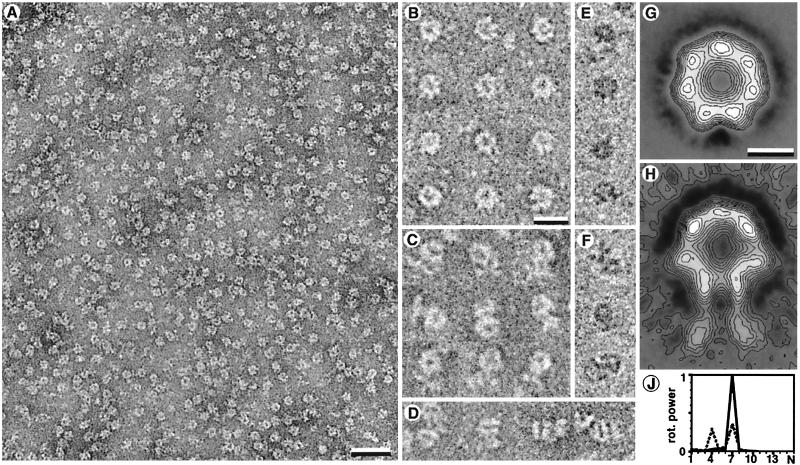
(A–D) Images of vitrified negatively stained crosslinked Lon particles (–28). (A) Bar = 30 nm. (B) Legless Lon particles as predominating in the presence of ATP or AMP-PNP. (C) Leg-containing Lon particles. (D) Rare side views of leg-containing particles. (E and F) Leg-less (E) and leg-containing (F) crosslinked particles visualized by cryo-TEM without staining. Although the signal to noise ratio is lower, the images resemble those of negatively stained samples. [Bars = 15 nm (B–F).] (G) The nonsymmetrized average image of the first class containing 2,571 images. (H) The nonsymmetrized average of the images of the second class containing 1,377 images. The leg-like structures are less contrasted in the average image because of their high flexibility. [Bars = 5 nm (G and H).] (J) Angular power analysis of the gray-value distribution within a circular radial interval on the average images of the two classes. The abscissa is given in arbitrary units. The legless class of images clearly reveals a 7-fold symmetry (continuous line). The circular core of the average image of the second class indicates a predominant 7-fold symmetry and a weaker contribution of a 4-fold symmetry (dotted line). The latter is attributable to the deformation of the circular core of the particles.
References
-
- Maurizi M R. Experientia. 1992;48:178–201. - PubMed
-
- Kutejová E, Durcova G, Surovka E, Kuzela S. FEBS Lett. 1993;329:47–50. - PubMed
-
- Goldberg A L, Moerschell R P, Chung C H, Maurizi M R. Methods Enzymol. 1994;244:350–375. - PubMed
-
- Gottesman S, Wickner S, Maurizi M R. Genes Dev. 1997;11:815–823. - PubMed
-
- Suzuki C K, Rep M, Maarten van Dijl J, Suda K, Grivell L A, Schatz G. Trends Biochem Sci. 1997;22:118–123. - PubMed
Publication types
MeSH terms
Substances
LinkOut - more resources
Full Text Sources
Other Literature Sources
Molecular Biology Databases
