


Effect of sex steroids on beta-endorphin levels at rest and during submaximal treadmill exercise in anovulatory and ovulatory runners
- PMID: 10360915
- PMCID: PMC8386669
- DOI: 10.1016/s0015-0282(99)00144-2
Effect of sex steroids on beta-endorphin levels at rest and during submaximal treadmill exercise in anovulatory and ovulatory runners
Abstract
Objective: To examine the interaction between circulating beta-endorphin levels and sex steroids during sustained submaximal exercise in runners who are either anovulatory and oligomenorrheic (AO) or ovulatory and eumenorrheic (EO).
Design: Controlled clinical study.
Setting: General clinical research center at an academic medical center.
Patient(s): Three AO and four EO runners.
Intervention(s): The athletes underwent 60 minutes of submaximal treadmill exercise on three separate occasions. Anovulatory and oligomenorrheic runners underwent exercise at baseline and after physiologic estrogen and combined estrogen and progesterone replacement. Ovulatory and eumenorrheic runners underwent exercise in the follicular and luteal phases and after GnRH agonist desensitization.
Main outcome measure(s): Serum cortisol, beta-endorphin, progesterone, estrogen, and gonadotropin levels at rest and during exercise.
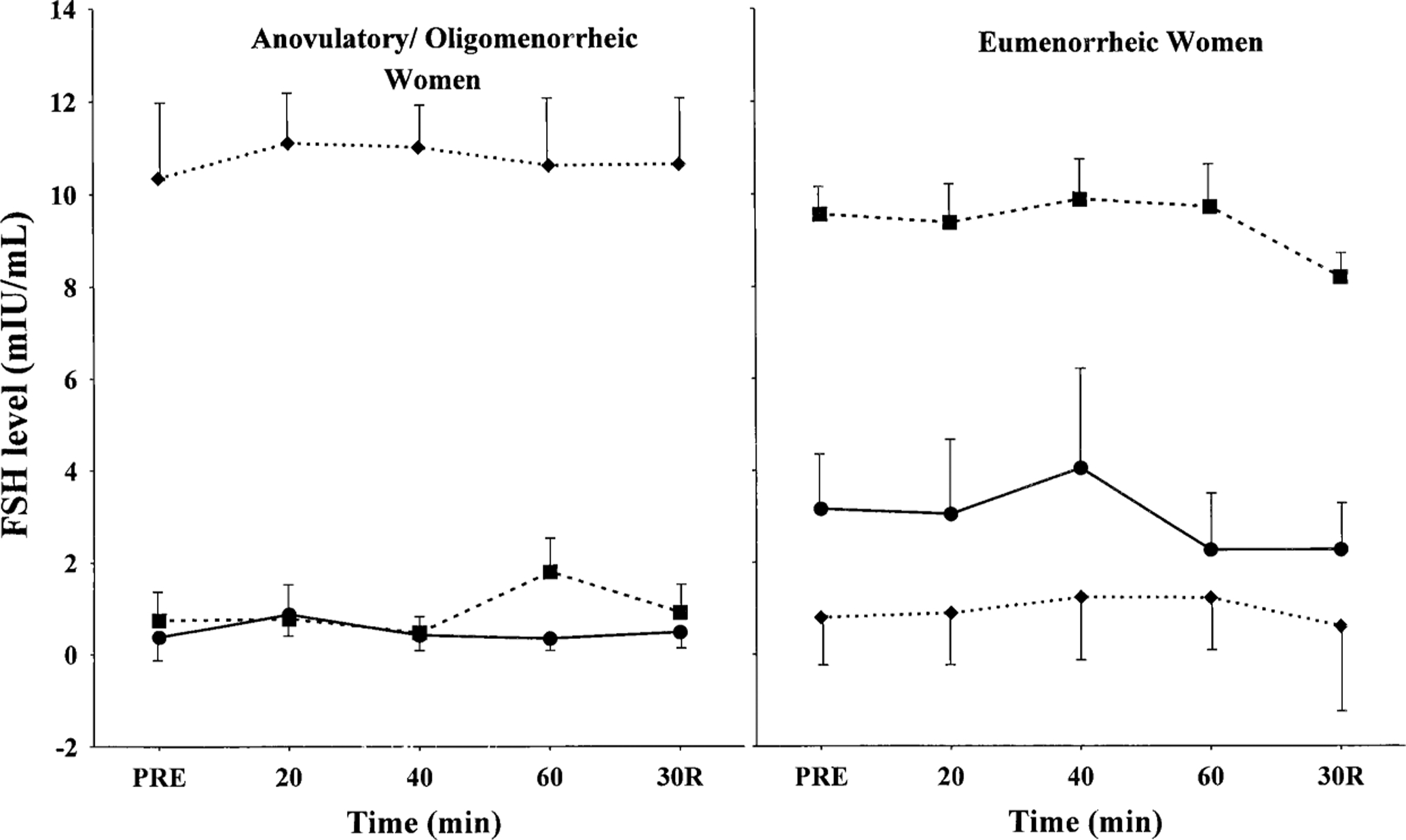
Result(s): Serum levels of E2 increased in response to exercise in both EO and AO runners during sex steroid replacement. Baseline peripheral beta-endorphin and cortisol levels were not different between the EO and AO groups. A significant increase in beta-endorphin levels in response to exercise occurred only in the EO group after GnRH agonist desensitization.
Conclusion(s): Alterations in menstrual cyclicity and ovulation in conditioned runners probably are not due to an increase in opioid tone. The hypothalamic-gonadotropic axis appears to be intact in AO runners, as measured by the gonadotropic response to exogenous exposure to estrogen and progesterone. Sex steroid administration had no effect on basal beta-endorphin levels, but this probably was not due to preexisting increased opioid tone.
Figures


References
-
- Hohtari H, Elovaino R, Salminen K, Laatikainen T. Plasma cortiocotropin-releasing hormone, corticotropin and endorphins at rest and during exercise in eumenorrheic and amenorrheic athletes. Fertil Steril 1988;50:233–7. - PubMed
-
- Colt EWD, Wardlaw SL, Frantz AG. The effect of running on plasma beta-endorphin. Life Sci 1981;28:1637–45. - PubMed
-
- D’Amico JF, Greendale GA, Lu JRH, Judd HL. Induction of hypothalamic opioid activity with transdermal estradiol administration in post-menopausal women. Fertil Steril 1991;55:754–9. - PubMed
-
- Quigley ME, Yen SSC. The role of endogenous opiates on LH secretion during the menstrual cycle. J Clin Endocrinol Metab 1980;51:179–81. - PubMed
-
- Wilson EE, Little BB, Bynd W, McGee E, Carr BR. The effect of gonadotropin-releasing hormone agonists on adrenocorticotropin and cortisol secretion in adult premenopausal women. J Clin Endocrinol Metab 1993;76:162–4. - PubMed
Publication types
MeSH terms
Substances
Grants and funding
LinkOut - more resources
Full Text Sources
Medical
