. 1999 Jul;73(7):5875-86.
doi: 10.1128/JVI.73.7.5875-5886.1999.

Functional analysis of carboxy-terminal deletion mutants of c-Myb

Affiliations

Functional analysis of carboxy-terminal deletion mutants of c-Myb

D M Wang et al. J Virol. 1999 Jul.

Abstract

The c-myb gene is implicated in the differentiation and proliferation of hematopoietic cells. Truncations of the N and/or C terminus of c-Myb, found in v-Myb, can potentiate its transforming ability. Two negative regulatory subregions, located in the C terminus, were mapped previously by using GAL4-c-Myb fusion proteins in transient transfection assays for the transcriptional activation of a GAL4-responsive reporter gene. To dissect the C terminus of c-Myb in terms of its involvement in transcriptional activation and oncogenic transformation, a series of C-terminal deletion mutants of c-Myb were analyzed. In addition, linker insertion mutants within the transactivation domain and/or heptad leucine repeat of c-Myb were examined along with those deletion mutants. In this study, we demonstrated that the removal of both of the two previously mapped negative regulatory subregions from the native form of c-Myb not only supertransactivates a Myb-responsive reporter gene but also potentiates its transforming ability in culture. However, in contrast to previous results, cells transformed by all of the mutants analyzed here except v-Myb itself exhibited the same phenotype as those transformed by c-Myb. The proliferating cells were bipotenial and differentiated into both the granulocytic and monocytic lineages. This result implies that the C terminus of c-Myb alone has no effect on the lineage determination. Finally, the transactivation activities of these mutants correlated with their transforming activities when a mim-1 reporter gene was used but not when a model promoter containing five tandem Myb-binding sites was used. In particular, a very weakly transforming mutant with a linker insertion in the heptad leucine repeat superactivated the model promoter but not the mim-1 reporter gene.


Figures
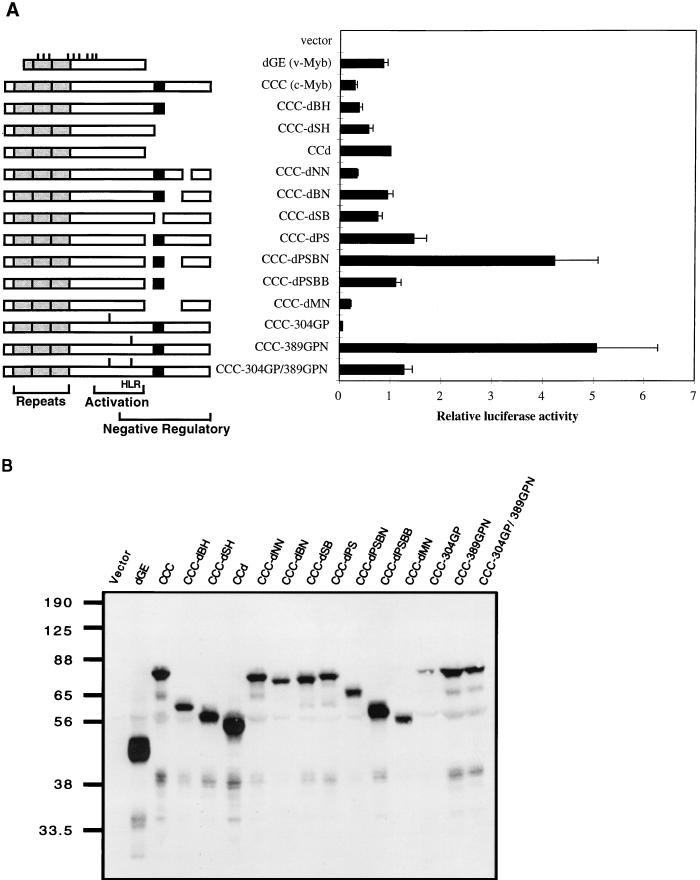
FIG. 1
FIG. 1
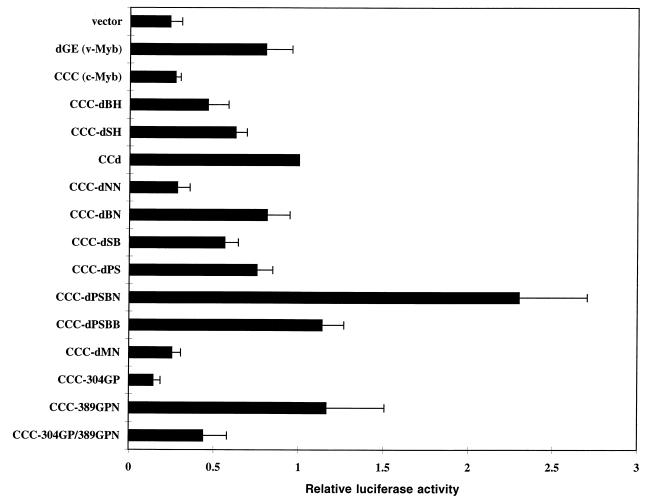
Transactivation of the EW5 reporter gene by c-Myb mutants. (A) A series of deletion or insertion mutants of c-Myb expressed from a retroviral vector were assayed for transcriptional activity in QT6 cells by transient transfection. For each transfection, 3 μg of activator and 1 μg of EW5 reporter were cotransfected into QT6 cells, along with 0.5 μg of a β-galactosidase-expressing vector (CMV-β-Gal) as an internal control. Half of the cells from each transfection were used to determine transactivation activity, as described in Materials and Methods. The other half of the cells were reserved for immunoblotting. Relative luciferase activities were obtained by assigning the luciferase activity of CCd a value of 1. Shown are the mean values of relative luciferase activities from at least three transfections and average deviations (error bars) from the mean. Schematic diagrams of c-Myb mutants are shown at the left. The point mutations in v-Myb are indicated as short bars above the v-Myb diagram. The gray boxes represent the DNA-binding domain and are also marked by repeats. The C-terminal most highly conserved domain is shown as a black box. The linker insertions are indicated as bars above the diagrams for CCC-304GP, CCC-389GPN, and CCC-304GP/389GPN. (B) Representative immunoblot of transiently transfected QT6 cells from the experiments whose results are shown in panel A. Cell lysates with equal amounts of β-Gal activity were resolved on an SDS–10% PAGE gel and immunoblotted with anti-Myb antibodies (5E and 2.7). The relative mobilities of protein markers are indicated in kilodaltons.
FIG. 2
FIG. 2
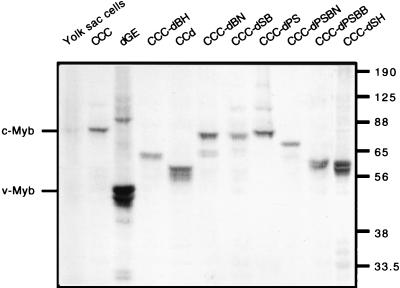
Immunoblotting analysis of c-Myb mutant-transformed chicken yolk sac cells. From the above yolk sac assays, v-Myb, c-Myb, and c-Myb mutant-transformed yolk sac cells were collected and subjected to immunoblot analysis. All yolk sac cell lysates were derived from 5 × 10⁵ cells with the exception of primary yolk sac cells obtained from a 13-day-old chicken embryo (6 × 10⁶ cells/lane) and CCC-dPS (3 × 10⁵ cells/lane). The cell lysates were resolved on an SDS–10% PAGE gel and immunoblotted with Myb antibodies (5E and 2.7). The relative mobilities of protein markers are indicated in kilodaltons.
FIG. 3
FIG. 3
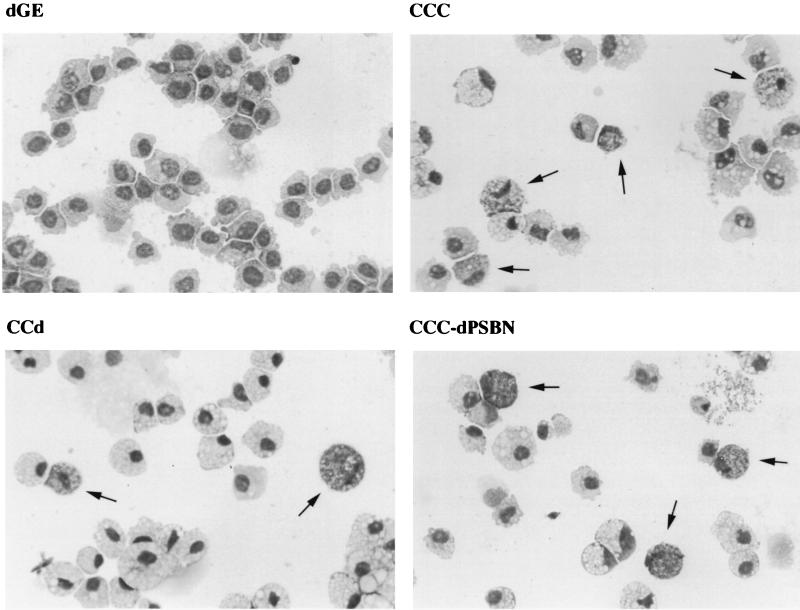
Morphology of yolk sac cells transformed by dGE, CCC, CCd, and CCC-dPSBN. The morphologies of a representative set of transformed yolk sac cells are shown. The yolk sac cells from liquid culture outgrowth were cytocentrifuged onto glass slides and stained with Diff-Quick (DADE). The v-Myb-transformed cells (dGE) are a homogeneous population of monoblasts. The cells transformed by c-Myb (CCC), a double deletion mutant of c-Myb (CCC-dPSBN), and a C-terminal truncation of c-Myb (CCd) exhibited heterogeneous phenotypes. Cells of one type (marked with arrowheads) resemble granulocytes with distinct cytoplasmic granules. The rest of the cells are macrophage-like and have an eccentric nucleus with many vacuoles in the cytoplasm.
FIG. 4
FIG. 4
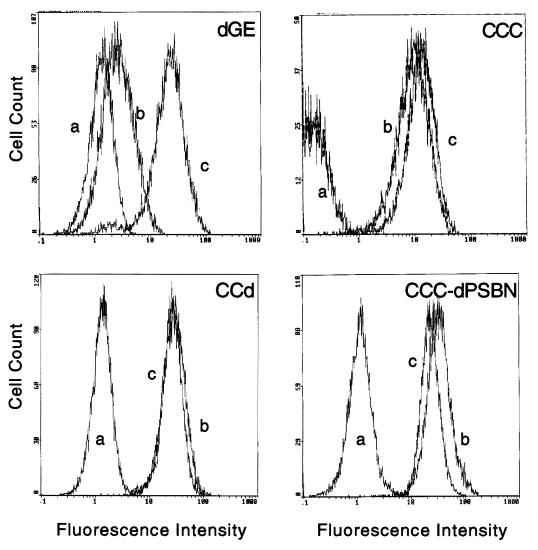
FACS analysis of cell surface markers on yolk sac cells transformed by dGE, CCC, CCd, and CCC-dPSBN. The same representative set of Myb-transformed yolk sac cells shown in Fig. 3 were stained with antibodies specific for cell surface markers. The antibodies 1C3 and HLO72 were used to detect granulocytic and monocytic lineages, respectively. Fluorescence profiles are shown after the cells were stained with wash medium control (a), 1C3 (b), or HLO72 (c).
FIG. 5
FIG. 5
Transactivation by c-Myb mutants with the mim-1 reporter gene. The same series of c-Myb mutants shown in Fig. 1 was analyzed in QT6 cells for transactivation with a reporter promoter derived from mim-1. The transfections were performed in the way mentioned previously, except for the use of a mim-1 reporter gene. Relative luciferase activities were obtained by assigning the luciferase activity of CCd a value of 1. Shown are the mean values of relative luciferase activities from at least three transfections and average deviations (error bars) from the mean.
FIG. 6
FIG. 6
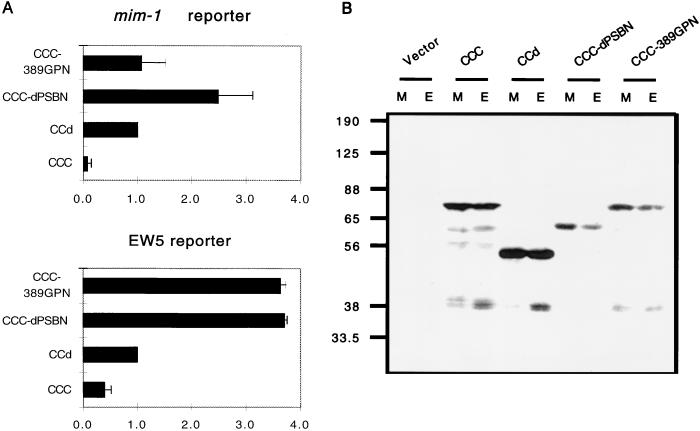
Differential activation of promoters by CCC-dPSBN and CCC-389GPN. (A) Transfections were repeated with both reporters in the same experiment to show the differential effect of CCC-389GPN on EW5 and mim-1 reporter genes. Because the mim-1 reporter gene has a high-level basal activity, we subtracted the activity obtained from the vector (N-Cla). Relative luciferase activities were then calculated by assigning the subtracted luciferase activity of CCd a value of 1. Shown are the mean values of relative luciferase activities from at least three transfections and average deviations (error bars) from the mean. (B) Cell lysates prepared from the same transfection assays were resolved by SDS–10% PAGE and immunoblotted with anti-Myb antibodies. The relative mobilities of protein markers are indicated in kilodaltons. M, mim-1; E, EW5.

References

    1. Ausubel F M, Brent R, Kingston R E, Moore D D, Seidman J G, Smith J A, Struhl K. Current protocols in molecular biology. New York, N.Y: John Wiley & Sons; 1989.
    1. Aziz N, Miglarese M R, Hendrickson R C, Shabanowitz J, Sturgill T W, Hunt D F, Bender T P. Modulation of c-Myb-induced transcription activation by a phosphorylation site near the negative regulatory domain. Proc Natl Acad Sci USA. 1995;92:6429–6433. - PMC - PubMed
    1. Aziz N, Wu J, Dubendorff J W, Lipsick J S, Sturgill T W, Bender T P. c-Myb and v-Myb are differentially phosphorylated by p42mapk in vitro. Oncogene. 1993;8:2259–2265. - PubMed
    1. Bartunek P, Karafiat V, Dvorakova M, Zahorova V, Mandikova S, Zenke M, Dvorak M. The Myb leucine zipper is essential for leukemogenicity of the v-Myb protein. Oncogene. 1997;15:2939–2949. - PubMed
    1. Biedenkapp H, Borgmeyer U, Sippel A E, Klempnauer K H. Viral myb oncogene encodes a sequence-specific DNA-binding activity. Nature. 1988;335:835–837. - PubMed

Publication types

Substances

LinkOut - more resources