Identification of Burkholderia spp. in the clinical microbiology laboratory: comparison of conventional and molecular methods
- PMID: 10364579
- PMCID: PMC85108
- DOI: 10.1128/JCM.37.7.2158-2164.1999
Identification of Burkholderia spp. in the clinical microbiology laboratory: comparison of conventional and molecular methods
Abstract
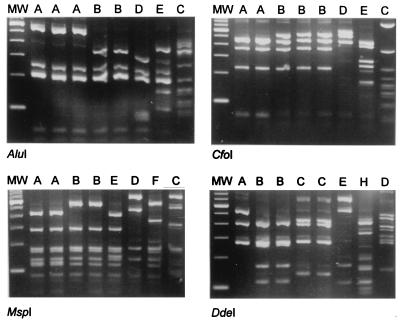
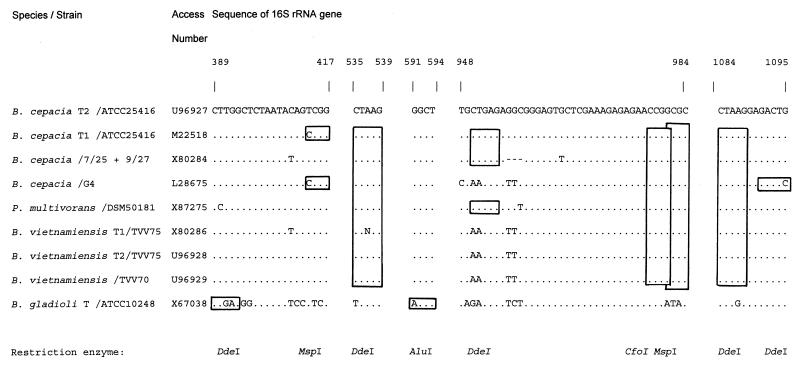
Cystic fibrosis (CF) predisposes patients to bacterial colonization and infection of the lower airways. Several species belonging to the genus Burkholderia are potential CF-related pathogens, but microbiological identification may be complicated. This situation is not in the least due to the poorly defined taxonomic status of these bacteria, and further validation of the available diagnostic assays is required. A total of 114 geographically diverse bacterial isolates, previously identified in reference laboratories as Burkholderia cepacia (n = 51), B. gladioli (n = 14), Ralstonia pickettii (n = 6), B. multivorans (n = 2), Stenotrophomonas maltophilia (n = 3), and Pseudomonas aeruginosa (n = 11), were collected from environmental, clinical, and reference sources. In addition, 27 clinical isolates putatively identified as Burkholderia spp. were recovered from the sputum of Dutch CF patients. All isolates were used to evaluate the accuracy of two selective growth media, four systems for biochemical identification (API 20NE, Vitek GNI, Vitek NFC, and MicroScan), and three different PCR-based assays. The PCR assays amplify different parts of the ribosomal DNA operon, either alone or in combination with cleavage by various restriction enzymes (PCR-restriction fragment length polymorphism [RFLP] analysis). The best system for the biochemical identification of B. cepacia appeared to be the API 20NE test. None of the biochemical assays successfully grouped the B. gladioli strains. The PCR-RFLP method appeared to be the optimal method for accurate nucleic acid-mediated identification of the different Burkholderia spp. With this method, B. gladioli was also reliably classified in a separate group. For the laboratory diagnosis of B. cepacia, we recommend parallel cultures on blood agar medium and selective agar plates. Further identification of colonies with a Burkholderia phenotype should be performed with the API 20NE test. For final confirmation of species identities, PCR amplification of the small-subunit rRNA gene followed by RFLP analysis with various enzymes is recommended.
Figures
References
-
- Barker P M, Wood R E, Gilligan P H. Lung infection with Burkholderia gladioli in a child with cystic fibrosis: acute clinical and spirometric deterioration. Pediatr Pulmonol. 1997;23:123–125. - PubMed
-
- Baxter I A, Lambert P A, Simpson I N. Isolation from clinical sources of Burkholderia cepacia possessing characteristics of Burkholderia gladioli. J Antimicrob Chemother. 1997;39:169–175. - PubMed
-
- Bevinino A, Tabacchioni S, Chiarini L, Carusi M V, del Gallo M, Visca P. Phenotypic comparison between rhizosphere and clinical isolates of Burkholderia cepacia. Microbiology. 1994;140:1069–1077. - PubMed
Publication types
MeSH terms
Substances
LinkOut - more resources
Full Text Sources
Molecular Biology Databases
Miscellaneous