


Differentiation of Burkholderia species by PCR-restriction fragment length polymorphism analysis of the 16S rRNA gene and application to cystic fibrosis isolates
- PMID: 10364586
- PMCID: PMC85118
- DOI: 10.1128/JCM.37.7.2201-2208.1999
Differentiation of Burkholderia species by PCR-restriction fragment length polymorphism analysis of the 16S rRNA gene and application to cystic fibrosis isolates
Abstract
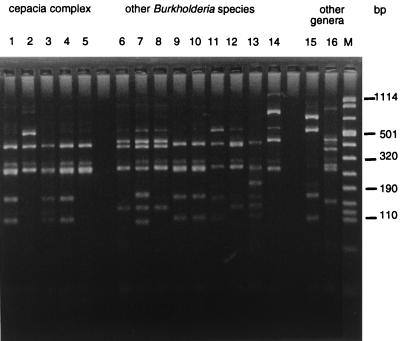
Burkholderia cepacia, which is an important pathogen in cystic fibrosis (CF) owing to the potential severity of the infections and the high transmissibility of some clones, has been recently shown to be a complex of five genomic groups, i.e., genomovars I, II (B. multivorans), III, and IV and B. vietnamiensis. B. gladioli is also involved, though rarely, in CF. Since standard laboratory procedures fail to provide an accurate identification of these organisms, we assessed the ability of restriction fragment length polymorphism (RFLP) analysis of amplified 16S ribosomal DNA (rDNA), with the combination of the patterns obtained with six endonucleases, to differentiate Burkholderia species. This method was applied to 16 type and reference strains of the genus Burkholderia and to 51 presumed B. cepacia clinical isolates, each representative of one clone previously determined by PCR ribotyping. The 12 Burkholderia type strains tested were differentiated, including B. cepacia, B. multivorans, B. vietnamiensis, and B. gladioli, but neither the genomovar I and III reference strains nor the genomovar IV reference strain and B. pyrrociniaT were distinguishable. CF clinical isolates were mainly distributed in RFLP group 2 (which includes B. multivoransT) and RFLP group 1 (which includes B. cepacia genomovar I and III reference strains, as well as nosocomial clinical isolates). Two of the five highly transmissible clones in French CF centers belonged to RFLP group 2, and three belonged to RFLP group 1. The remaining isolates either clustered with other Burkholderia species (B. cepacia genomovar IV or B. pyrrocinia, B. vietnamiensis, and B. gladioli) or harbored unique combinations of patterns. Thus, if further validated by hybridization studies, PCR-RFLP of 16S rDNA could be an interesting identification tool and contribute to a better evaluation of the respective clinical risks associated with each Burkholderia species or genomovar in patients with CF.
Figures
References
-
- Brett P, DeShazer D, Woods D. Burkholderia thailandensis sp. nov., a Burkholderia pseudomallei-like species. Int J Syst Bacteriol. 1998;48:317–320. - PubMed
-
- Burkholder W H. Sour skin, a bacterial rot of onion bulbs. Phytopathology. 1950;40:115–117.
Publication types
MeSH terms
Substances
LinkOut - more resources
Full Text Sources
Medical
Molecular Biology Databases
