. 1999 Jul;37(7):2215-22.
doi: 10.1128/JCM.37.7.2215-2222.1999.

Detection and identification of Ehrlichia, Borrelia burgdorferi sensu lato, and Bartonella species in Dutch Ixodes ricinus ticks

Affiliations

Detection and identification of Ehrlichia, Borrelia burgdorferi sensu lato, and Bartonella species in Dutch Ixodes ricinus ticks

L M Schouls et al. J Clin Microbiol. 1999 Jul.

Abstract

A sensitive and specific PCR hybridization assay was developed for the simultaneous detection and identification of Ehrlichia and Borrelia burgdorferi sensu lato. In separate assays the 16S rRNA gene of Ehrlichia species and the 23S-5S rRNA spacer region of B. burgdorferi sensu lato were amplified and labeled by PCR. These PCR products were used in a reverse line blot hybridization assay in which oligonucleotide probes are covalently linked to a membrane in parallel lines. Hybridization of the samples with the oligonucleotide probes on this membrane enabled the simultaneous detection and identification of Ehrlichia, B. burgdorferi, and Bartonella species in 40 different samples. The application of the assay to DNA extracts from 121 Ixodes ricinus ticks collected from roe deer demonstrated that 45% of these ticks carried Ehrlichia DNA. More than half of these positive ticks carried species with 16S rRNA gene sequences closely related to those of E. phagocytophila and the human granulocytic ehrlichiosis agent. The majority of the other positive ticks were infected with a newly identified Ehrlichia-like species. In addition, 13% of the ticks were infected with one or more B. burgdorferi genospecies. In more than 70% of the ticks 16S rRNA gene sequences for Bartonella species or other species closely related to Bartonella were found. In five of the ticks both Ehrlichia and B. burgdorferi species were detected.


Figures

FIG. 1
FIG. 1
Multiple alignment of the variable part of the 16S rRNA gene sequences of the E. phagocytophila group. The region where differences were detected is shown for E. phagocytophila, E. equi, HGE, and the variants of E. phagocytophila and HGE. The positions of the residues that differ in the 16S rRNA gene are shown below the multiple alignment. Residues identical to those of the E. phagocytophila sequence are indicated by a dot. The sequence of E. equi was obtained from GenBank (accession no. M73223). The 500 bp of the 5′ end of the 16S rRNA gene sequences of E. phagocytophila and HGE were determined in this study and compared with the sequences in the GenBank and EMBL database and were found to be identical to published sequences (accession nos. M73320 and U02521, respectively). The 16S rRNA sequences of the E. phagocytophila variant and the HGE variant were determined in this study.
FIG. 2
FIG. 2
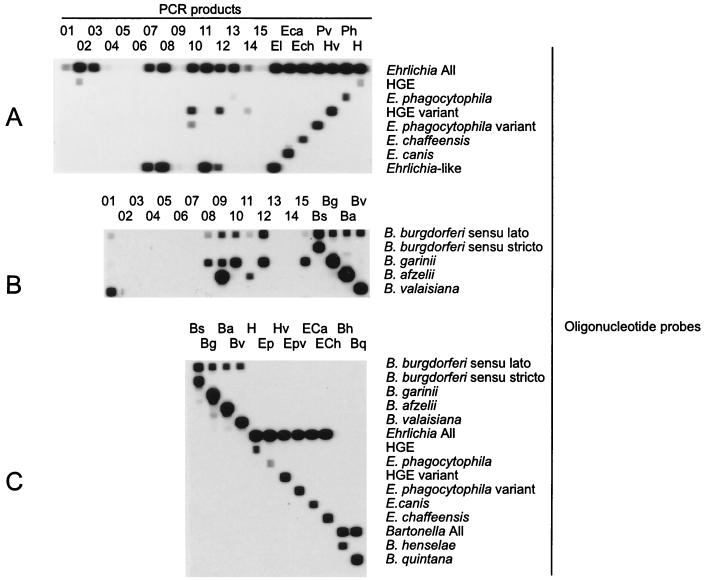
Reverse line blot hybridization assay analyses for the detection and identification of Ehrlichia, B. burgdorferi, and Bartonella spp. in ticks. (A) Membrane carrying Ehrlichia-specific oligonucleotide probes; (B) membrane carrying B. burgdorferi genospecies-specific probes; (C) combined membrane carrying probes for Ehrlichia, B. burgdorferi, and Bartonella species. The oligonucleotide probes are attached to the membrane in the horizontal direction, and the PCR samples were applied perpendicularly in the vertical direction. The numbered lanes represent tick-derived PCR products, and the lanes marked with letters show the PCR products obtained from the positive control samples. El, Ehrlichia-like; Eca, E. canis; Ech, E. chaffeensis; Epv, E. phagocytophila variant; Hv, HGE variant; Ep, E. phagocytophila; H, HGE; Bs, B. burgdorferi sensu stricto; Bg, B. garinii; Ba, B. afzelii; Bv, B. valaisiana; Bh, B. henselae; Bq, B. quintana.
FIG. 3
FIG. 3
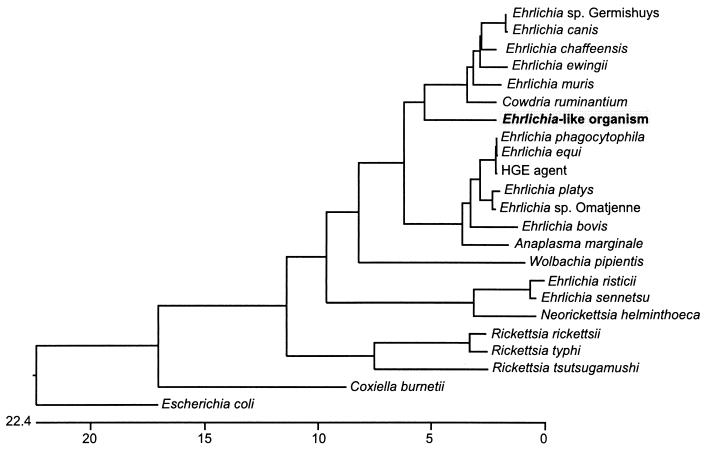
Dendrogram showing the phylogenetic relationships of the 16S rRNA gene sequences of the newly identified Ehrlichia-like and those of other rickettsiae. The tree was constructed by comparing sequences of the segment of the 16S rRNA gene ranging from bases 40 to 1434 (E. phagocytophila coordinates). The scale beneath the tree measures the distance between sequences expressed as the number of substitution events. The sequences used for comparison were obtained from the GenBank and EMBL database.

References

    1. Anderson B E, Dawson J E, Jones D C, Wilson K H. Ehrlichia chaffeensis, a new species associated with human ehrlichiosis. J Clin Microbiol. 1991;29:2838–2842. - PMC - PubMed
    1. Belongia E A, Reed K D, Mitchell P D, Kolbert C P, Persing D H, Gill J S, Kazmierczak J J. Prevalence of granulocytic Ehrlichia infection among white-tailed deer in Wisconsin. J Clin Microbiol. 1997;35:1465–1468. - PMC - PubMed
    1. Bergmans A M C, Schellekens J F P, Vanembden J D A, Schouls L M. Predominance of two Bartonella henselae variants among cat-scratch disease patients in The Netherlands. J Clin Microbiol. 1996;34:254–260. - PMC - PubMed
    1. Bergmans A M, Groothedde J W, Schellekens J F, van Embden J D, Ossewaarde J M, Schouls L M. Etiology of cat scratch disease: comparison of polymerase chain reaction detection of Bartonella (formerly Rochalimaea) and Afipia felis DNA with serology and skin tests. J Infect Dis. 1995;171:916–923. - PubMed
    1. Brouqui P, Dumler J S, Lienhard R, Brossard M, Raoult D. Human granulocytic ehrlichiosis in Europe. Lancet. 1995;346:782–783. - PubMed

MeSH terms

Associated data

LinkOut - more resources