. 1999 Jul;37(7):2236-40.
doi: 10.1128/JCM.37.7.2236-2240.1999.

Detection of Helicobacter pylori DNA in fecal samples from infected individuals

Affiliations

Detection of Helicobacter pylori DNA in fecal samples from infected individuals

W A Gramley et al. J Clin Microbiol. 1999 Jul.

Abstract

Stool, gastric biopsy, and serum samples were collected from 22 subjects. DNA from stool was extracted, amplified, and hybridized with primers specific for the 16S rRNA gene of Helicobacter pylori. DNA from gastric biopsy specimens was analyzed similarly for comparison. Universal primers were used to confirm successful extraction of DNA from samples. Histologic, serologic, and DNA analyses were scored in a blinded fashion. Universal primer amplification verified successful DNA extraction from all stool and gastric tissue specimens. The gastric tissue DNA assay was positive for H. pylori in 11 of the 22 subjects, correlating completely with histologic and serologic results. Stool DNA was positive for H. pylori by our molecular assay in 8 of these 11 H. pylori-positive subjects. All subjects who were negative by histologic, serologic, and gastric tissue DNA analyses were also negative by stool DNA analysis. Compared to histology, serology, and gastric tissue DNA analyses, the sensitivity of our stool DNA assay was 73%, with a specificity of 100%.


Figures
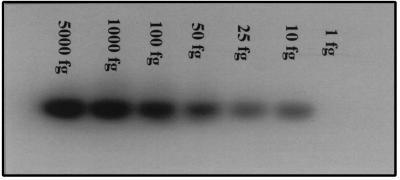
FIG. 1
FIG. 1
Molecular assay sensitivity. DNA was extracted from cultured H. pylori and then diluted to amounts ranging from 5,000 to 1 fg of bacterial DNA and amplified with primers specific for the 16S rRNA gene of H. pylori. The PCR products were then hybridized with a 32P-labeled H. pylori-specific oligomer. The lowest amount that produced a signal was 10 fg, which corresponds to less than seven bacterial genomes.
FIG. 2
FIG. 2
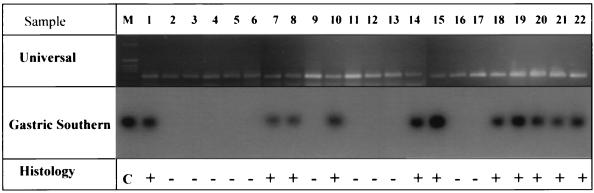
Gastric tissue DNA analysis. The ethidium bromide-stained agarose gel in the top panel demonstrates amplification of exon 7 of Smad4 in gastric tissue DNAs of all 22 subjects, confirming the presence of amplifiable DNA. Lane M displays DNA size markers (Bethesda Research Laboratories 1-kb ladder). Specific H. pylori amplification produced an expected 139-bp PCR product with samples from infected subjects, seen as hybridization signals in the middle panel, with a 32P-labeled H. pylori-specific oligomer used as a probe. The results of histologic analysis (+, positive; −, negative) are presented in the bottom panel for comparison. The positive control lane (C) used DNA extracted from cultured H. pylori as a template.
FIG. 3
FIG. 3
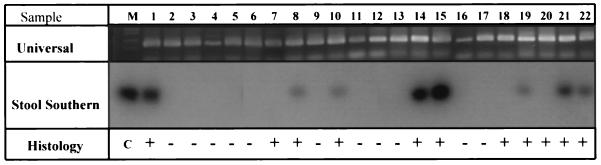
Stool DNA analysis. The ethidium bromide-stained agarose gel in the top panel illustrates amplification from the stool DNA of all 22 subjects of an expected 148-bp PCR product with universal 16S rRNA gene primers, confirming the presence of amplifiable DNA. Lane M displays DNA size markers (Bethesda Research Laboratories 1-kb ladder). Specific H. pylori amplification primers generated an expected 139-bp PCR product with samples from infected subjects, seen as hybridization signals in the middle panel, with a 32P-labeled H. pylori-specific oligomer used as a probe. The results of histologic analysis (+, positive; −, negative) are presented in the bottom panel for comparison. The positive control lane (C) used DNA extracted from cultured H. pylori as a template.

References

    1. Albert M J, Islam D, Nahar S, Qadri F, Falklind S, Wintraub A. Rapid detection of Vibrio cholerae O139 Bengal from stool specimens by PCR. J Clin Microbiol. 1997;35:1633–1635. - PMC - PubMed
    1. Atherton J C, Peek R M, Jr, Tham K T, Cover T L, Blaster M J. Clinical and pathological importance of heterogeneity in VacA, the vacuolating cytotoxin gene of helicobacter pylori. Gastroenterology. 1997;112:92–99. - PubMed
    1. Casswal T H, Nilsson H, Bergstrom M, Aleljung P, Wadstrom T, Dahlstrom A K, Albert M J, Sarker S A. Evaluation of serology, 13C-urea breath test, and polymerase chain reaction of stool samples to detect Helicobacter pylori in Bangladeshi children. J Pedicatr Gastroenterol Nutr. 1999;28:31–36. - PubMed
    1. Chiu C, Ou J T. Rapid identification of Salmonella serovars in feces by specific detection in virulence genes, invA and spvC, by an enrichment broth culture-multiplex PCR combination assay. J Clin Microbiol. 1996;34:2619–2622. - PMC - PubMed
    1. Clayton C L, Kleanthous H, Coates P J, Morgan D D, Tabaqchali S. Sensitive detection of Helicobacter pylori by using polymerase chain reaction. J Clin Microbiol. 1992;30:192–200. - PMC - PubMed

Publication types

MeSH terms