


Basolateral amygdala noradrenergic influences on memory storage are mediated by an interaction between beta- and alpha1-adrenoceptors
- PMID: 10366644
- PMCID: PMC6782651
- DOI: 10.1523/JNEUROSCI.19-12-05119.1999
Basolateral amygdala noradrenergic influences on memory storage are mediated by an interaction between beta- and alpha1-adrenoceptors
Abstract
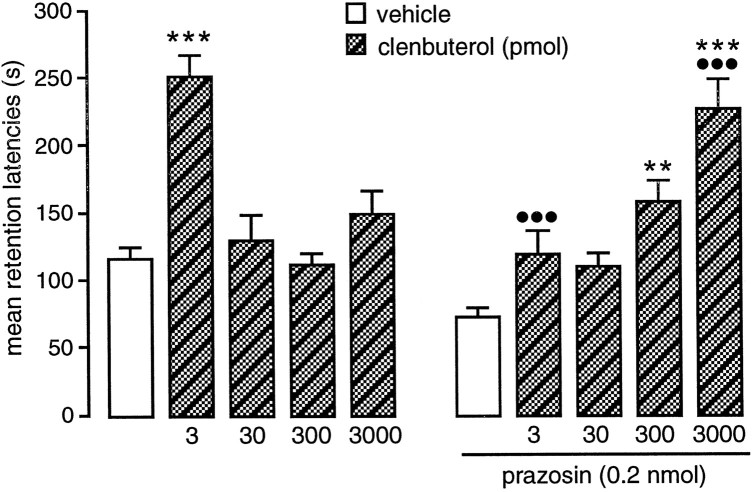
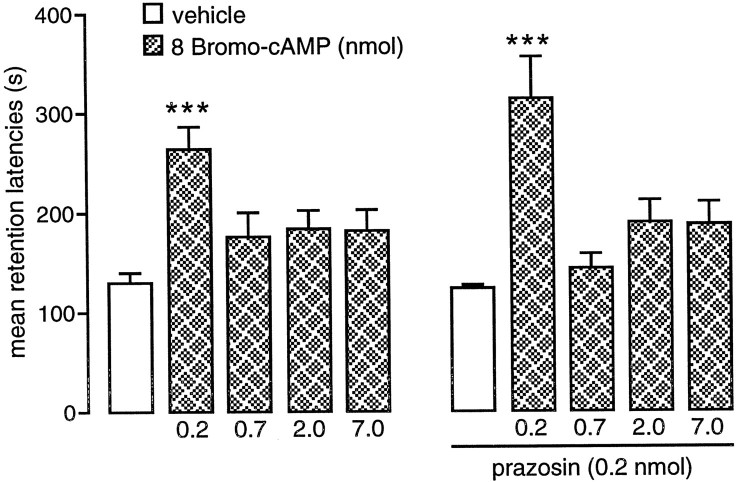
Extensive evidence indicates that norepinephrine modulates memory storage through an activation of beta-adrenoceptors in the basolateral nucleus of the amygdala (BLA). Recent findings suggest that the effects of beta-adrenergic activation on memory storage are influenced by alpha1-adrenoceptor stimulation. Pharmacological findings indicate that activation of postsynaptic alpha1-adrenoceptors potentiates beta-adrenoceptor-mediated activation of cAMP formation. The present study examined whether inactivation of alpha1-adrenoceptors in the BLA would alter the dose-response effects on memory storage of intra-BLA infusions of a beta-adrenoceptor agonist, as well as that of a synthetic cAMP analog. Male Sprague Dawley rats received bilateral microinfusions into the BLA of either the beta-adrenoceptor agonist clenbuterol (3-3000 pmol in 0.2 microliter) or 8-bromoadenosine 3':5'-cyclic monophosphate (8-bromo-cAMP) (0.2-7 nmol in 0.2 microliter) alone or together with the alpha1-adrenoceptor antagonist prazosin (0.2 nmol) immediately after training in an inhibitory avoidance task. Retention was tested 48 hr later. Clenbuterol induced a dose-dependent enhancement of retention, and prazosin attenuated the dose-response effects of clenbuterol. Posttraining intra-BLA infusions of 8-bromo-cAMP also induced a dose-dependent enhancement of retention latencies. However, concurrent infusion of prazosin did not alter the dose-response effects of 8-bromo-cAMP. These findings are consistent with the view that alpha1-adrenoceptors affect memory storage by modulating beta-adrenoceptor activation in the BLA. Moreover, these findings are consistent with those of pharmacological studies indicating that beta-adrenoceptors modulate memory storage by a direct coupling to adenylate cyclase, whereas alpha1-receptors act indirectly by influencing the beta-adrenoceptor-mediated influence on cAMP formation.
Figures
References
-
- Bernabeu R, Schmitz P, Faillance MP, Izquierdo I, Medina JH. Hippocampal cGMP and cAMP are differentially involved in memory processing of inhibitory avoidance learning. NeuroReport. 1996;7:585–588. - PubMed
-
- Bernabeu R, Bevilaqua L, Ardenghi P, Bromberg E, Schmitz P, Bianchin M, Izquierdo I, Medina JH. Involvement of hippocampal cAMP/cAMP-dependent protein kinase signaling pathways in a late memory consolidation phase of aversively motivated learning in rats. Proc Natl Acad Sci USA. 1997;94:7041–7046. - PMC - PubMed
-
- Bicknell RJ, Luckman SM, Inenaga K, Mason WT, Hatton GI. β-adrenergic and opioid receptors on pituicytes cultured from adult rat neurophyophysis: regulation of cell morphology. Brain Res Bull. 1989;22:379–388. - PubMed
-
- Burkard WP. Catecholamines induced increase of cyclic adenosine 3′,5′-monophosphate in rat brain in vivo. J Neurochem. 1972;19:2615–2619. - PubMed
Publication types
MeSH terms
Substances
Grants and funding
LinkOut - more resources
Full Text Sources
Other Literature Sources
Medical
