. 1999 Jun;181(12):3777-83.
doi: 10.1128/JB.181.12.3777-3783.1999.

Transcriptional regulation in the hyperthermophilic archaeon Pyrococcus furiosus: coordinated expression of divergently oriented genes in response to beta-linked glucose polymers

Affiliations

Transcriptional regulation in the hyperthermophilic archaeon Pyrococcus furiosus: coordinated expression of divergently oriented genes in response to beta-linked glucose polymers

W G Voorhorst et al. J Bacteriol. 1999 Jun.

Abstract

The genetic organization, expression, and regulation of the celB locus of the hyperthermophilic archaeon Pyrococcus furiosus were analyzed. This locus includes the celB gene, which codes for an intracellular beta-glucosidase, and a divergently orientated gene cluster, adhA-adhB-lamA, which codes for two alcohol dehydrogenases and an extracellular beta-1,3-endoglucanase that is transcribed as a polycistronic messenger (the lamA operon). During growth of P. furiosus on either the beta-1,4-linked glucose dimer cellobiose or the beta-1,3-linked glucose polymer laminarin, the activities of both beta-glucosidase and endoglucanase were increased at least fivefold compared with levels during growth on maltose or pyruvate. Northern blot analysis revealed an enhanced transcription of both the celB gene and the lamA operon in the presence of these glucose-containing substrates. The in vivo and in vitro transcription initiation sites of both the celB gene and the lamA operon were identified 25 nucleotides downstream of conserved TATA box motifs. A number of repeating sequences have been recognized in the celB-adhA intergenic region, some of which might be part of a transcriptional regulator-binding site.


Figures
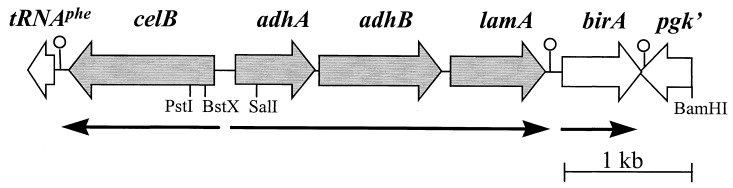
FIG. 1
FIG. 1
Genetic organization of the celB locus. The locations and orientations of the genes (open and solid arrows) are indicated. Relevant restriction sites used for cloning and in vitro transcription analysis are shown, as are putative transcription termination signals (○).
FIG. 2
FIG. 2
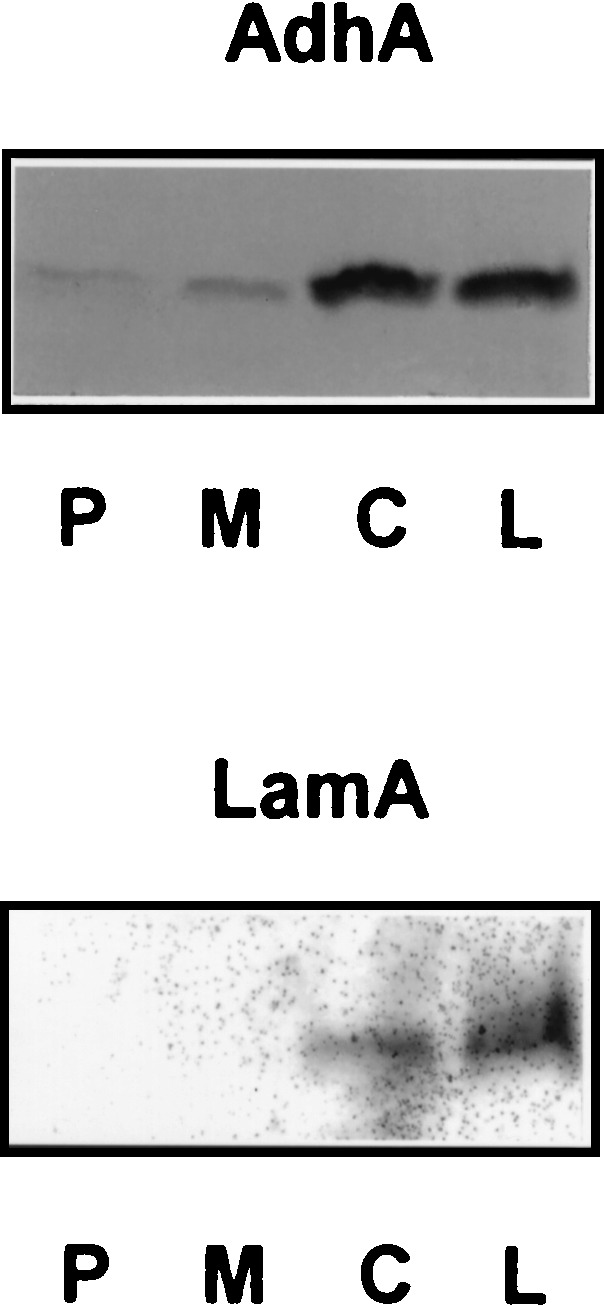
Western blot analysis of AdhA and LamA of P. furiosus when it was grown on different substrates. Shown are results with cell extracts (AdhA) and concentrated culture supernatants (LamA) of P. furiosus cells after cells were grown on pyruvate (P), maltose (M), cellobiose (C), and laminarin (L), separated by SDS-PAGE, blotted on nitrocellulose membranes, and detected with polyclonal antibodies raised against AdhA and LamA, respectively.
FIG. 3
FIG. 3
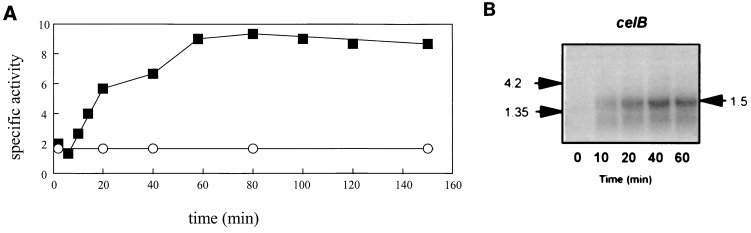
Kinetics of the induction of β-glucosidase activity and celB transcription by cellobiose. (A) Specific β-glucosidase activity (in units per milligram) in P. furiosus cells grown on pyruvate with (■) or without (○) cellobiose. (B) Northern blot analysis of total RNA extracted from P. furiosus cells grown on pyruvate following addition of cellobiose. Hybridization was performed with a 32P-labelled probe specific for celB. A control experiment was performed with the constitutively expressed P. furiosus por gene, which encodes pyruvate ferredoxin oxidoreductase, indicating that equal amounts of RNA were applied in all lanes (data not shown and reference 42). The size of the celB transcript (1.5 kb) was estimated by using a RNA molecular size standard (Life Technologies) as indicated (4.2 or 1.35 kb).
FIG. 4
FIG. 4
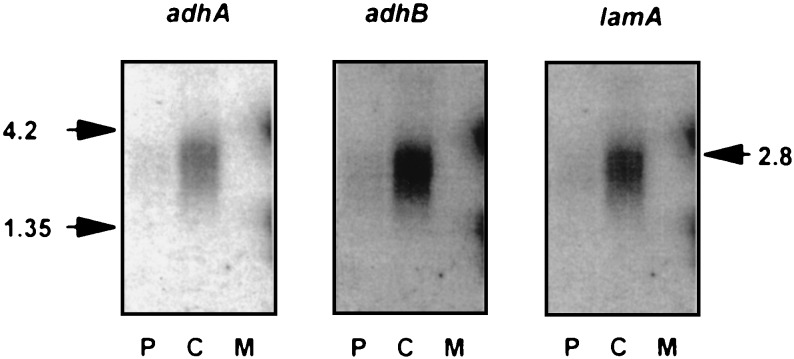
Detection of the transcript of the lamA operon in RNAs extracted from cells grown on pyruvate (P), cellobiose (C), and maltose (M). Equal amounts of RNA were used for agarose gel electrophoresis. The Northern blots were hybridized with 32P-labelled gene-specific probes as indicated. The size of the transcript (2.8 kb) was estimated by using a RNA molecular size standard (Life Technologies) as indicated (4.2 or 1.35 kb).
FIG. 5
FIG. 5
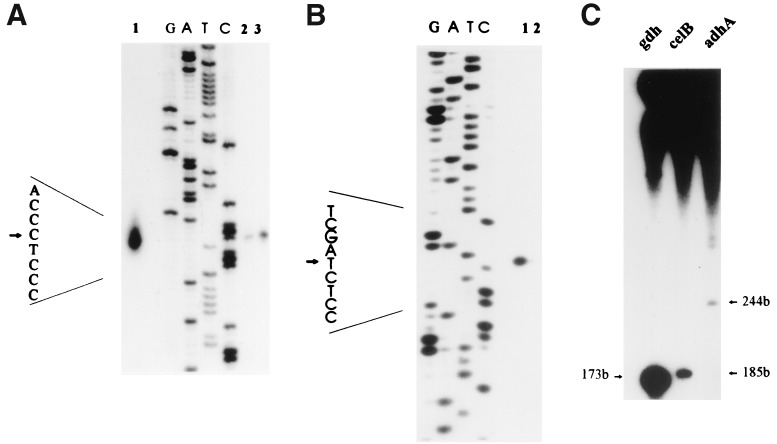
In vivo and in vitro transcriptional analyses of the celB locus. (A) Analysis of the transcription initiation site at the adhA promoter by primer extension. Primer-extended products of transcripts produced in vivo (lane 1) and in vitro (lane 2), together with the sequence ladder (lanes G, A, T, and C) generated with the same primer on the noncoding strand of adhA, were loaded and separated on polyacrylamide gel. Annealing reactions were performed at 60°C (lane 2) and 50°C (lane 3). (B) In vitro analysis of the transcription initiation site at the celB promoter by primer extension. Primer-extended products were loaded next to the sequence ladder (lanes G, A, T, and C) generated with the same primer on the noncoding strand of celB. Annealing reactions were performed at 50°C (lane 1) and 60°C (lane 2). (C) Comparison of the in vitro transcription efficiencies of the gdh, celB, and adhA genes. RNA polymerase, the Superdex fraction of a TFB, and the heparin-Sepharose fraction of a TFA were assayed for specific activity in cell-free transcription system reactions as described in the work of Hethke et al. (16). Labelled runoff transcripts of the gdh (16) and, after optimization, of the celB and adhA genes were separated on an 8% polyacrylamide–urea gel and identified by autoradiography. Only one-fifth of the product generated with the gdh template was loaded. The arrows label the runoff transcripts and show their lengths in bases.
FIG. 6
FIG. 6
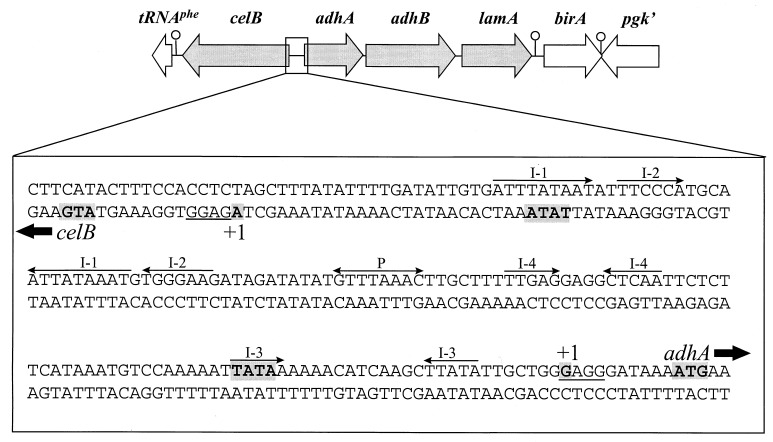
Intergenic region between celB and adhA. The TATA box, transcription initiation sites (+1), and translation start sites (boldface letters and gray shading) are indicated; putative ribosome-binding sites are underlined. Many repeating sequences are present; for clarity, only inverted repeats (I-1 to I-4) and the palindromic sequence (P) are shown; inverted repeat 4 resembles a recognition site for a bacterial transcription regulator (FNR), as discussed in the text.

References

    1. Baumann P, Qureshi S A, Jackson S P. Transcription: new insights from studies on Archaea. Trends Genet. 1995;11:279–283. - PubMed
    1. Bell S D, Jackson S P. Transcription and translation in Archaea: a mosaic of eukaryal and bacterial features. Trends Microbiol. 1998;6:222–228. - PubMed
    1. Brinkman, A. B., I. Dahlke, J. E. Tuininga, T. Lammers, V. Dumay, E. de Heus, J. H. G. Lebbink, M. Thomm, W. M. de Vos, and J. van der Oost. Submitted for publication. - PubMed
    1. Brown J W, Daniels C J, Reeve J N. Gene structure, organization, and expression in archaebacteria. Crit Rev Microbiol. 1989;16:287–338. - PubMed
    1. Bult C J, White O, Olsen G J, Zhou L X, Fleischmann R D, Sutton G G, Blake J A, FitzGerald L M, Clayton R A, Gocayne J D, Kerlavage A R, Dougherty B A, Tomb J F, Adams M D, Reich C I, Overbeek R, Kirkness E F, Weinstock K G, Merrick J M, Glodek A, Scott J L, Geoghagen N S M, Weidman J F, Fuhrmann J L, Nguyen D, Utterback T R, Kelley J M, Peterson J D, Sadow P W, Hanna M C, Cotton M D, Roberts K M, Hurst M A, Kaine B P, Borodovsky M, Klenk H P, Fraser C M, Smith H O, Woese C R, Venter J C. Complete genome sequence of the methanogenic archaeon, Methanococcus jannaschii. Science. 1996;273:1058–1073. - PubMed

Publication types

MeSH terms

Associated data

LinkOut - more resources