Response to interferon alpha treatment and disappearance of cryoglobulinaemia in patients infected by hepatitis C virus
- PMID: 10369715
- PMCID: PMC1727565
- DOI: 10.1136/gut.45.1.122
Response to interferon alpha treatment and disappearance of cryoglobulinaemia in patients infected by hepatitis C virus
Abstract
Background: Mixed cryoglobulinaemia is closely associated with hepatitis C virus (HCV) infection.
Aim: To assess in a prospective open study the efficiency of interferon alpha treatment of cryoglobulinaemia, as reflected by the disappearance of cryoglobulins and clinical manifestations of the disease, and to analyse the factors predictive of a response to interferon.
Method: Eighty seven consecutive patients with chronic hepatitis C treated for the first time with interferon at a dose of 3 x 10(6) international units three times a week for six months were studied. Forty three patients had cryoglobulins, which were responsible for clinical manifestations in 12.
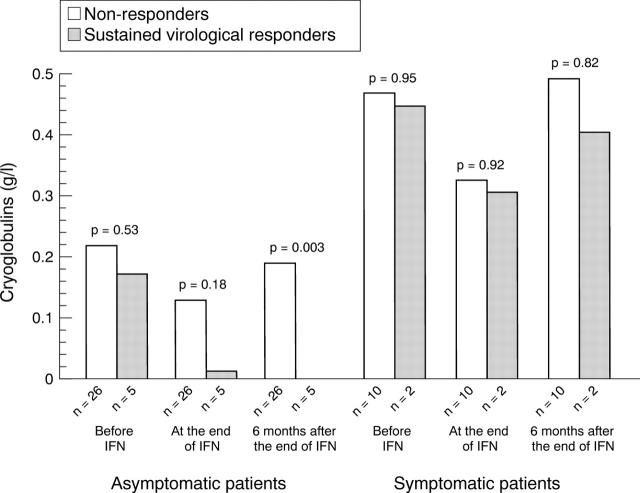
Results: At the end of interferon treatment, cryoglobulins had disappeared in 39% of the patients. A clinical improvement (except for neuropathies) was observed in all patients. Six months after interferon treatment was stopped, the same rate of response (normal alanine aminotransferase values and undectable HCV RNA) was observed in patients with or without cryoglobulins. Only 14% of patients still had undetectable cryoglobulins, and all of them also had undetectable serum HCV RNA. The disappearance of cryoglobulins was found less frequently in patients with clinical symptoms than in asymptomatic ones, but the difference was not significant. Sustained responders were more often men, infected by genotype 2 or 3, with a lower pretreatment viral load.
Conclusion: The presence of cryoglobulins does not seem to affect the response to interferon in HCV infected patients. The improvement in cryoglobulinaemia is strongly associated with a virological response, reinforcing the hypothesis of a direct role for HCV in the pathogenesis of this disease.
Figures
Comment in
-
Cryoglobulinaemia in HCV infection: coming in from the cold.Gut. 1999 Jul;45(1):8-9. doi: 10.1136/gut.45.1.8. Gut. 1999. PMID: 10369695 Free PMC article. No abstract available.
References
Publication types
MeSH terms
Substances
LinkOut - more resources
Full Text Sources