. 1999 Jul 1;19(13):5265-74.
doi: 10.1523/JNEUROSCI.19-13-05265.1999.

The concentration of synaptically released glutamate outside of the climbing fiber-Purkinje cell synaptic cleft

Affiliations

The concentration of synaptically released glutamate outside of the climbing fiber-Purkinje cell synaptic cleft

J A Dzubay et al. J Neurosci. .

Abstract

AMPA receptors and glutamate transporters expressed by cerebellar Bergmann glial cells are activated by neurotransmitter released from climbing fibers (). Based on anatomical evidence, this is most likely the result of glutamate diffusing out of the climbing fiber-Purkinje cell synaptic clefts (). We used the change in the EC50 of the Bergmann glia AMPA receptors produced by cyclothiazide (CTZ) to estimate the concentration of glutamate reached at the glial membrane. The decrease of the EC50 gives rise to a concentration-dependent potentiation of the AMPA receptor-mediated responses (). By comparing the increase in amplitude of the AMPA receptor response in the Bergmann glia (840 +/- 240%; n = 8) with the shift in the glutamate dose-response curve measured in excised patches (EC50, 1810 microM in control vs 304 microM in CTZ), we estimate that the extrasynaptic transmitter concentration reaches 160-190 microM. This contrasts with the concentration in the synaptic cleft, thought to rapidly rise above 1 mM, but is still high enough to activate glutamate receptors. These results indicate that the sphere of influence of synaptically released glutamate can extend beyond the synaptic cleft.


Figures

Fig. 1.
Fig. 1.
The effects of CTZ and temperature on the response of the Bergmann glial cell to climbing fiber activation.A, A plot of the peak amplitude of the Bergmann response to climbing fiber stimulation every 20 sec. After 5 min of stable baseline, 200 μm CTZ was applied in the perfusate, followed 10 min later by 10 μm NBQX. The resting–holding potential of the cell was −88 mV. B, Averages of five sweeps under control conditions, in CTZ, and in NBQX. C, Comparison of the time course of the different components of the response isolated by subtraction of the synaptically activated transporter current (STC), the current remaining in NBQX. Averages of five sweeps were scaled to their peaks.D, The AMPA receptor-mediated response in CTZ at 35°C, at 25°C, and again at 35°C. E, The AMPA receptor-mediated response (STC subtracted) at 35°C under control (CONT) conditions and with 200 μmCTZ present (CTZ). The responses in D andE are from a different cell than in A–Cand are averages of five responses. This resting–holding potential of the cell was −82 mV.
Fig. 2.
Fig. 2.
The Bergmann glia transporter current indicates no effect of CTZ on climbing fiber release. A,Top, Peak amplitude plot of the Bergmann glia response. The AMPA response was blocked with 10 μm NBQX, and no increase in amplitude of the remaining transport current was seen after application of 200 μm CTZ. Bottom, Averages of 10 traces, with the last trace located at the time points indicated in the amplitude plot. The membrane potential of the cell was −80 mV. B, The transporter current (isolated with 10 μm NBQX) of a different cell showing the effects of adding 5 μm Cd+2 or 5 mmCa+2 to the external solution. Averages of 5–15 traces. The membrane potential of this cell was −78 mV.
Fig. 3.
Fig. 3.
The Purkinje cell EPSC shows no increase of climbing fiber release in CTZ. A, Peak amplitude plot of the Purkinje cell EPSC evoked by climbing fiber stimulation. After a stable baseline period, 200 μm CTZ was added to the external solution. The cell was held at −6 mV. B, Averages of five responses under control conditions and in the presence of 200 μm CTZ. C, The above averages along with the second of a pair of responses isolated by subtraction of the single responses. The paired stimuli were delivered 30 msec apart.
Fig. 4.
Fig. 4.
CTZ increased Bergmann glia patch responses to glutamate in a dose-dependent manner. Responses of an outside-out patch to 300 (A) and 3000 (B) μmglutamate (GLU) under control conditions (thin lines) and in the presence of 200 μmCTZ (thick lines). The 300 μm response was increased 9.6-fold by CTZ, whereas the 3000 μm response was only increased 2.5-fold. The responses are averages of 20–40 traces. To account for a small amount of rundown, the conditions were repeated two to three times interleaving the various conditions. The patch was held at −80 mV. The applications were 10 msec long and separated by 10 sec.
Fig. 5.
Fig. 5.
Quantification of the glutamate reaching the Bergmann glia AMPA receptors. A, Dose–response curves were constructed using data from a total of 18 patches. Two or three concentrations with or without CTZ were tested in each patch. The patch responses, including those in CTZ, were all normalized to 3 mm glutamate under control conditions. The control EC50 for glutamate was 1810 μm, and in the presence of CTZ it was 304 μm. The dotted line is the fit of the control data multiplied by the increase in maximal amplitude (1.5-fold), illustrating what the data would look like with no change in affinity. B, The ratio of the CTZ fit over the control fit plotted against concentration. The average fold increase of the Bergmann glia AMPA response (8.4-fold) falls at 192 μm on the x-axis.
Fig. 6.
Fig. 6.
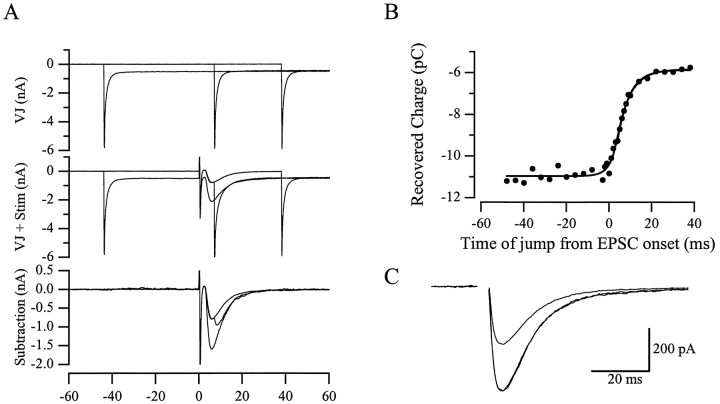
Voltage jump analysis of the Bergmann glia response. A, Three example time points superimposed to illustrate the voltage jump protocol. Top, Currents resulting from jumping the holding voltage from −50 to −80 mV at −44, 8, and 38 msec relative to the stimulus time point.Middle, The command voltages are the same, and climbing fiber stimulation is added at t = 0.Bottom, Subtractions of the currents in the top panel from the middle panel. These are integrated to calculate the charge transferred. These experiments were performed in the presence of 200 μm CTZ to maximize the amount of charge recovered. B, The resulting charge recovery curve fit with the full analytical function (see Materials and Methods) and with a single exponential fit to the data to the right of 3 msec. The τvoltage was 3.2 msec, the τdecay was 6.0 msec, and the single exponential fit gave a τ of 5.5 msec. A single exponential fit to the average response recorded at the soma had a time constant of 6.6 msec. C, Averages of five responses at −50 and −80 mV. The response at −50 mV is also scaled up to the peak of the −80 mV response to compare their time course.
Fig. 7.
Fig. 7.
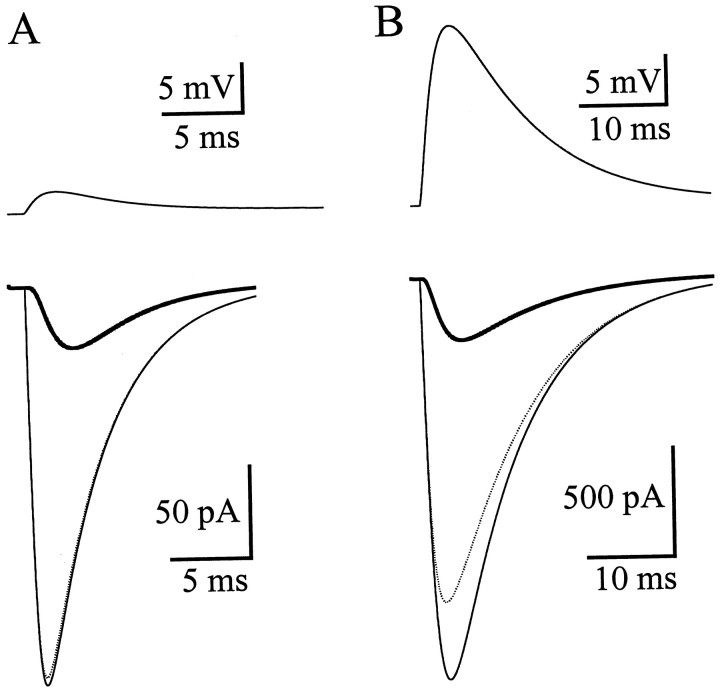
Simulation of somatic recordings of the Bergmann glia AMPA receptor responses. A, Simulated recordings under control conditions. Top, Membrane voltage at the synapse. Bottom, Current measured at the soma (thick line), flowing at the synapse (dotted line), and flowing at the synapse under perfect voltage clamp (thin line). B, Simulated recordings in the presence of CTZ. Top, Membrane voltage at the synapse. Bottom, Current measured at the soma (thick line), flowing at the synapse (dotted line), and flowing at the synapse under perfect voltage clamp (thin line).
Fig. 8.
Fig. 8.
Simulations of AMPA receptor responses to brief applications of glutamate. A, State diagram used to reproduce AMPA receptor kinetics. Rates were as follows [units are micromolar per millisecond (for ka) or per millisecond]: ka, 0.009; k−a, 16.0 (6.0 in cyclothiazide);k−1, 0.0025;k2, 5.0;k−2, 0.006 (0 in cyclothiazide); α, 1.3; β, 13.0. k1 was set to 2.08 (0 in cyclothiazide) to satisfy microscopic reversibility. B, Simulated responses to 10 msec pulses of glutamate at 0.1, 0.3, 1.0, 3.0, 10.0, and 30.0 mm. C, Simulated responses to 10 msec pulses of glutamate at the same concentrations as in B but with k−a set to 6 msec and k1 andk2 set to 0 to mimic the effects of cyclothiazide. D, Simulated dose–response curves superimposed on the data from Figure 5A.E, The amplitude ratio of the CTZ simulation over the control simulation plotted against concentration (solid line). The ratio of the logistic fits to the patch data given in Figure 5 is superimposed (dotted line).
Fig. 9.
Fig. 9.
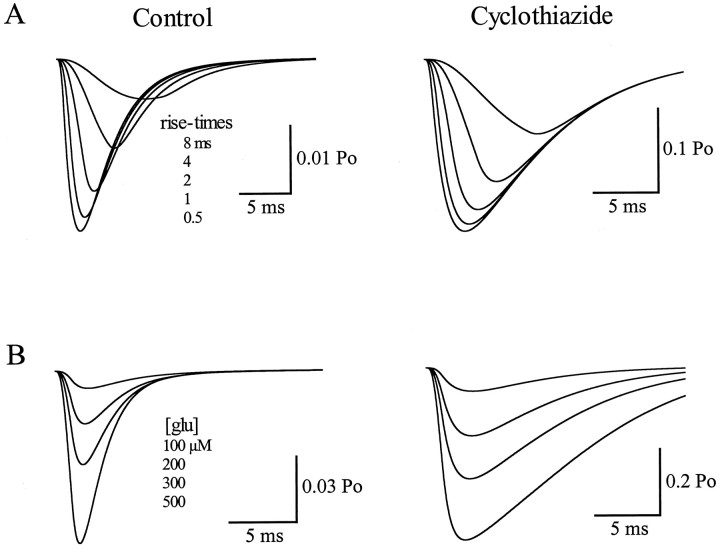
Simulated Bergmann glia responses to synaptically released glutamate. A, Synaptic simulations in control (k−a, 16.0 msec) and cyclothiazide (k−a, 6.0 msec;k1 and k2 set to 0) with rise time of the driving function (glutamate transient) set to 0.5, 1, 2, 4, and 8 msec. Decay time constant was set at 10 msec and peak concentration at 190 μm. B, Synaptic simulations in control and cyclothiazide as in A with the peak concentration set to 100, 200, 300, and 500 μm. Decay time constant was 10 msec, and the rise time was 1.2 msec.

References

    1. Asztely F, Erdemli G, Kullmann DM. Extrasynaptic glutamate spillover in the hippocampus: dependence on temperature and the role of active glutamate uptake. Neuron. 1997;18:281–293. - PubMed
    1. Atluri PP, Regehr WG. Determinants of the time course of facilitation at the granule cell to purkinje cell synapse. J Neurosci. 1996;16:5661–5671. - PMC - PubMed
    1. Barnes-Davies M, Forsythe ID. Pre- and postsynaptic glutamate receptors at a giant excitatory synapse in rat auditory brainstem slices. J Physiol (Lond) 1995;488:387–406. - PMC - PubMed
    1. Baude A, Molnar E, Latawiec D, McIlhinney RA, Somogyi P. Synaptic and nonsynaptic localization of the GluR1 subunit of the AMPA-type excitatory amino acid receptor in the rat cerebellum. J Neurosci. 1994;14:2830–2843. - PMC - PubMed
    1. Bergles DE, Jahr CE. Synaptic activation of glutamate transporters in hippocampal astrocytes. Neuron. 1997;19:1297–1308. - PubMed

Publication types

MeSH terms

LinkOut - more resources