


doi: 10.1073/pnas.96.13.7117.
Hominids and hybrids: the place of Neanderthals in human evolution
Affiliations
- PMID: 10377375
- PMCID: PMC33580
- DOI: 10.1073/pnas.96.13.7117
Item in Clipboard
Hominids and hybrids: the place of Neanderthals in human evolution
Proc Natl Acad Sci U S A.
.
No abstract available
Figures
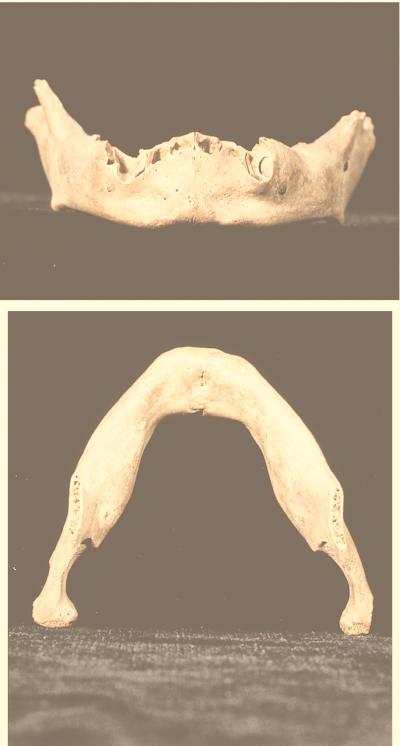
Mandible of recent 2–3 year old Homo
sapiens (American Museum of Natural History, uncatalogued)
illustrating the essential features of the symphyseal region.
(Upper) Anterior view showing the central keel, which
broadens at the mental tuberosity, fans out inferiorly, and terminates
bilaterally in blunt “corners.” (Lower) Inferior view
showing the marked thickness of the mandible in the symphyseal region
compared to the corpus behind it and the contribution of the marginal
attributes of the mental tuberosity to mandibular shape. Not to
scale.
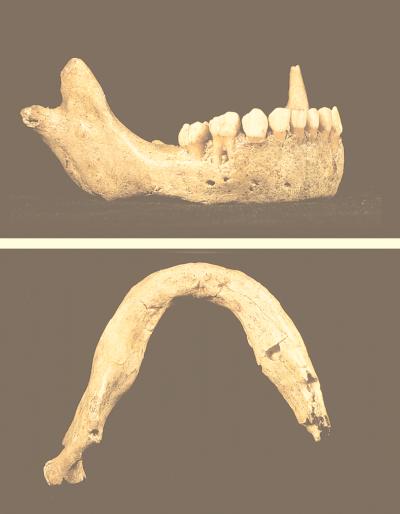
Mandible of 3–4 year old Neanderthal from Roc de
Marsal, France (Museé National de Prehistoire, Les Eyzies).
(Upper) Oblique view of essentially featureless front of
mandible, which is vertical yet also broad and somewhat arcuate from
side to side. (Lower) Inferior view illustrating how
uniformly thinner the symphyseal region is buccolingually compared to
the bone farther back along the corpus. Not to scale.
Comment on
-
The early Upper Paleolithic human skeleton from the Abrigo do Lagar Velho (Portugal) and modern human emergence in Iberia.Proc Natl Acad Sci U S A. 1999 Jun 22;96(13):7604-9. doi: 10.1073/pnas.96.13.7604. Proc Natl Acad Sci U S A. 1999. PMID: 10377462 Free PMC article.
References
-
- Stringer C, Gamble C. In Search of the Neanderthals: Solving the Puzzle of Human Origins. London: Thames and Hudson; 1993.
-
- Tattersall I. The Last Neanderthal: The Rise, Success, and Mysterious Extinction of Our Closest Human Relatives. New York: Macmillan; 1995.
-
- Trinkaus E, Shipman P. The Neanderthals: Changing the Image of Mankind. New York: Knopf; 1993.
-
- Stringer C. In: Current Issues in Human Evolution. Michael W, Howell C, Jablonski N, editors. San Francisco: California Acad. Sciences; 1996. pp. 114–134.
MeSH terms
LinkOut - more resources
Full Text Sources
