


MADS-box genes reveal that gnetophytes are more closely related to conifers than to flowering plants
- PMID: 10377416
- PMCID: PMC22087
- DOI: 10.1073/pnas.96.13.7342
MADS-box genes reveal that gnetophytes are more closely related to conifers than to flowering plants
Abstract
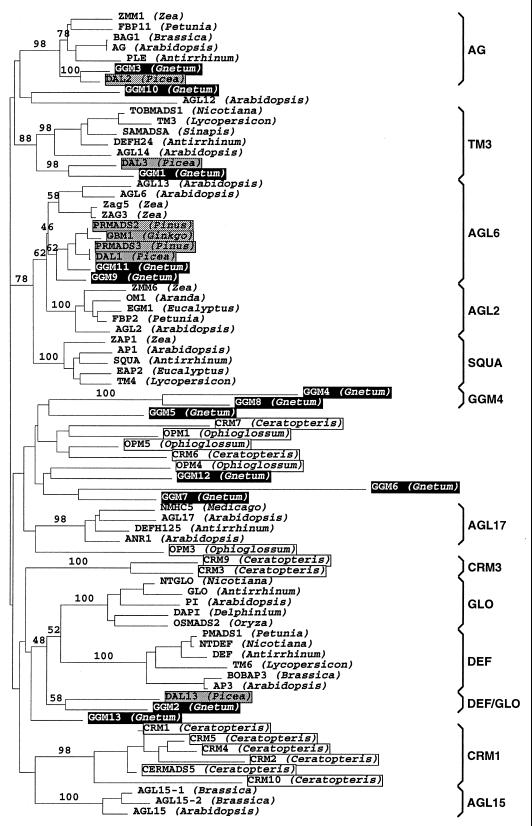
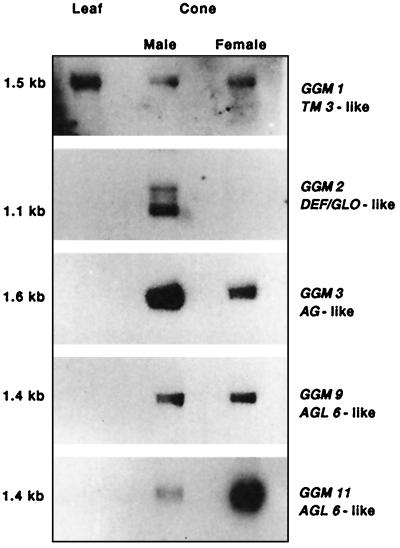
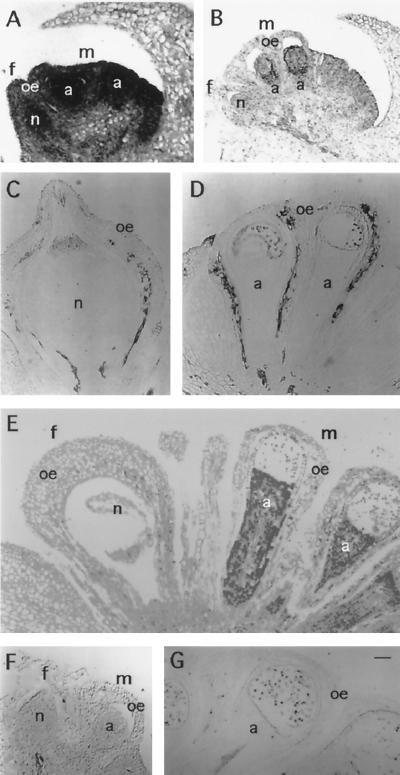
The evolutionary origin of the angiosperms (flowering plants sensu stricto) is still enigmatic. Answers to the question of angiosperm origins are intimately connected to the identification of their sister group among extinct and extant taxa. Most phylogenetic analyses based on morphological data agree that among the groups of extant seed plants, the gnetophytes are the sister group of the angiosperms. According to this view, angiosperms and gnetophytes are the only extant members of a clade called "anthophytes" to emphasize their shared possession of flower-like reproductive structures. However, most phylogeny reconstructions based on molecular data so far did not support an anthophyte clade, but also could not clarify the case because support for alternative groupings has been weak or controversial. We have isolated 13 different homologs of MADS-type floral homeotic genes from the gnetophyte Gnetum gnemon. Five of these genes fall into monophyletic gene clades also comprising putatively orthologous genes from flowering plants and conifers, among them orthologs of floral homeotic B and C function genes. Within these clades the Gnetum genes always form distinct subclades together with the respective conifer genes, to the exclusion of the angiosperm genes. This provides strong molecular evidence for a sister-group relationship between gnetophytes and conifers, which is in contradiction to widely accepted interpretations of morphological data for almost a century. Our phylogeny reconstructions and the outcome of expression studies suggest that complex features such as flower-like reproductive structures and double-fertilization arose independently in gnetophytes and angiosperms.
Figures
Comment in
-
MADS about Gnetales.Proc Natl Acad Sci U S A. 1999 Aug 3;96(16):8811-3. doi: 10.1073/pnas.96.16.8811. Proc Natl Acad Sci U S A. 1999. PMID: 10430847 Free PMC article. Review. No abstract available.
References
-
- Crane P R, Friis E M, Pedersen K R. Nature (London) 1995;374:27–33.
-
- Arber E A N, Parkin J. J Linn Soc Bot. 1907;38:29–80.
-
- Arber E A N, Parkin J. Ann Bot. 1908;22:489–515.
-
- Doyle, J. A. (1994) Plant Syst. Evol.8, Suppl., 7–29.
-
- Doyle J A. Int J Plant Sci. 1996;157, Suppl. 6:S3–S39.
Publication types
MeSH terms
Substances
Associated data
- Actions
- Actions
- Actions
- Actions
- Actions
- Actions
- Actions
- Actions
- Actions
- Actions
- Actions
- Actions
- Actions
LinkOut - more resources
Full Text Sources
