. 1999 Jun 22;96(13):7508-13.
doi: 10.1073/pnas.96.13.7508.

Murine gammaherpesvirus M2 gene is latency-associated and its protein a target for CD8(+) T lymphocytes

Affiliations

Murine gammaherpesvirus M2 gene is latency-associated and its protein a target for CD8(+) T lymphocytes

S M Husain et al. Proc Natl Acad Sci U S A. .

Abstract

Murine gammaherpesvirus 68 (MHV-68) infection of mice is a potential model with which to address fundamental aspects of the pathobiology and host control of gammaherpesvirus latency. Control of MHV-68 infection, like that of Epstein-Barr virus, is strongly dependent on the cellular immune system. However, the molecular biology of MHV-68 latency is largely undefined. A screen of the MHV-68 genome for potential latency-associated mRNAs revealed that the region encompassing and flanking the genomic terminal repeats is transcriptionally active in the latently infected murine B-cell tumor line S11. Transcription of one MHV-68 gene, that encoding the hypothetical M2 protein, was detected in virtually all latently infected S11 cells and in splenocytes of latently infected mice, but not in lytically infected fibroblasts. Furthermore, an epitope was identified in the predicted M2 protein that is recognized by CD8(+) T cells from infected mice and a cytotoxic T lymphocyte line that recognizes this epitope killed S11 cells, indicating that the M2 protein is expressed during latent infection and is a target for the host cytotoxic T lymphocyte response. This work therefore provides essential information for modeling MHV-68 latency and strategies of immunotherapy against gammaherpesvirus-related diseases in a highly tractable animal model.


Figures
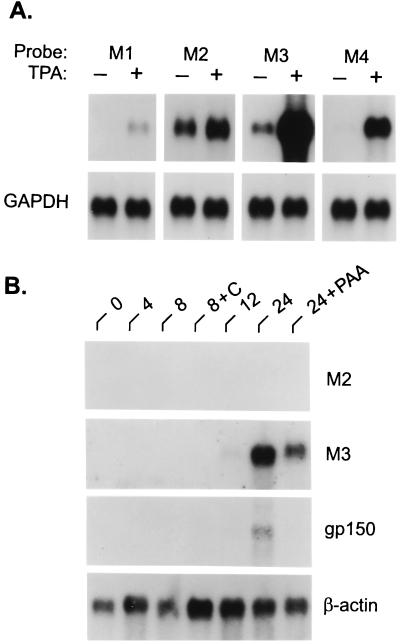
Figure 1
Figure 1
Expression of unique MHV-68 genes M1-M4 during latent and lytic infection. (A) Detection of M1, M2, M3, and M4 RNAs in S11 cells with gene-specific probes. Each RNA blot contained poly(A)+ RNA (2.5 μg per lane) from untreated (−) or TPA-treated (+) S11 cells; all transcripts detected were ≈1.4 kb. (B) Poly(A)+ RNA isolated from lytically infected BHK cells at time points up to 24 hr p.i. was analyzed by successive Northern blot hybridization for expression of the M2, M3, and gp150 genes; cells infected in the presence of cycloheximide (C) or phosphonoacetic acid (PAA) are indicated. All blots were stripped and rehybridized to a probe for either glyceraldehyde-3-phosphate dehydrogenase (GAPDH) or β-actin to control for differences in RNA loading.
Figure 2
Figure 2
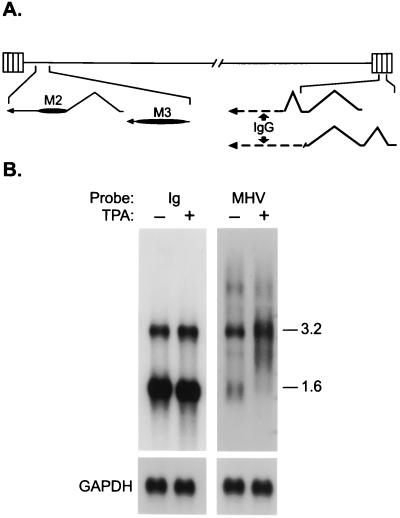
Characterization of potential MHV-68 latency-associated transcripts. (A) Structures of transcripts as determined by cDNA nucleotide sequence relative to genomic sequence. Genomic coordinates, presented 5′ to 3′ with respect to the mRNA, are according to Virgin et al. (20): M2 mRNA, 5924–5815 (exon 1); 4609–3375 (exon 2); M3 mRNA, 7291–6007. Two cDNAs derived from MHV-68/IgG fusion transcripts contained one complete and one partial copy each of a 91-nt exon (118, 695–118, 605) encoded within each TR; the longer cDNA (lower-most structure) also contained a 179-nt exon (119, 373–119,195) derived from a TR and was fused directly to mouse IgG-2A heavy chain via an incomplete copy of the 91-nt exon, whereas in the shorter cDNA a complete copy of the 91-nt exon was spliced to an IgG-2A exon. All cDNAs contained a poly(A) tract at their 3′ end. (B) Northern blot analysis of poly(A)+ RNA from S11 cells by using Ig- and MHV-specific probes derived from the fusion cDNAs.
Figure 3
Figure 3
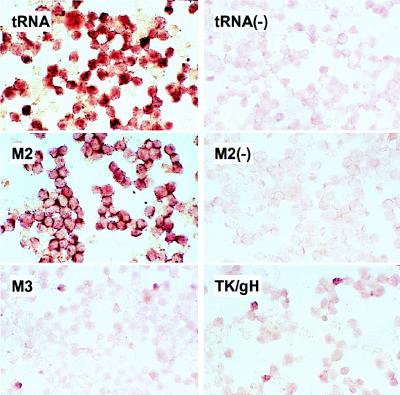
The M2 gene, but not M3, is expressed in virtually all latently infected cells in vitro. S11 cells were hybridized in situ to digoxygenin-labeled antisense RNA probes specific for MHV-68 tRNAs 1–4, M2, M3, and dually for the lytic cycle genes thymidine kinase (TK) and glycoprotein H (gH); hybridizations with sense tRNA and M2 probes were included as negative controls (−).
Figure 4
Figure 4
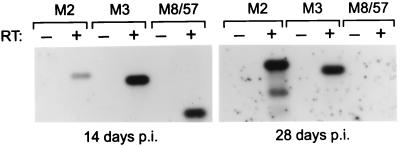
M2 and M3 mRNAs are expressed in splenocytes of latently infected mice. RNA isolated from spleens of infected BALB/c mice at 14 and 28 days p.i. was subjected to RT-PCR followed by Southern blot hybridization to detect expression of the MHV-68 M2, M3, and M8/57 mRNAs. After the initial 30 cycles of amplification of cDNA generated from the RNA isolated at 28 days p.i., the PCR product was diluted 50-fold and reamplified to confirm that expression of the M8/57 lytic cycle-specific mRNA was undetectable. Product sizes are 650 bp (M2), 589 bp (M3), and 340 bp (M8/57); the respective sizes of the M2 and M3 fragments from 14 and 28 days p.i. samples are identical.
Figure 5
Figure 5
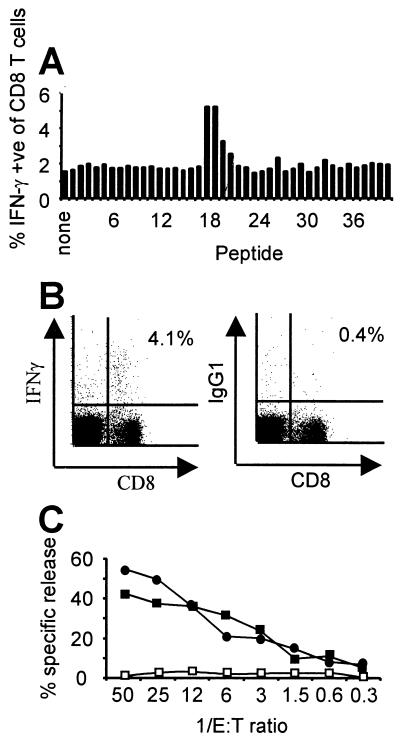
The M2 protein contains an epitope recognized by CD8+ T cells. (A) Each 15-aa peptide from a panel of overlapping peptides encompassing the entire M2 protein was incubated with pooled splenocytes harvested from two BALB/c mice 18 days p.i. The percentage of CD8+ T cells producing IFN-γ in response to each peptide was measured by flow cytometry. Data are representative of two independent experiments. Phorbol 12-myristate 13-acetate plus ionomycin stimulation resulted in production of IFN-γ by 47% of CD8+ T cells (not shown). (B) IFN-γ production by splenocytes from a BALB/c mouse (representative of three mice tested) at 18 days p.i. in response to the 9-mer peptide GFNKLRSTL (M291–99) that is present within peptides 18–20 in A; staining with an isotype-matched control antibody is also shown (Right). Splenocytes from uninfected mice did not respond to M291–99 (not shown). (C) A CD8+ CTL line kills S11 cells (●) and BALB/c 3T3 cells pulsed with M291–99 (■), but not unpulsed 3T3 cells (□). Results are from a standard 5-hr 51Cr-release assay (32) at various effector to target (E:T) ratios and are representative of six independent experiments.

References

    1. Rickinson A B, Kieff E. In: Fields Virology. Fields B N, Knipe D M, Howley P M, editors. New York: Lippincott; 1996. pp. 2397–2446.
    1. Ganem D. Cell. 1997;91:157–160. - PubMed
    1. Boshoff C, Weiss R A. In: Advances in Cancer Research. Vande Woude G F, Klein G, editors. London: Academic; 1998. pp. 57–86. - PubMed
    1. Kieff E. In: Fields Virology. Fields B N, Knipe D M, Howley P M, editors. New York: Lippincott; 1996. pp. 2343–2396.
    1. Tierney R J, Steven N, Young L S, Rickinson A B. J Virol. 1994;68:7374–7385. - PMC - PubMed

Publication types

MeSH terms

Substances