


The early Upper Paleolithic human skeleton from the Abrigo do Lagar Velho (Portugal) and modern human emergence in Iberia
- PMID: 10377462
- PMCID: PMC22133
- DOI: 10.1073/pnas.96.13.7604
The early Upper Paleolithic human skeleton from the Abrigo do Lagar Velho (Portugal) and modern human emergence in Iberia
Abstract
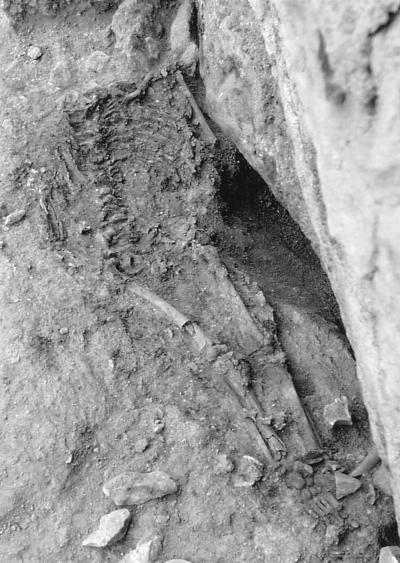
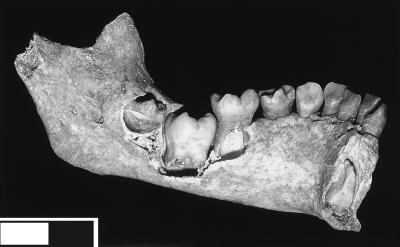
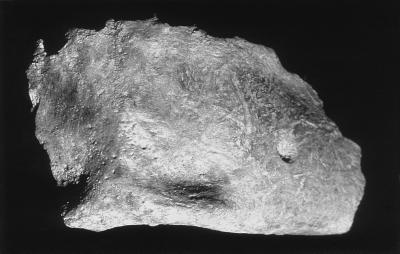
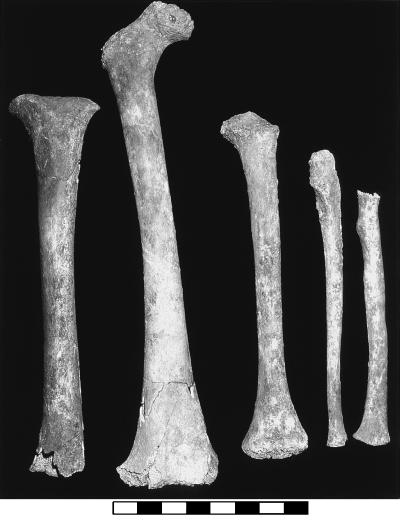
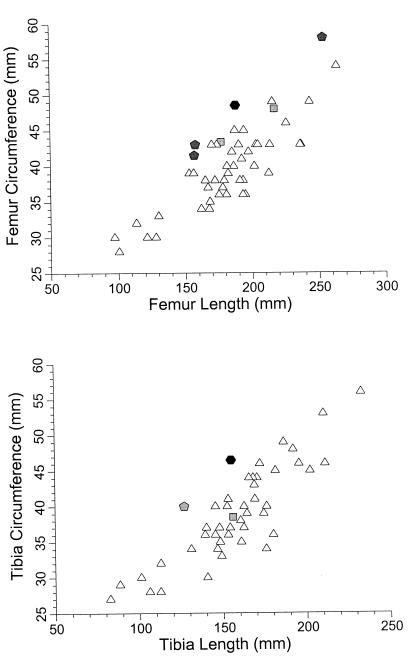
The discovery of an early Upper Paleolithic human burial at the Abrigo do Lagar Velho, Portugal, has provided evidence of early modern humans from southern Iberia. The remains, the largely complete skeleton of a approximately 4-year-old child buried with pierced shell and red ochre, is dated to ca. 24,500 years B.P. The cranium, mandible, dentition, and postcrania present a mosaic of European early modern human and Neandertal features. The temporal bone has an intermediate-sized juxtamastoid eminence. The mandibular mentum osseum and the dental size and proportions, supported by mandibular ramal features, radial tuberosity orientation, and diaphyseal curvature, as well as the pubic proportions align the skeleton with early modern humans. Body proportions, reflected in femorotibial lengths and diaphyseal robusticity plus tibial condylar displacement, as well as mandibular symphyseal retreat and thoracohumeral muscle insertions, align the skeleton with the Neandertals. This morphological mosaic indicates admixture between regional Neandertals and early modern humans dispersing into southern Iberia. It establishes the complexities of the Late Pleistocene emergence of modern humans and refutes strict replacement models of modern human origins.
Figures
Comment in
-
Hominids and hybrids: the place of Neanderthals in human evolution.Proc Natl Acad Sci U S A. 1999 Jun 22;96(13):7117-9. doi: 10.1073/pnas.96.13.7117. Proc Natl Acad Sci U S A. 1999. PMID: 10377375 Free PMC article. No abstract available.
References
-
- Vega Toscano L G. Mem Mus Prehist Ile France. 1990;3:169–176.
-
- Villaverde V, Fumanal M P. Mem Mus Prehist Ile France. 1990;3:177–183.
-
- Zilhão J. In: El Origen del Hombre Moderno en el Suroeste de Europa. Cabrera V, editor. Madrid: Univ. Nacl. Educ. Distancia; 1993. pp. 127–145.
-
- Hublin J J, Barroso Ruiz C, Lara P M, Fontugne M, Reyss J L. C R Acad Sci Ser II. 1995;321:931–937.
-
- Garcia Sanchez M. Homenaje a Luis Siret. Granada, Spain: Consejeria Cult. Junta Andalucia; 1986. pp. 49–56.
MeSH terms
LinkOut - more resources
Full Text Sources
