


Acute diarrhea: a practical review
- PMID: 10378626
- PMCID: PMC7124219
- DOI: 10.1016/s0002-9343(99)00128-x
Acute diarrhea: a practical review
Abstract
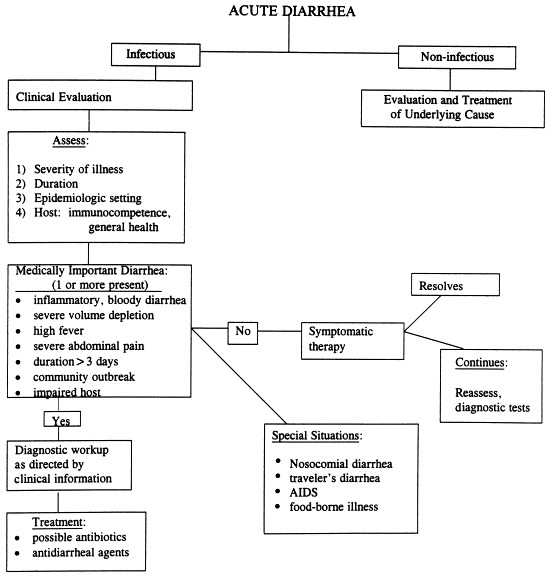
This review provides a practical, simple, and logical approach to the diagnosis and management of patients with acute infectious diarrhea, one of the most common diagnoses in clinical practice. Diarrhea in the immunocompromised host, traveler's diarrhea, and diarrhea in the hospitalized patient are also discussed. Most episodes of acute diarrhea are self-limited, and investigations should be performed only if the results will influence management and outcome. After an adequate history and physical examination, the clinician should be able to classify the acute diarrheal illness, assess the severity, and determine whether investigations are needed. Most patients do not require specific therapy. Therapy should mainly be directed at preventing dehydration. Various home remedies frequently suffice in mild, self-limited diarrhea. However, in large-volume, dehydrating diarrhea, oral rehydration solutions should be used, as they are formulated to stimulate sodium and water absorption. Antidiarrheal agents can be useful in reducing the number of bowel movements and diminishing the magnitude of fluid loss. The most useful agents are opiate derivatives and bismuth subsalicylate. Antibiotic therapy is not required in most patients with acute diarrheal disorders. Guidelines for their use are presented.
Figures
References
-
- Fine K.D, Krejs G.J, Fordtran J.S. Diarrhea. In: Sleisenger M.H, Fordtran J.S, editors. Gastrointestinal Disease: Pathophysiology, Diagnosis, Management. 6th ed. WB Saunders; Philadelphia: 1998. pp. 1043–1072.
-
- Powell D.W. Approach to the patient with diarrhea. In: Yamada T, Alpers D.H, Owyang C, Powell D.W, Silverstein F.E, editors. Textbook of Gastroenterology. 2nd ed. JB Lippincott; Philadelphia: 1995. pp. 813–831.
-
- Prado V, O’Ryan M.L. Acute gastroenteritis in Latin America. Infect Dis Clin of North Am. 1994;8:77–106. - PubMed
-
- DuPont H.L. Diarrheal diseases in the developing world. Infect Dis Clin of North Am. 1995;9:313–324. - PubMed
Publication types
MeSH terms
LinkOut - more resources
Full Text Sources
Other Literature Sources
Medical
