


Neuropeptide Y is a prejunctional inhibitor of vagal but not sympathetic inotropic responses in guinea-pig isolated left atria
- PMID: 10385237
- PMCID: PMC1566037
- DOI: 10.1038/sj.bjp.0702565
Neuropeptide Y is a prejunctional inhibitor of vagal but not sympathetic inotropic responses in guinea-pig isolated left atria
Abstract
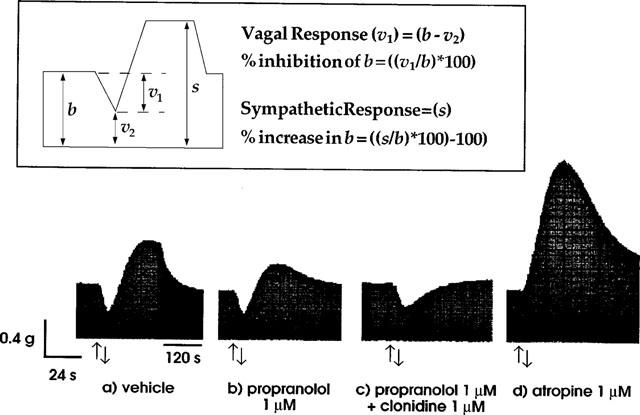
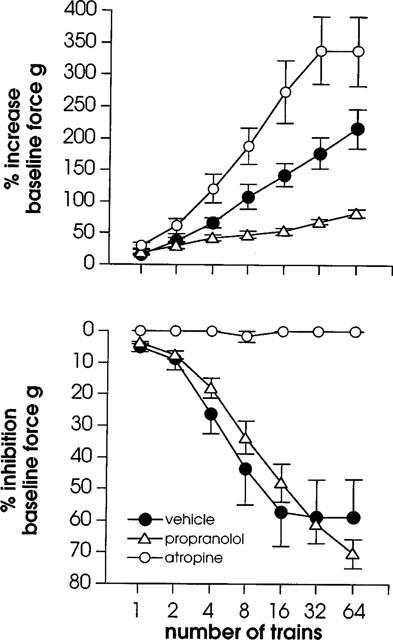
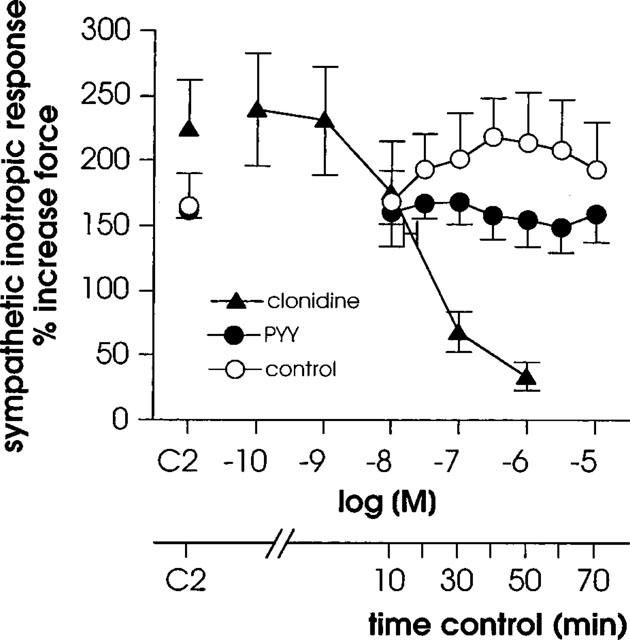
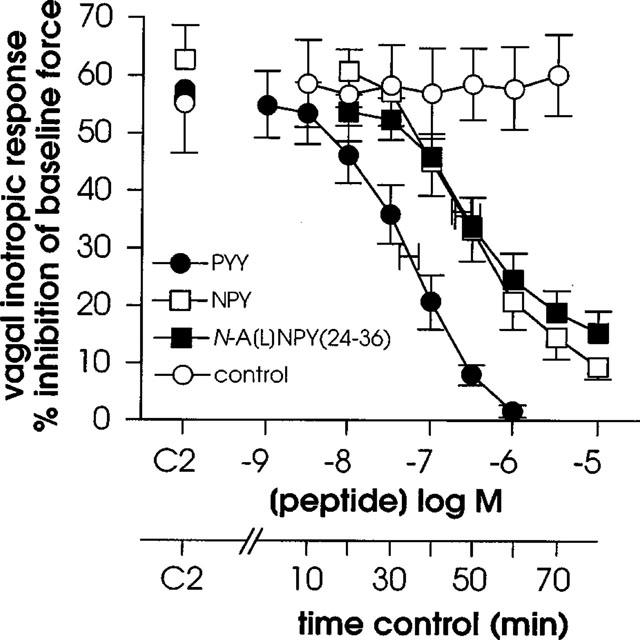
1. The effects of NPY and related peptides were examined on basal contractile force and nerve-mediated inotropic responses to electrical field stimulation of the guinea-pig isolated left atrium. 2. Electrical field stimulus (EFS)-inotropic response curves were constructed by applying 1-64 trains of four field pulses (200 Hz, 0.1 ms duration, 100 V) across isolated left atria (paced at 4 Hz, 2 ms, 1-4 V) within the atrial refractory period. Curves were constructed in presence of vehicle, propranolol (1 microM) or atropine (1 microM) to determine appropriate stimulus conditions. 3. The effects of PYY (1-10,000 nM), NPY (0.01-10 microM), N-Ac-[Leu28,31]NPY(24-36) (N-A[L]NPY(24-36); 0.01-10 microM) and clonidine (0.1-1000 nM) were examined on the positive and negative inotropic responses to EFS (eight trains, four pulses per refractory period). 4. NPY-related peptides had no effect on basal force of contraction nor on the inotropic concentration-response curves to bethanechol or isoprenaline. All three peptides inhibited vagally-mediated negative inotropic responses; rank order of potency PYY>NPY> or =N-A[L]NPY(24-36) was consistent with an action at prejunctional Y2-receptors. Clonidine concentration-dependently inhibited sympathetic inotropic responses. However, PYY, NPY and N-A[L]NPY(24-36) failed to mediate any significant inhibition of the positive inotropic response to EFS. 5. These data demonstrate that NPY is an effective inhibitor of vagal but not sympathetically-mediated inotropic responses in the guinea-pig isolated left atria. This may suggest that endogenously co-released NPY is important in mediating cross talk between efferent components of the autonomic nervous system modulating cardiac contractility, acting overall to sustain positive inotropic responses.
Figures
References
-
- ALLEN J.M., BIRCHAM P.M.M., EDWARDS A.V., TATEMOTO K., BLOOM S.R. Neuropeptide Y (NPY) reduces myocardial perfusion and inhibits the force of contraction of the isolated perfused rabbit heart. Regulatory Peptides. 1983;6:247–253. - PubMed
-
- ALLEN J.M., GJORSTRUP P., BJORKMAN J.A., EK L., ABRAHAMSSON T., BLOOM S.R. Studies on cardiac distribution and function of neuropeptide Y. Acta Physiol. Scand. 1986;126:405–411. - PubMed
-
- AMERINI S., RUBINO A., FILIPPI S., LEDDA F., MANTELLI L. Modulation by adrenergic transmitters of the efferent function of capsaicin-sensitive nerves in cardiac tissue. Neuropeptides. 1991;20:225–232. - PubMed
-
- ANGUS J.A., HARVEY K. Refractory period field stimulation of right atria: A method for studying presynaptic receptors in cardiac autonomic transmission. J. Pharmacol. Meth. 1981;6:51–64. - PubMed
Publication types
MeSH terms
Substances
LinkOut - more resources
Full Text Sources
Medical
Miscellaneous
