Respiratory action of capsaicin microinjected into the nucleus of the solitary tract: involvement of vanilloid and tachykinin receptors
- PMID: 10385248
- PMCID: PMC1566015
- DOI: 10.1038/sj.bjp.0702522
Respiratory action of capsaicin microinjected into the nucleus of the solitary tract: involvement of vanilloid and tachykinin receptors
Abstract
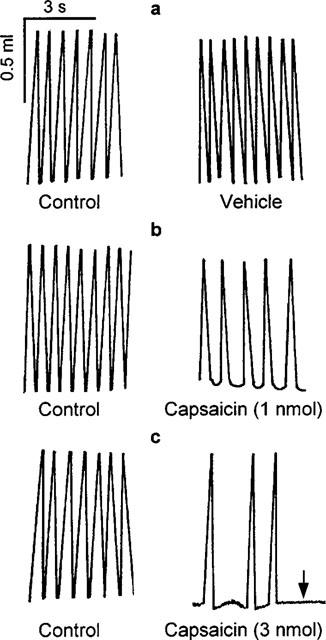
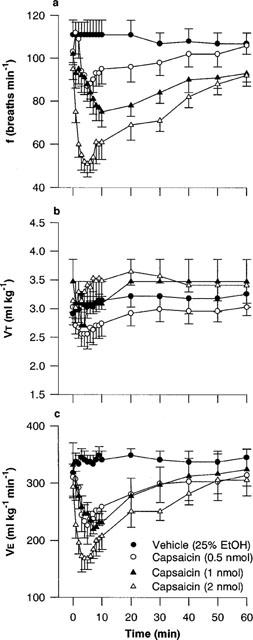
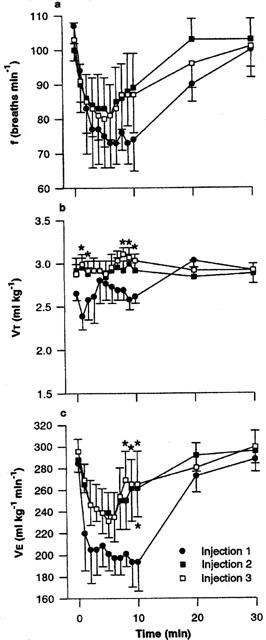
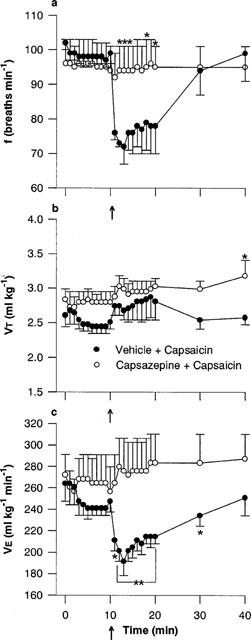
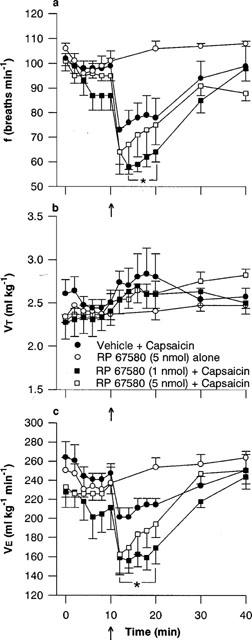
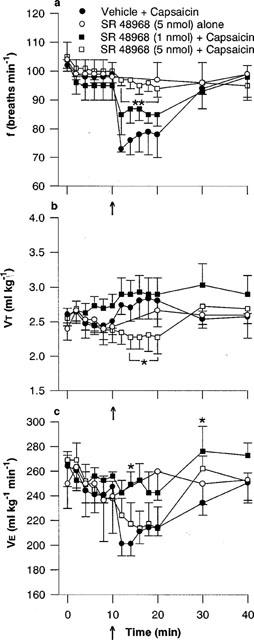
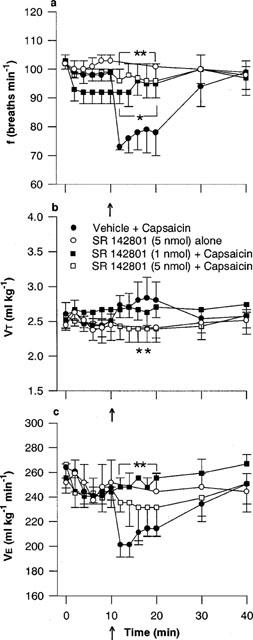
1. The respiratory response to microinjection of capsaicin into the commissural nucleus of the solitary tract (cNTS) of urethane-anaesthetized rats was investigated in the absence and presence of the competitive vanilloid (capsaicin) antagonist, capsazepine, and selective tachykinin NK1, NK2 and NK3 antagonists (RP 67580, SR 48968 and SR 142801, respectively). 2. Microinjection of capsaicin reduced respiratory frequency but not tidal volume (VT), leading to an overall reduction in minute ventilation (VE). The effect was dose-dependent between 0.5 and 2 nmol capsaicin. Doses greater than 2 nmol produced apnoea. Tachyphylaxis was observed following repeated injection of capsaicin (1 nmol, 30 min apart). 3. Capsazepine (1 nmol) had no effect on frequency or VT when injected alone but completely blocked the respiratory response to capsaicin (1 nmol). 4. RP 67580 (1 but not 5 nmol) alone depressed frequency and VT slightly. Moreover, RP 67580 appeared to potentiate the bradypnoeic effect of capsaicin. In contrast, SR 48968 and SR 142801 (1 and 5 nmol) alone had no significant effect on respiration. However, both agents significantly attenuated the reduction in frequency produced by capsaicin. 5. In conclusion, microinjection of capsaicin into the cNTS decreases overall ventilation, primarily by reducing frequency. The action of capsaicin appears from the data to be mediated by vanilloid receptors since it is blocked by the competitive vanilloid antagonist capsazepine and is subject to tachyphylaxis. However, since NK2 (SR 48968) and NK3 (SR 142801) receptor antagonists block the actions of capsaicin, we propose that capsaicin acts also by releasing tachykinins from central afferent terminals in the cNTS.
Figures
References
-
- ACS G., PALKOVITS M., BLUMBERG P.M. [3H]-Resiniferatoxin binding by the human vanilloid (capsaicin) receptor. Mol. Brain Res. 1994;23:185–190. - PubMed
-
- BEVAN S., SZOLCSANYI J. Sensory neuron-specific actions of capsaicin: mechanisms and applications. TIPS. 1990;11:330–333. - PubMed
-
- BUTCHER J.W., DE FELIPE C., SMITH A.J.H., HUNT S.P., PATON J.F.R. Comparison of cardiorespiratory reflexes in NK1 receptor knockout, heterozygous and wild-type mice in vivo. J. Autonom. Nerv. Sys. 1998;69:89–95. - PubMed
-
- CATERINA M.J., SCHUMACHER M.A., TOMINAGA M., ROSEN T.A., LEVINE J.D., JULIUS D. The capsaicin receptor: a heat-activated ion channel in the pain pathway. Nature. 1997;389:816–824. - PubMed
Publication types
MeSH terms
Substances
LinkOut - more resources
Full Text Sources
Research Materials