


The agricultural pathology of ant fungus gardens
- PMID: 10393936
- PMCID: PMC22176
- DOI: 10.1073/pnas.96.14.7998
The agricultural pathology of ant fungus gardens
Abstract
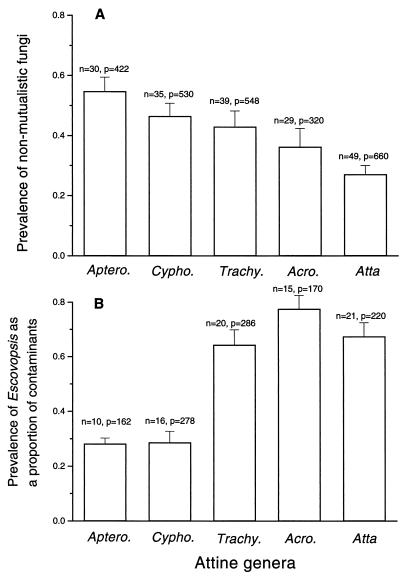
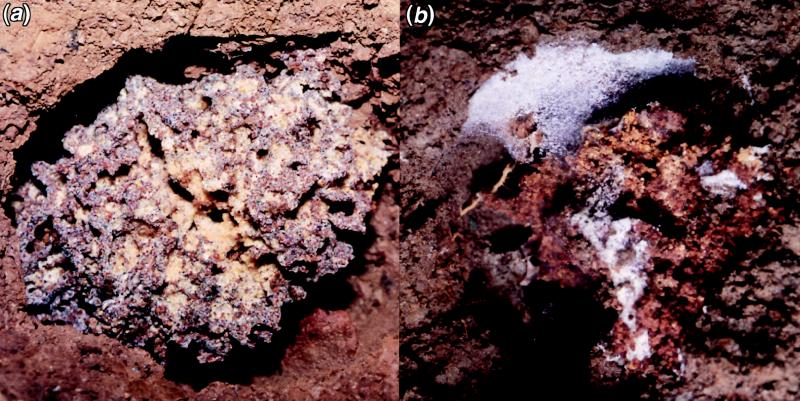
Gardens of fungus-growing ants (Formicidae: Attini) traditionally have been thought to be free of microbial parasites, with the fungal mutualist maintained in nearly pure "monocultures." We conducted extensive isolations of "alien" (nonmutualistic) fungi from ant gardens of a phylogenetically representative collection of attine ants. Contrary to the long-standing assumption that gardens are maintained free of microbial pathogens and parasites, they are in fact host to specialized parasites that are only known from attine gardens and that are found in most attine nests. These specialized garden parasites, belonging to the microfungus genus Escovopsis (Ascomycota: anamorphic Hypocreales), are horizontally transmitted between colonies. Consistent with theory of virulence evolution under this mode of pathogen transmission, Escovopsis is highly virulent and has the potential for rapid devastation of ant gardens, leading to colony mortality. The specialized parasite Escovopsis is more prevalent in gardens of the more derived ant lineages than in gardens of the more "primitive" (basal) ant lineages. Because fungal cultivars of derived attine lineages are asexual clones of apparently ancient origin whereas cultivars of primitive ant lineages were domesticated relatively recently from free-living sexual stocks, the increased virulence of pathogens associated with ancient asexual cultivars suggests an evolutionary cost to cultivar clonality, perhaps resulting from slower evolutionary rates of cultivars in the coevolutionary race with their pathogens.
Figures
References
-
- Wilson E O. The Insect Societies. Cambridge, MA: Belknap; 1971.
-
- Schultz T R, Meier R A. Syst Entomol. 1995;20:337–370.
-
- Wetterer J K, Schultz T R, Meier R. Mol Phylogenet Evol. 1998;9:42–47. - PubMed
-
- Chapela I H, Rehner S A, Schultz T R, Mueller U G. Science. 1994;266:1691–1694. - PubMed
-
- Mueller U G, Rehner S A, Schultz T R. Science. 1998;281:2034–2038. - PubMed
LinkOut - more resources
Full Text Sources
