. 1999 Aug;73(8):6282-92.
doi: 10.1128/JVI.73.8.6282-6292.1999.

The gag domains required for avian retroviral RNA encapsidation determined by using two independent assays

Affiliations

The gag domains required for avian retroviral RNA encapsidation determined by using two independent assays

E g Lee et al. J Virol. 1999 Aug.

Abstract

The Rous sarcoma virus (RSV) Gag precursor polyprotein is the only viral protein which is necessary for specific packaging of genomic RNA. To map domains within Gag which are important for packaging, we constructed a series of Gag mutations in conjunction with a protease (PR) active-site point mutation in a full-length viral construct. We found that deletion of either the matrix (MA), the capsid (CA), or the protease (PR) domain did not abrogate packaging, although the MA domain is likely to be required for proper assembly. A previously characterized deletion of both Cys-His motifs in RSV nucleocapsid protein (NC) reduced both the efficiency of particle release and specific RNA packaging by 6- to 10-fold, consistent with previous observations that the NC Cys-His motifs played a role in assembly and RNA packaging. Most strikingly, when amino acid changes at Arg 549 and 551 immediately downstream of the distal NC Cys-His box were made, RNA packaging was reduced by more than 25-fold with no defect in particle release, demonstrating the importance of this basic amino acid region in packaging. We also used the yeast three-hybrid system to study avian retroviral RNA-Gag interactions. Using this assay, we found that the interactions of the minimal packaging region (Mpsi) with Gag are of high affinity and specificity. Using a number of Mpsi and Gag mutants, we have found a clear correlation between a reporter gene activation in a yeast three-hybrid binding system and an in vivo packaging assay. Our results showed that the binding assay provides a rapid genetic assay of both RNA and protein components for specific encapsidation.


Figures
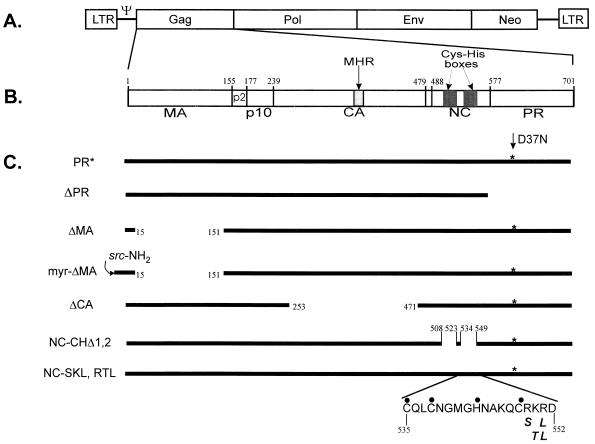
FIG. 1
FIG. 1
(A) Diagram of the RSV genome containing the selectable marker neo in the place of the src gene. LTR, long terminal repeat; Gag, viral structural protein; Pol, polymerase protein containing reverse transcriptase and integrase; Env, envelope protein. (B) Details of the Gag polyprotein. Amino acid numbering is from the amino terminus of Gag. (C) Gag constructs used to determine domains required for the specific viral RNA packaging into virions. End parts of the deletions are indicated by breaks flanked by amino acid numbers. PR* is a Gag polyprotein carrying an active-site mutation, D37N (indicated by asterisks), in the protease domain, which abolishes protease activity. In myr-ΔMA, the sequence encoded by the first 10 codons of p60v-src comprising a myristylation signal (64) were added to the N terminus of a Gag polyprotein lacking MA. Amino acids comprising the second Cys-His box in the NC domain are indicated by dots. The locations of the mutated residues in NC-SKL and RTL are indicated below the amino acid sequence, in italics.
FIG. 2
FIG. 2
Viral particle release of Gag mutants. (A) RIPA analysis of the expression of Gag polyproteins in transfected cells. Lysates from G418 mass culture of QT6 cells transfected with the mutant plasmids described in Fig. 1 were immunoprecipitated with anti-p10 antisera and electrophoresed on SDS-polyacrylamide gels, as described in Materials and Methods. The specific Gag polyproteins of the expected sizes are indicated by the asterisks. Abbreviations are same as in Fig. 1; untransf., untransfected cells. Two separate ΔMA transfectants are shown. (B) RIPA analysis of pelleted virus-like particles collected from supernatants. (C) Relative efficiency of particle release. The number of PhosphorImager machine units counted for each Gag band detected in the media was divided by the number obtained for the respective Gag band detected in the cells. These ratio were then normalized to the ratio obtained for the intact full-length Gag polyprotein by correcting for the number of methionines in the respective Gag mutants to give a relative efficiency of particle release. Each experiment was done four or five times, and the bars show the standard deviations.
FIG. 3
FIG. 3
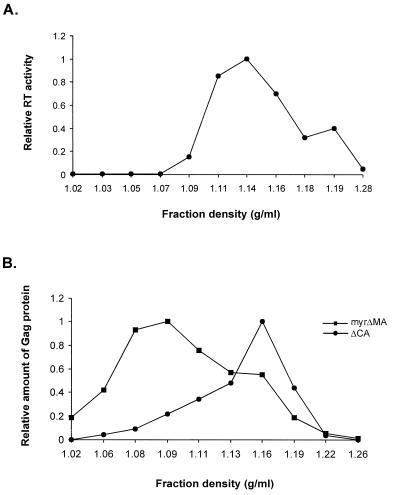
Viral particle density analysis. (A) Viral particles obtained from stably transfected QT6 cells with wt RSV proviral DNAs were fractionated through 10 to 40% iodixanol gradients. Eleven fractions were collected, and the density of each fraction was measured on a refractometer. RT assays of each fraction were performed, as described in Materials and Methods. (B) QT6 cells transfected with mutant plasmid DNAs were labeled with [35S]methionine, and viral pellets were centrifuged in 10 to 40% iodixanol gradients. Ten fractions were collected, and the density of each fraction was measured on a refractometer. The labeled Gag proteins in each fraction were immunoprecipitated and electrophoresed on SDS-polyacrylamide gels, as described in Materials and Methods. The relative amount of Gag proteins in each fraction were quantitated by using ImageQuant software.
FIG. 4
FIG. 4
RNA packaging of Gag mutants. (A) RPA to measure RNA packaging. The probe used was an antisense neo RNA. The sample in lane 1 contained probe RNA with no RNase added. Abbreviations are same as in Fig. 1. (B) Ratio of viral to cellular RNA. The unit numbers from PhosphorImager analysis were obtained. The numbers for the packaged neo-specific RNA in virions were divided by those in the cells. The relative packaged viral RNAs of Gag mutants were normalized to PR*. The standard deviations are indicated by bars. (C) Relative packaging efficiencies of Gag mutants normalized to PR*. Packaging efficiency was calculated as the ratio of relative amount of neo-specific RNA packaged in particles, as measured by RPA (Fig. 4B), to the relative number of particles, as measured by RIPA (Fig. 2C). The standard deviations are indicated by bars.
FIG. 5
FIG. 5
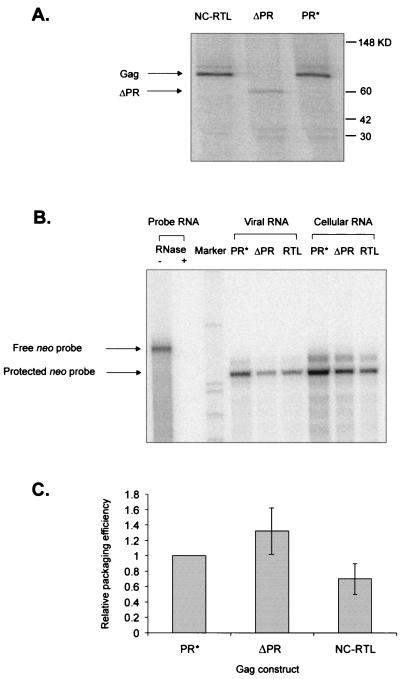
Viral packaging by NC-RTL and ΔPR mutants. (A) RIPA to determine the number of viral particles released from cultures transfected with the indicated Gag mutant vectors. The bands of Gag polyproteins of the expected size are indicated by arrows. (B) RPA to determine the amount of neo-specific RNA expressed in the stably transfected cells and in viral particles. The samples in probe RNA had no viral RNA added. (C) Relative packaging efficiencies of ΔPR and NC-RTL mutants normalized to PR*. Packaging efficiency was calculated as the ratio of relative amount of neo-specific RNA packaged in particles, as measured by RPA (panel B), to the relative number of particles, as measured by RIPA (panel A). Each experiment was done three to five times, and the standard deviations are indicated by bars.
FIG. 6
FIG. 6
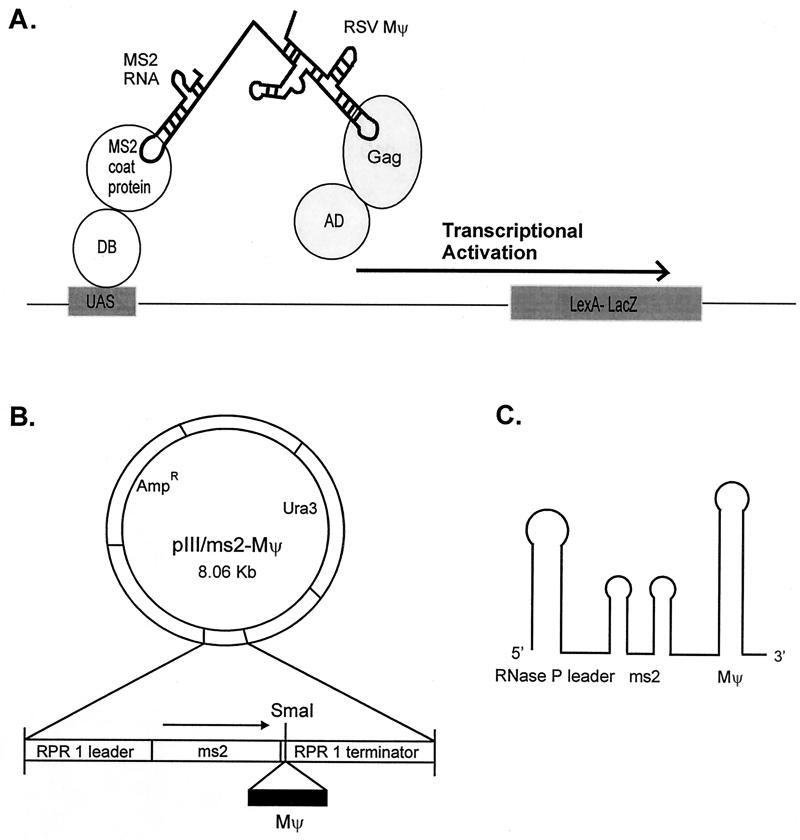
(A) Schematic diagram of a yeast three-hybrid system. The specific binding of MS2-RSV Mψ RNA to the Gag polyprotein would reconstitute the activity of transcriptional activator and lead to the expression of a reporter gene, lacZ. DB, DNA binding domain of LexA; AD, activation domain of Gal4; UAS, binding site for the transcriptional activator upstream of the reporter gene. (B) Diagram of the RNA hybrid expression vector. The RSV Mψ was introduced into the SmaI site downstream of two copies of the MS2 RNA coat protein binding sequence. MS2-Mψ hybrid RNAs were expressed from an RNase P promoter by using RNA polymerase III in S. cerevisiae. Thus, RNA hybrid contains both 5′ RNase P RNA leader and 3′ terminator sequences. Ura3 is a selectable gene. (C) Schematic structure of the hybrid RNA. It retains the 5′ MS2 stem-loop structure(s) and the 3′ end of RNase P RNA.
FIG. 7
FIG. 7
Putative secondary structure of minimal-packaging RNA in avian leukosis virus (RSV Mψ) (7). The location of the O3 stem is shown as S1 and S2. Nucleotides substituted for each Mψ mutations are shown as white nucleotides in black boxes in the appropriate regions of Mψ RNA. In the XbaMΨ mutant, GGGG was replaced by UCUAGA; in the c12 MΨ mutant, CUGCG was replaced by GAUUC; in the EcoRIMΨ mutant, GGGGG was replaced by GAAUUC.
FIG. 8
FIG. 8
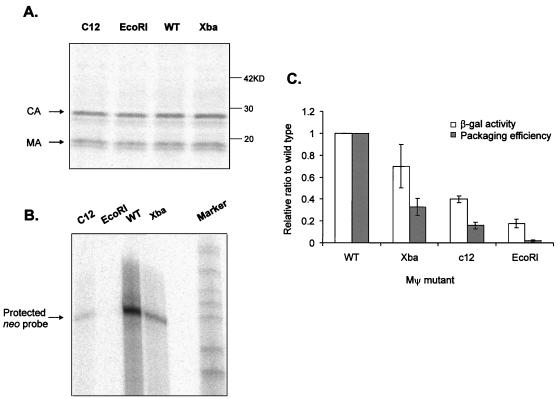
Effects of Mψ mutations on RNA packaging. (A) RIPA to determine the number of viral particles released from cultures transfected with indicated plasmids. (B) RPA to measure the amount of neo-specific RNA packaged in virions. (C) Comparison of the β-gal activity measured in the yeast three-hybrid system and the packaging efficiency determined in vivo. The packaging efficiency was calculated as the ratio of the relative amount of neo-specific RNA packaged in particles, as measured by RPA (Fig. 8B), to the relative number of particles, as measured by RIPA (Fig. 8A). Both packaging efficiencies and β-gal activities were normalized to PR*. Each experiment was done three or four times, and the bars show the standard deviations.

References

    1. Aldovini A, Young R A. Mutations of RNA and protein sequences involved in human immunodeficiency virus type 1 packaging results in production of noninfectious virus. J Virol. 1990;64:1920–1926. - PMC - PubMed
    1. Allen P, Collins B, Brown D, Hostomsky Z, Gold L. A specific RNA structural motif mediates high affinity binding by the HIV-1 nucleocapsid protein (NCp7) Virology. 1996;225:306–315. - PubMed
    1. Anderson D J, Stone J, Lum R, Linial M L. The packaging phenotype of SE21Q1b provirus is related to high proviral expression and not trans-acting factors. J Virol. 1995;69:7319–7323. - PMC - PubMed
    1. Aronoff R, Hajjar A M, Linial M L. Avian retroviral RNA encapsidation: reexamination of functional 5′ RNA sequences and the role of nucleocapsid Cys-His motifs. J Virol. 1993;67:178–188. - PMC - PubMed
    1. Aronoff R, Linial M L. Specificity of retroviral RNA packaging. J Virol. 1991;65:71–80. - PMC - PubMed

Publication types