. 1999 Aug;73(8):6387-93.
doi: 10.1128/JVI.73.8.6387-6393.1999.

Proteolytic activity, the carboxy terminus of Gag, and the primer binding site are not required for Pol incorporation into foamy virus particles

Affiliations

Proteolytic activity, the carboxy terminus of Gag, and the primer binding site are not required for Pol incorporation into foamy virus particles

D N Baldwin et al. J Virol. 1999 Aug.

Abstract

Human foamy virus (HFV) is the prototype member of the spumaviruses. While similar in genomic organization to other complex retroviruses, foamy viruses share several features with their more distant relatives, the hepadnaviruses such as human hepatitis B virus (HBV). Both HFV and HBV express their Pol proteins independently from the structural proteins. However unlike HBV, Pol is not required for assembly of HFV core particles or for packaging of viral RNA. These results suggest that the assembly of Pol into HFV particles must occur by a mechanism different from those used by retroviruses and hepadnaviruses. We have examined possible mechanisms for HFV Pol incorporation, including the role of proteolysis in assembly of Pol and the role of initiation of reverse transcription. We have found that proteolytic activity is not required for Pol incorporation. p4 Gag and the residues immediately upstream of the cleavage site in Gag are also not important. Deletion of the primer binding site had no effect on assembly, ruling out early steps of reverse transcription in the process of Pol incorporation.


Figures
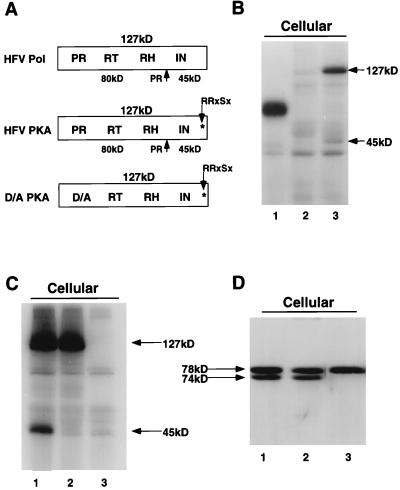
FIG. 1
FIG. 1
IP-PKA and Western blot analysis of HFV-PKA and HFV-D/A-PKA. Assay conditions are as described in Materials and Methods except that the second IP step was omitted for PKA analysis of cellular Pol proteins. Anti-RH antiserum was used to immunoprecipitate Pol, and anticapsid antiserum was used for Gag Western blots. (A) Schematic diagram of HFV (wt) and HFV-PKA Pol proteins. (B) IP-PKA analysis of HFV-PKA. Lanes: 1, positive control for PKA phosphorylation; purified interleukin-1 receptor (38); 2, HFV (wt)-transfected cells; 3, HFV-PKA-transfected cells. (C) PKA analysis of cell lysates mock transfected (lane 3) or transfected with HFV-PKA and HFV-D/A-PKA (lanes 1 and 2, respectively). (D) Western blot analysis of HFV-PKA Gag proteins. Lanes: 1, HFV (wt); 2, HFV-PKA; 3, HFV-D/A-PKA.
FIG. 2
FIG. 2
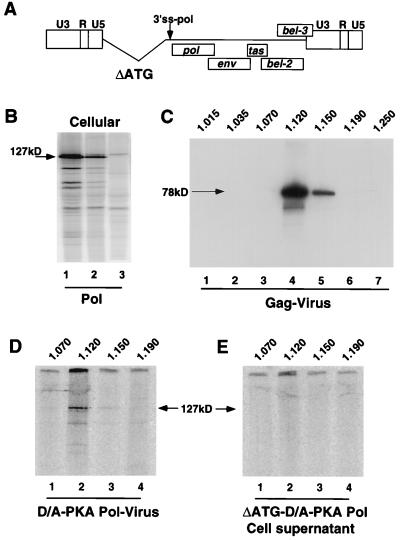
Optiprep gradient purification and analysis of Gag and Pol proteins from HFV-D/A-PKA virus particles. Gradients and analyses were performed as described in Materials and Methods. (A) Schematic of negative control for virus assembly and Pol incorporation, ΔATG-PKA. (B) IP-PKA analysis of cell-associated Pol proteins from ΔATG-PKA and HFV-D/A-PKA, using anti-RH serum. Cells were transfected with ΔATG-D/A-PKA (lane 1) or HFV-D/A-PKA (lane 2) or mock transfected (lane 3). (C) Western blot analysis of purified HFV-D/A-PKA particles, using anti-Gag antiserum. Fraction densities (in grams per cubic centimeter) are listed above the lanes. Lanes 1 to 7 correspond to fractions 1 to 7 from the gradient; 78 kDa is the expected size for unprocessed Gag from HFV-D/A-expressing constructs (Fig. 3A). (D) IP-PKA analysis of gradient-purified HFV-D/A-PKA virus particles. Lanes 1 to 4 correspond to fractions 3 to 6 from the gradient. Fraction densities (in grams per cubic centimeter) are listed above the lanes. (E) IP-PKA analysis of gradient fractions from cell supernatants of the negative control for virus assembly, ΔATG-D/A-PKA. Lanes 1 to 4 correspond to fractions 3 to 6.
FIG. 3
FIG. 3
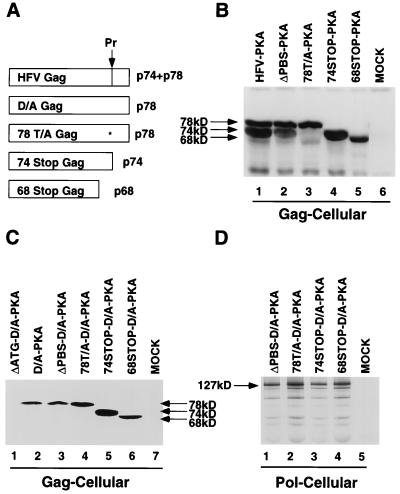
Analysis of cellular Gag and Pol expression from HFV-PKA and HFV-D/A-PKA mutants. (A) Schematic of expected Gag protein products from mutant proviral constructs. (B) Western blot analysis of Gag proteins from cells mock transfected (lane 6) or transfected with the constructs indicated at the top. (C) Western blot analysis of Gag proteins from cells mock transfected (lane 7) or transfected with the HFV-D/A-PKA-expressing constructs indicated at the top. (D) IP-PKA analysis of cellular Pol proteins. Shown are the mutants in the D/A-PKA background which were tested for Pol incorporation into virus particles. These experiments included a second IP step after the phosphorylation reaction.
FIG. 4
FIG. 4
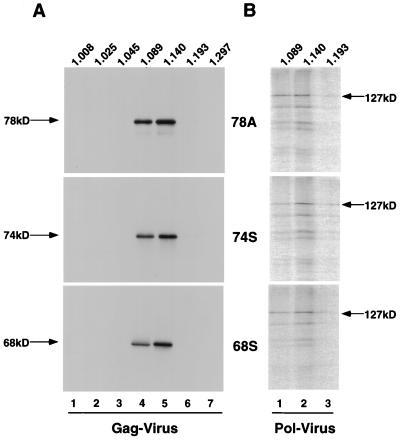
Gradient purification and analysis of Gag mutant viruses. (A) Western blot analysis of gradient fractions for viral Gag. Lanes 1 to 7 correspond to gradient fractions 1 to 7. (B) IP-PKA analysis of fractions 4 to 6 from the gradients shown in panel A. Lanes 1 to 3 correspond to fractions 4 to 6. 78A, 78T/A; 74S, 74Stop; 68S, 68Stop (see Fig. 3B for schematic). Fraction densities (in grams per cubic centimeter) are listed above the lanes.
FIG. 5
FIG. 5
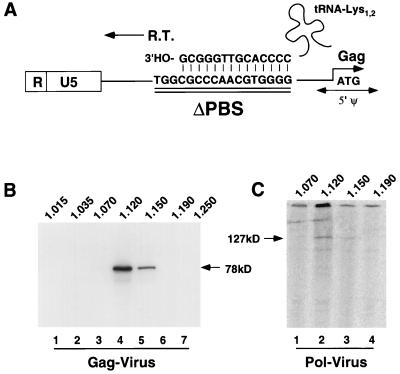
Gradient purification and analysis of ΔPBS-D/A-PKA. (A) Detailed schematic of the PBS deletion on the RNA genome. Shown is the homology with the 3′ end of tRNA1,2Lys from which reverse transcription is initiated. Deleted nucleotides are underlined; a putative 5′ encapsidation signal is labeled Ψ. (B) Western blot analysis of Gag. Lanes 1 to 7 correspond to fractions 1 to 7. Fraction densities (in grams per cubic centimeter) are listed above the lanes. (C) IP-PKA analysis of Pol proteins. Lanes 1 to 4 correspond to fractions 3 to 6 shown in panel B.

References

    1. Baldwin D N, Linial M L. The roles of Pol and Env in the assembly pathway of human foamy virus. J Virol. 1998;72:3658–3665. - PMC - PubMed
    1. Baldwin, D. N., and M. L. Linial. 1998. Unpublished results.
    1. Bartenschlager R, Junker-Niepmann M, Schaller H. The P gene product of hepatitis B virus is required as a structural component for genomic RNA encapsidation. J Virol. 1990;64:5324–5332. - PMC - PubMed
    1. Bartenschlager R, Kuhn C, Schaller H. Expression of the P-protein of the human hepatitis B virus in a vaccinia virus system and detection of the nucleocapsid-associated P-gene product by radiolabelling at newly introduced phosphorylation sites. Nucleic Acids Res. 1992;20:195–202. - PMC - PubMed
    1. Bartenschlager R, Schaller H. Hepadnavirus assembly is initiated by polymerase binding to the encapsidation signal in the viral RNA genome. EMBO J. 1992;11:3413–3420. - PMC - PubMed

Publication types

LinkOut - more resources