. 1999 Jun;9(6):568-74.

The CMT2D locus: refined genetic position and construction of a bacterial clone-based physical map

Affiliations

The CMT2D locus: refined genetic position and construction of a bacterial clone-based physical map

R E Ellsworth et al. Genome Res. 1999 Jun.

Abstract

Charcot-Marie-Tooth (CMT) disease is a progressive neuropathy of the peripheral nervous system, typically characterized by muscle weakness of the distal limbs. CMT is noted for its genetic heterogeneity, with four distinct loci already identified for the axonal form of the disease (CMT2). In 1996, linkage analysis of a single large family revealed the presence of a CMT2 locus on chromosome 7p14 (designated CMT2D). Additional families have been linked subsequently to the same genomic region, including one with distal spinal muscular atrophy (dSMA) and one with mixed features of dSMA and CMT2; symptoms in both of these latter families closely resemble those seen in the original CMT2D family. There is thus a distinct possibility that CMT2 and dSMA encountered in these families reflect allelic heterogeneity at a single chromosome 7 locus. In the study reported here, we have performed more detailed linkage analysis of the original CMT2D family based on new knowledge of the physical locations of various genetic markers. The region containing the CMT2D gene, as defined by the original family, overlaps with those defined by at least two other families with CMT2 and/or dSMA symptoms. Both yeast artificial chromosome (YAC) and bacterial clone-based [bacterial artificial chromosome (BAC) and P1-derived artificial chromosome (PAC)] contig maps spanning approximately 3.4 Mb have been assembled across the combined CMT2D critical region, with the latter providing suitable clones for systematic sequencing of the interval. Preliminary analyses have already revealed at least 28 candidate genes and expressed-sequence tags (ESTs). The mapping information reported here in conjunction with the evolving sequence data should expedite the identification of the CMT2D/dSMA gene or genes.


Figures
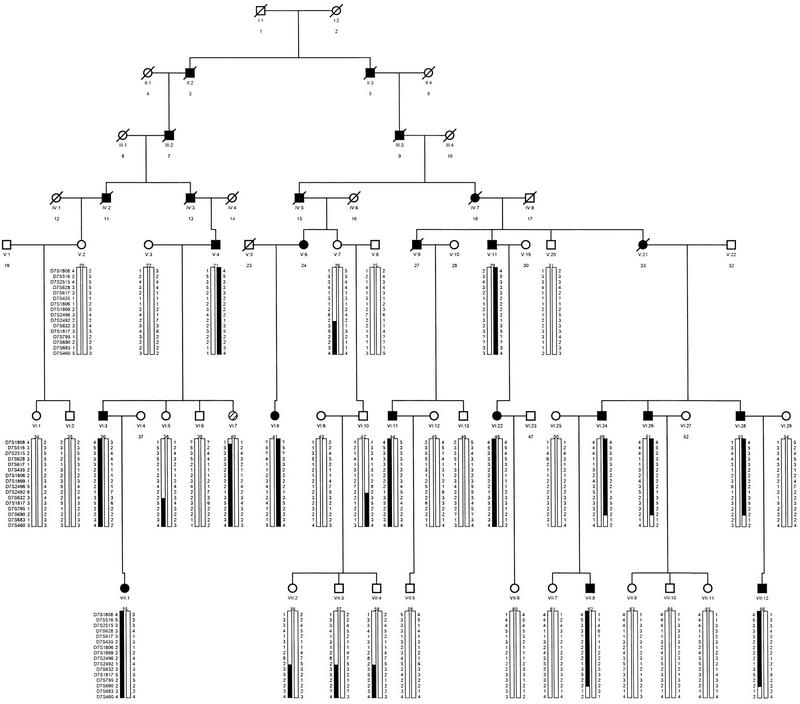
Figure 1
Figure 1
Updated genetic mapping data and deduced haplotypes for the CMT1019 family. Additional genetic mapping data was collected for key members of the CMT1019 family originally reported by Ionasescu et al. (1996). The indicated order of the genetic markers from 7pter (top) to 7cen (bottom) was established by YAC-based physical mapping (Bouffard et al. 1997b). Note that individual 60 is indicated as unaffected (unlike the original description of this family, where this individual was coded as affected) and individual 40 is represented by a hatched symbol to indicate an uncertain phenotypic status (see text). (Solid bars) Affected haplotype; (open bars) a normal chromosome. Also note the recombination events detected in individual 40 (denoted by a switch from an open to a solid bar at D7S1808) and individual 26 (denoted by a switch from an open to a solid bar at D7S632).
Figure 2
Figure 2
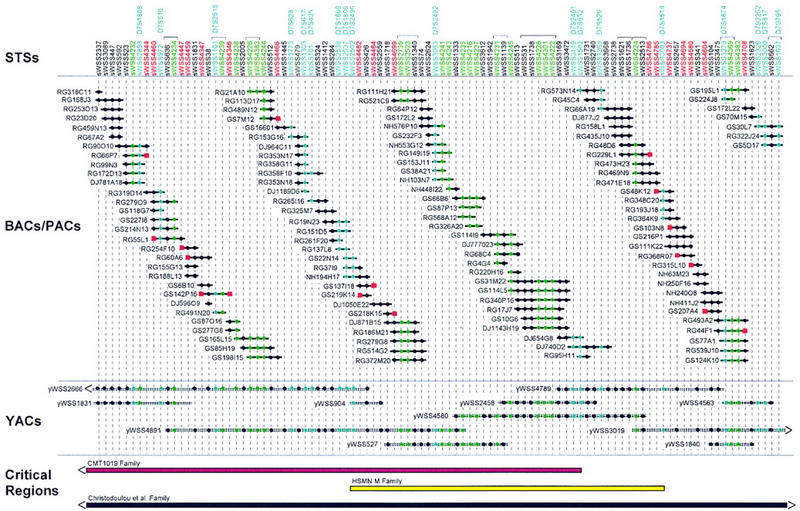
Clone-based physical map of the CMT2D critical region. A bacterial clone (BAC and PAC)-based STS-content map of the CMT2D critical region is depicted (oriented with 7pter left and 7cen right). The deduced positions of 100 STSs are depicted along the top, with the indicated clones shown as horizontal lines below. Relevant information about the STSs is available in GenBank (see http://www.ncbi.nlm.nih.gov). Bacterial clones are named starting with the following prefixes that reflect their library of origin: (RG) Research Genetics BAC library; see http://www.resgen.com, (GS) Genome Systems BAC library; see http://www.genomesystems.com, (NH) Roswell Park Cancer Institute BAC library RPCI-11; see http://bacpac.med.buffalo.edu, and (DJ) Roswell Park Cancer Institute PAC library RPCI-4 or RPCI-5. A solid circle indicates that the STS is confirmed to be present in that clone by PCR testing. When an STS corresponds to a BAC insert end, its name is shown in red and a red square is present at the end of the clone from which it was derived. STSs corresponding to genetic markers and genes/ESTs are indicated in blue and green, respectively (both the STS name and the corresponding solid circles). In the case of the genetic markers, the corresponding D7S number is indicated above the name of the STS. Groups of STSs that could not be ordered based on the STS content of the BACs, PACs, and YACs are indicated with brackets above their names. STSs are depicted in an equidistant fashion from one another. The indicated BAC/PAC overlaps were confirmed by restriction enzyme digest-based fingerprint analysis (data not shown) (Marra et al. 1997). Shown below the BACs and PACs is a small, representative set of YACs spanning the region [see Bouffard et al. (1997b) and http://www.nhgri.nih.gov/DIR/GTB/CHR7 for additional details about the complete YAC contig map]. The YACs were not tested for the presence of some of the newly developed STSs; in these cases, a solid circle is not indicated at the appropriate position in the clone. Along the bottom are depicted the CMT2D critical regions as defined by genetic analysis of the CMT1019 family (Ionasescu et al. 1996; see Fig. 1), the HSMN M family (Sambuughin et al. 1998), and the family reported by Christodoulou et al. (1995). Note that the end(s) of the critical regions defined by the first and last families extend beyond the interval covered by the depicted contig map.
Figure 3
Figure 3
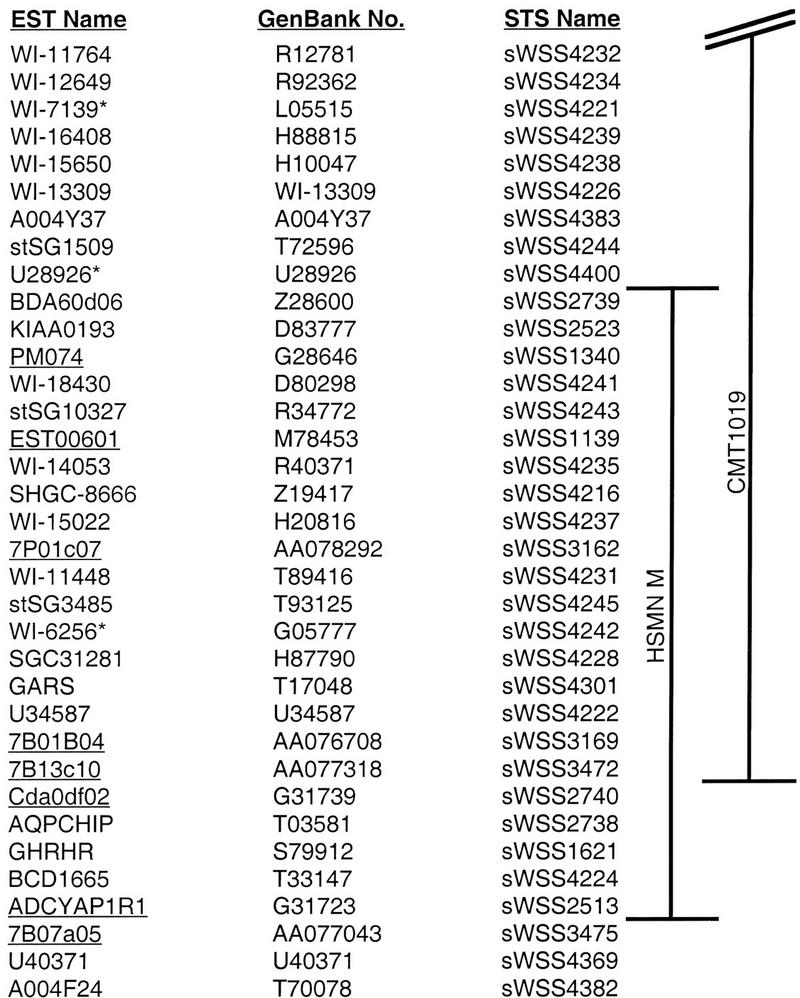
Genes and ESTs mapping to the CMT2D critical region. A list of genes and ESTs from the greater CMT2D critical region is provided in their established physical order (from 7pter at the top to 7cen at the bottom). Also indicated are the corresponding GenBank accession nos. and names of the STSs used for physical mapping (see Fig. 2). A total of 18 genes/ESTs have been localized thus far within the critical region defined by the CMT1019 (Ionasescu at al. 1996) and the HSMN M (Sambuughin et al. 1998) families. The three ESTs marked with an asterisk were localized on the YAC contig map and by genomic sequence data but not mapped by STS-content analysis of BAC/PAC clones (e.g., in Fig. 2). The eight genes/ESTs whose names are underlined were mapped on the YAC contig map (Bouffard et al. 1997b) but are not present on the transcript map reported by Schuler et al. (1996; see http://www.ncbi.nlm.nih.gov/genemap).

References

    1. Basam BJ, Caetano-Anolles G, Gresshoff PM. Fast and sensitive silver staining of DNA in polyacrylamide gels. Anal Biochem. 1991;196:80–83. - PubMed
    1. Ben Othmane K, Middleton LT, Loprest LJ, Wilkenson KM, Lennon F, Rozear MP, Stajich JM, Gaskell PC, Roses AD, Pericak-Vance MA, Vance JM. Localization of a gene (CMT2A) for autosomal dominant Charcot-Marie-Tooth disease type 2 to chromosome 1p and evidence of genetic heterogeneity. Genomics. 1993;17:370–375. - PubMed
    1. Bouffard GG, Iyer LM, Idol JR, Braden VV, Cunningham AF, Weintraub LA, Mohr-Tidwell RM, Peluso DC, Fulton RS, Leckie MP, Green ED. A collection of 1814 human chromosome 7-specific STSs. Genome Res. 1997a;7:59–66. - PubMed
    1. Bouffard GG, Idol JR, Braden VV, Iyer LM, Cunningham AF, Weintraub LA, Touchman JW, Mohr-Tidwell RM, Peluso DC, Fulton RS, et al. A physical map of human chromosome 7: An integrated YAC contig map with average STS spacing of 79 kb. Genome Res. 1997b;7:673–692. - PubMed
    1. Charcot JM, Marie P. Sur une forme particuliere d’atrophie musculaire progressive, souvent familiale, débutant pas les pieds and les jambes et atteignant plus tard les mains. Rev Med. 1886;6:97–138.

MeSH terms

Substances