


Recurrent bacteremia caused by a "Flexispira"-like organism in a patient with X-linked (Bruton's) agammaglobulinemia
- PMID: 10405381
- PMCID: PMC85249
- DOI: 10.1128/JCM.37.8.2439-2445.1999
Recurrent bacteremia caused by a "Flexispira"-like organism in a patient with X-linked (Bruton's) agammaglobulinemia
Abstract
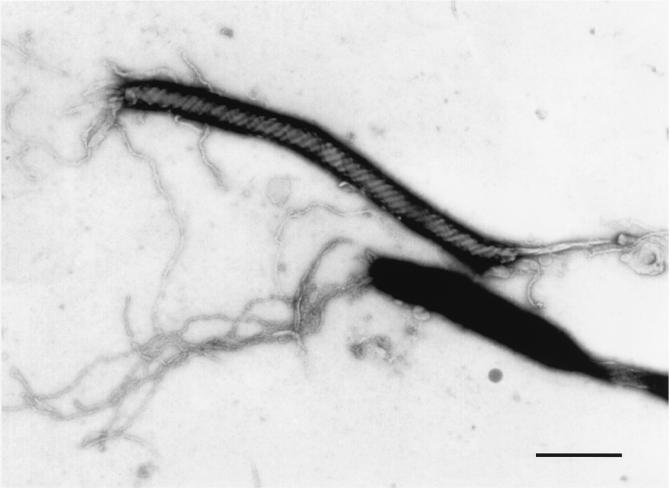
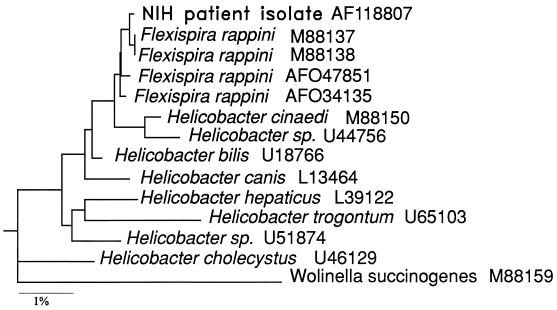
Helicobacter spp., except for Helicobacter cinaedi, have only rarely been reported in cases of septicemia. A patient with X-linked (Bruton's) agammaglobulinemia was found to have persistent sepsis with a Helicobacter-like organism despite multiple courses of antibiotics. His periods of sepsis were associated with leg swelling thought to be consistent with cellulitis. The organism was fastidious and required a microaerophilic environment containing H(2) for growth. Optimal growth was observed at 35 to 37 degrees C on sheep blood, CDC anaerobe, and Bordet-Gengou agars. Serial subcultures every 4 to 5 days were required to maintain viability. The organism was strongly urease positive and showed highest relatedness to Helicobacter-like organisms with the vernacular name "Flexispira rappini" by 16S rRNA gene sequence analysis. Genomic DNA hybridization studies, however, found 24 to 37% relatedness to "F. rappini" and even less to other Helicobacter spp. Although the organism phenotypically resembles "Flexispira" and Helicobacter, it is thought to represent a new taxon. The patient's infection was eventually cleared with a prolonged (5-month) course of intravenous imipenem and gentamicin.
Figures
References
-
- Bryner J H, Ritchie A E, Pollet L, Kirkbride C A. Experimental infection and abortion of pregnant guinea pigs with a unique spirillum-like bacterium isolated from aborted ovine fetuses. Am J Vet Res. 1987;48:91–95. - PubMed
Publication types
MeSH terms
Associated data
- Actions
LinkOut - more resources
Full Text Sources
Other Literature Sources
Medical
Molecular Biology Databases
Miscellaneous
