


TT virus infection in French hemodialysis patients: study of prevalence and risk factors
- PMID: 10405397
- PMCID: PMC85277
- DOI: 10.1128/JCM.37.8.2538-2542.1999
TT virus infection in French hemodialysis patients: study of prevalence and risk factors
Abstract
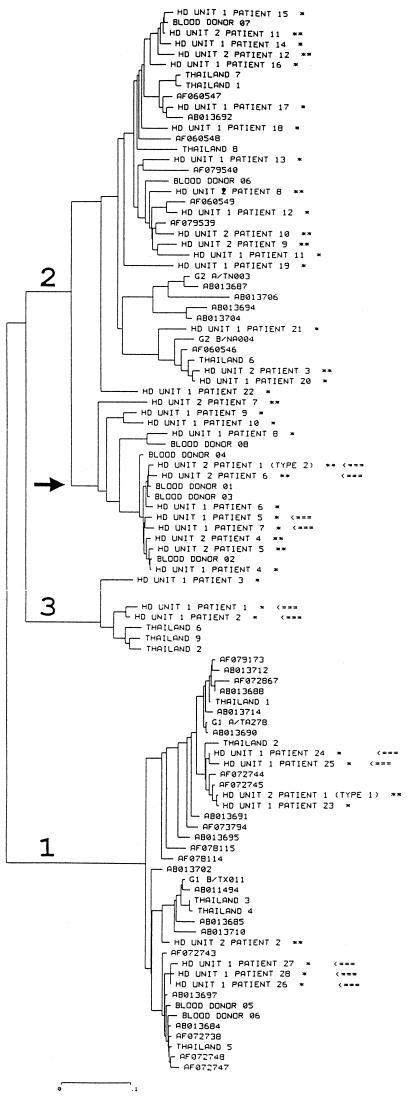
The TT virus (TTV) is a recently discovered DNA virus which was first identified in patients with non-A to -G hepatitis following blood transfusion. In this study, we tested 150 attendees of two hemodialysis (HD) units of the public hospitals of Marseilles, France, for the presence of TTV genome by using a PCR-based methodology. The overall prevalence of TTV viremia was 28% (compared to 5.3% in blood donors from the same region). We demonstrated the existence of chronic infections and superinfections by strains belonging to different genotypes. The prevalence of infection was higher in patients originating from Africa, in patients with previous blood transfusion or organ transplantation, in patients with antibody to hepatitis B core antigen, and in those with diabetes mellitus. A high prevalence of TTV infection (50%) was also observed in a population of patients with diabetes mellitus but without renal disease. No significant relationship was found between TTV viremia and hepatitis C virus or GB virus C, transaminases, age, sex, and duration of HD treatment. The PCR amplification products (located in open reading frame 1 of the TTV genome) were sequenced. These genomic sequences were submitted to phylogenetic analysis by using the Jukes-Cantor algorithm for distance determination and the neighbor-joining method for tree building. In several instances, sequences from viruses isolated in a HD unit were grouped in the same phylogenetic cluster. These results together with the different distribution of cases in the two HD units suggest there is viral transmission within each.
Figures
References
-
- Biagini P, Gallian P, Attoui H, Cantaloube J F, de Micco P, de Lamballerie X. Determination and phylogenetic analysis of partial sequences from TT virus isolates. J Gen Virol. 1999;80:419–424. - PubMed
-
- Biagini P, Gallian P, Cantaloube J F, De Micco P, de Lamballerie X. Presence of TT virus in French blood donors and intravenous drug users. J Hepatol. 1998;29:684–685. - PubMed
-
- Cantaloube J F, Charrel R N, Attoui H, Biagini P, De Micco P, de Lamballerie X. Evaluation of four PCR systems amplifying different genomic regions for molecular diagnosis of GB virus C infections. J Virol Methods. 1997;6:131–135. - PubMed
-
- Kumar, S., K. Tamura, and M. Nei. MEGA: Molecular Evolutionary Genetics Analysis, version 1.02. Pennsylvania State University, University Park.
-
- Nishizawa T, Okamoto H, Konishi K, Yoshizawa H, Miyakawa Y, Mayumi M. A novel DNA virus (TTV) associated with elevated transaminase levels in posttransfusion hepatitis of unknown etiology. Biochem Biophys Res Commun. 1997;241:92–97. - PubMed
MeSH terms
Substances
LinkOut - more resources
Full Text Sources
Medical
