


doi: 10.1073/pnas.96.15.8795.
Oreopithecus was a bipedal ape after all: evidence from the iliac cancellous architecture
Affiliations
- PMID: 10411955
- PMCID: PMC17596
- DOI: 10.1073/pnas.96.15.8795
Item in Clipboard
Oreopithecus was a bipedal ape after all: evidence from the iliac cancellous architecture
Proc Natl Acad Sci U S A.
.
Abstract
Textural properties and functional morphology of the hip bone cancellous network of Oreopithecus bambolii, a 9- to 7-million-year-old Late Miocene hominoid from Italy, provide insights into the postural and locomotor behavior of this fossil ape. Digital image processing of calibrated hip bone radiographs reveals the occurrence of trabecular features, which, in humans and fossil hominids, are related to vertical support of the body weight, i.e., to bipedality.
Figures
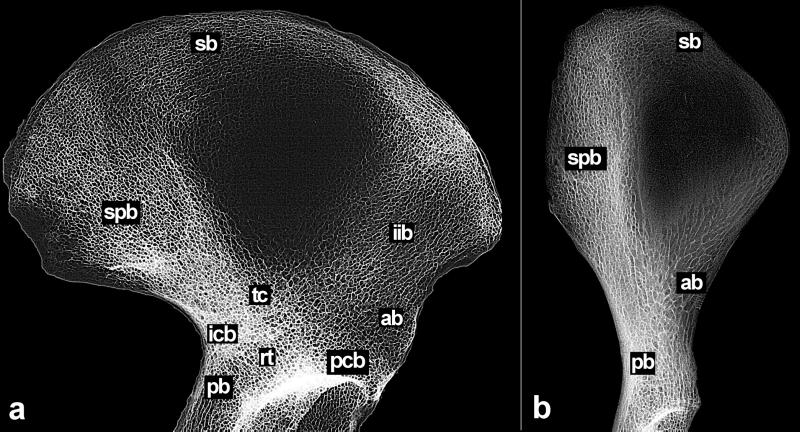
Iliac trabecular architecture in Homo sapiens (SCR 252) (a) and Hylobates syndactylus (AIZIU 1726) (b) (not to scale). ab, anterior; sb, superior; pb, posterior; pcb, pericotyloid; icb, iliocotyloid; spb, sacropubic bundle; and iib, ilioischial bundle; rt, radial trabeculae; tc, trabecular crossing between the spbs and the iibs. Major gait-related features in the trabecular system of human ilium (a) include: a distinctive iib, a strong, undivided spb, and a diagonal full crossing (tc) of these bundles over the acetabulum. In H. syndactylus (b), as well as in all extant apes, a true iib is absent because of the lack of trabecular structural organization, resulting in a honeycomb-like cancellous network. The poorly structured inner bundles do not form a full crossing, but only partially flow into a slightly higher-density confluence of trabeculae located well high above the acetabular upper rim.
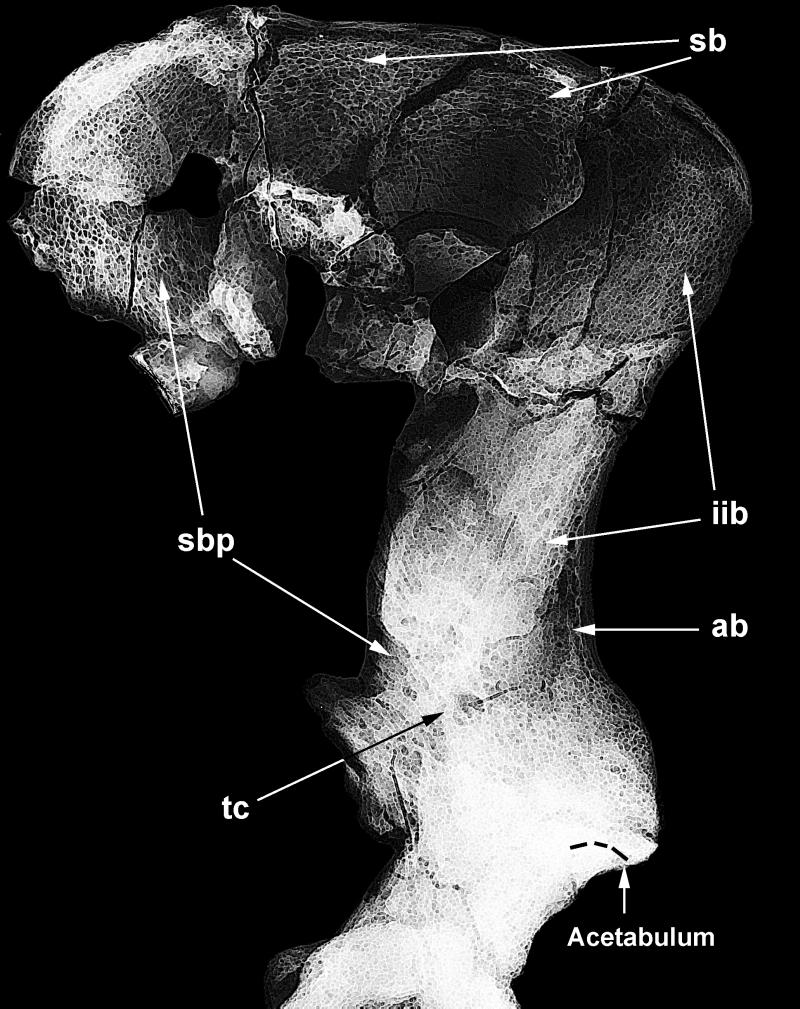
Electronically enhanced trabecular architecture of the O. bambolii ilium (left and mirrored-right IGF 11778 specimens digitally overlapped). See Fig. 1 caption for explanation of the bundle labels.
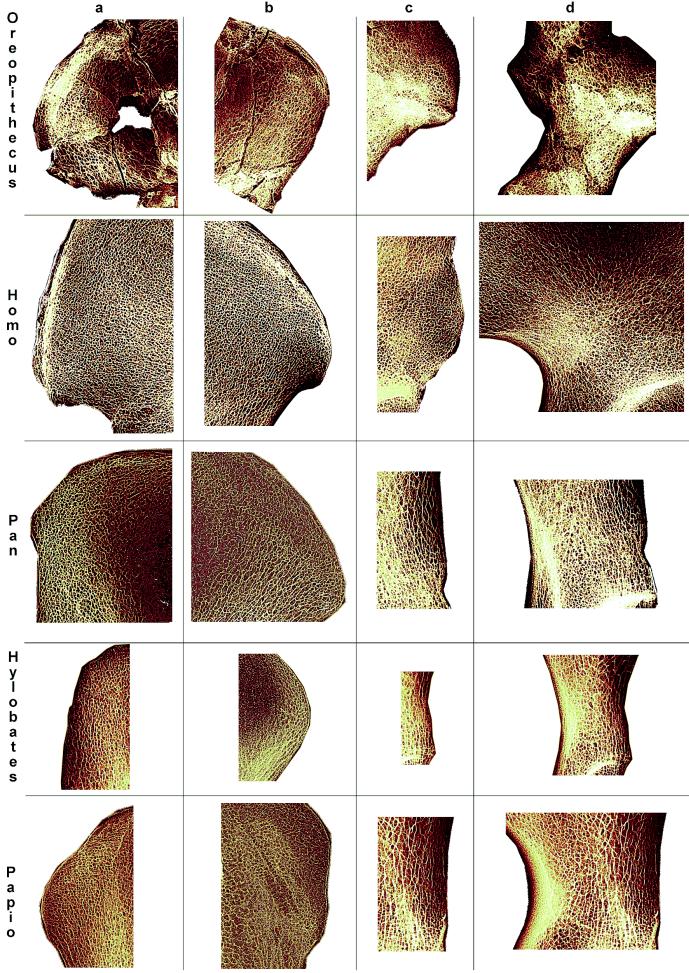
Comparative site-specific structural morphology of the hip bone in Oreopithecus (IGF 11778), Homo (SCR 352), Pan (PVA 2706), Hylobates (AIZIU 1726), and Papio (AIZIU PAL 109). Iliac blade posterosuperior margin (a), anterosuperior margin (b), anteroinferior margin (c), and supraacetabular area (d) are shown. Because specimens are not reproduced to scale, the sizes of the trabecular mesh are not directly comparable.
References
-
- Moyá-Solá S, Köhler M. C R Acad Sci Paris. 1996;324:141–148.
-
- Harrison T, Rook L. In: Function, Phylogeny, and Fossils: Miocene Hominoid Origins and Adaptations. Begun D R, Ward C W, Rose M D, editors. New York: Plenum; 1997. pp. 327–362.
-
- Coppens Y, Senut B, editors. Origine(s) de la Bipédie ches les Hominidés. Paris: Centre National de la Recherche Scientifique; 1991.
Publication types
MeSH terms
LinkOut - more resources
Full Text Sources
Research Materials
Miscellaneous
