


Comparative Study
doi: 10.1128/IAI.67.8.4276-4279.1999.
Intranasal immunization of mice with influenza vaccine in combination with the adjuvant LT-R72 induces potent mucosal and serum immunity which is stronger than that with traditional intramuscular immunization
Affiliations
- PMID: 10417205
- PMCID: PMC96738
- DOI: 10.1128/IAI.67.8.4276-4279.1999
Item in Clipboard
Comparative Study
Intranasal immunization of mice with influenza vaccine in combination with the adjuvant LT-R72 induces potent mucosal and serum immunity which is stronger than that with traditional intramuscular immunization
Infect Immun.
1999 Aug.
Abstract
Immunization of mice by the intranasal route with influenza virus hemagglutinin in combination with the mutant Escherichia coli heat-labile enterotoxin R72 (LT-R72) induced significantly enhanced serum and mucosal antibodies, surpassing, in most cases, responses achieved by traditional intramuscular immunization using inactivated split influenza vaccine. Furthermore, intranasal immunization with LT-R72 induced a potent serum immunoglobulin G2a response, indicating that this adjuvant has Th1 character.
Figures
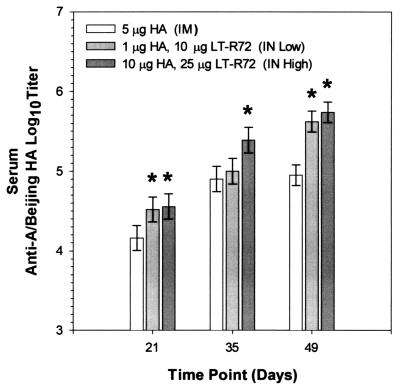
Comparison of the effects of i.m. and i.n. administrations of A/Beijing93 HA on antigen-specific serum antibody responses. Shown are mean anti-A/Beijing93 HA serum Ig antibody titers of groups of 10 mice immunized as shown in Table 1. Asterisks indicate groups whose values are significantly greater than those of the corresponding i.m. immunized group (P ≤ 0.05).
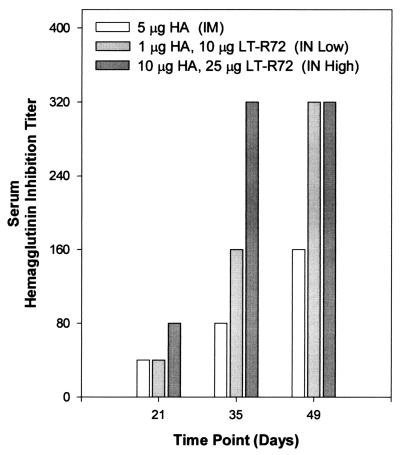
Comparison of the effects of i.m. and i.n. administrations of a bivalent vaccine containing A/Beijing93 HA on serum HI titers. The data shown is for pooled serum from groups of 10 mice immunized as shown in Table 1.
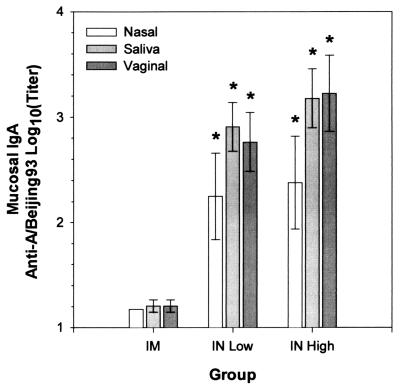
Comparison of the effects of i.m. and i.n. administrations of A/Beijing93 HA on antigen-specific IgA responses. Mean anti-A/Beijing93 HA IgA antibody titers of MW samples from groups of 10 mice immunized as shown in Table 1 (± 95% confidence intervals) are shown. Asterisks indicate groups whose titers are significantly greater than those of the corresponding i.m. immunized groups (P ≤ 0.05).
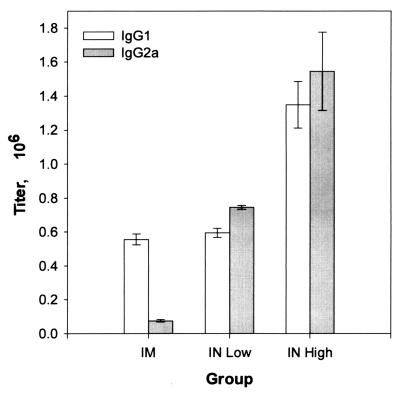
Comparison of the effects of i.m. and i.n. administrations of A/Beijing93 HA on the ratio of antigen-specific IgG1 to IgG2a antibodies in the sera of groups of 10 mice immunized as shown in Table 1.
References
-
- Andrews H P, Snee R D, Sarner M H. Graphical display of means. Am Statistician. 1980;34:195–199.
-
- Barchfeld G L, Hessler A L, Chen M, Pizza M, Rappuoli R, Van Nest G A. The adjuvants MF59 and LT-K63 enhance the mucosal and systemic immunogenicity of subunit influenza vaccine administered intranasally in mice. Vaccine. 1998;17:695–704. - PubMed
-
- Bender B S, Taylor S F, Zander D S, Cottey R. Pulmonary immune response of young and aged mice after influenza challenge. J Lab Clin Med. 1995;126:169–177. - PubMed
-
- Clements M L, Stephens I. New and improved vaccines against influenza. In: Levine M M, Woodrow G C, Kaper J B, Cobon G S, editors. New generation vaccines. 2nd edition. New York, N.Y: Marcel Dekker, Inc.; 1997. pp. 545–570.
Publication types
MeSH terms
Substances
LinkOut - more resources
Full Text Sources
Other Literature Sources
Medical
