


Smoking status as a vital sign
- PMID: 10417597
- PMCID: PMC1496600
- DOI: 10.1046/j.1525-1497.1999.09078.x
Smoking status as a vital sign
Abstract
Objective: We conducted this study to determine if a smoking status stamp would prompt physicians to increase the number of times they ask, advise, assist, and arrange follow-up for African-American patients about smoking-related issues.
Design: An intervention study with a posttest assessment (after the physician visit) conducted over four 1-month blocks. The control period was the first 2 weeks of each month, while the following 2 weeks served as the intervention period.
Setting: An adult walk-in clinic in a large inner-city hospital.
Participants: We consecutively enrolled into the study 2,595 African-American patients (1,229 intervention and 1, 366 control subjects) seen by a housestaff physician.
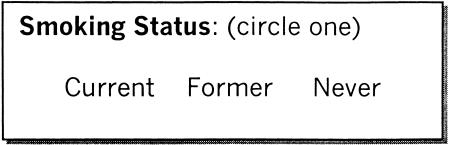
Interventions: A smoking status stamp placed on clinic charts during the intervention period.
Main results: Forty-five housestaff rotated through the clinic in 1-month blocks. In univariate analyses, patients were significantly more likely to be asked by their physicians if they smoke cigarettes during the intervention compared with the control period, 78.4% versus 45.6% (odds ratio [OR] 4.28; 95% confidence interval [CI] 3.58, 5.10). Patients were also more likely to be told by their physician to quit, 39.9% versus 26.9% (OR 1.81; 95% CI 1.36, 2.40), and have follow-up arranged, 12.3% versus 6.2% (OR 2.16; 95% CI 1.30, 3.38).
Conclusions: The stamp had a significant effect on increasing rates of asking about cigarette smoking, telling patients to quit, and arranging follow-up for smoking cessation. However, the stamp did not improve the low rate at which physicians offered patients specific advice on how to quit or in setting a quit date.
Figures
References
-
- U.S. Department of Health and Human Services. Smoking Cessation: Clinical Practice Guideline. Rockville, Md: Public Health Service, Agency for Health Care Policy and Research; 1996.
-
- Kottke TE, Battista RN, DeFriese GH, Brekke ML. Attributes of successful smoking cessation interventions in medical practice: a meta-analysis of 39 controlled trials. JAMA. 1988;259:2883–9. - PubMed
-
- Schwartz JL. Smoking Cessation Methods. Washington, DC: U.S. Department of Health and Human Services; 1987. USDHHS publication 87:2940.
-
- Fisher M. Report of the U.S. Preventive Services Task Force Guide to Clinical Preventive Services. Baltimore, Md: Williams and Wilkins; 1989.
Publication types
MeSH terms
Grants and funding
LinkOut - more resources
Full Text Sources