. 1999 Jul 5;190(1):135-9.
doi: 10.1084/jem.190.1.135.

Hypoxia-reoxygenation triggers coronary vasospasm in isolated bovine coronary arteries via tyrosine nitration of prostacyclin synthase

Affiliations

Hypoxia-reoxygenation triggers coronary vasospasm in isolated bovine coronary arteries via tyrosine nitration of prostacyclin synthase

M H Zou et al. J Exp Med. .

Abstract

The role of peroxynitrite in hypoxia-reoxygenation-induced coronary vasospasm was investigated in isolated bovine coronary arteries. Hypoxia-reoxygenation selectively blunted prostacyclin (PGI2)-dependent vasorelaxation and elicited a sustained vasoconstriction that was blocked by a cyclooxygenase inhibitor, indomethacin, and SQ29548, a thromboxane (Tx)A2/prostaglandin H2 receptor antagonist, but not by CGS13080, a TxA2 synthase blocker. The inactivation of PGI2 synthase, as evidenced by suppressed 6-keto-PGF1 alpha release and a decreased conversion of 14C-prostaglandin H2 into 6-keto-PGF1 alpha, was paralleled by an increased nitration in both vascular endothelium and smooth muscle of hypoxia-reoxygenation-exposed vessels. The administration of the nitric oxide (NO) synthase inhibitors as well as polyethylene-glycolated superoxide dismutase abolished the vasospasm by preventing the inactivation and nitration of PGI2 synthase, suggesting that peroxynitrite was implicated. Moreover, concomitant administration to the organ baths of the two precursors of peroxynitrite, superoxide, and NO mimicked the effects of hypoxia-reoxygenation, although none of them were effective when given separately. We conclude that hypoxia-reoxygenation elicits the formation of superoxide, which causes loss of the vasodilatory action of NO and at the same time yields peroxynitrite. Subsequently, peroxynitrite nitrates and inactivates PGI2 synthase, leaving unmetabolized prostaglandin H2, which causes vasospasm, platelet aggregation, and thrombus formation via the TxA2/prostaglandin H2 receptor.


Figures
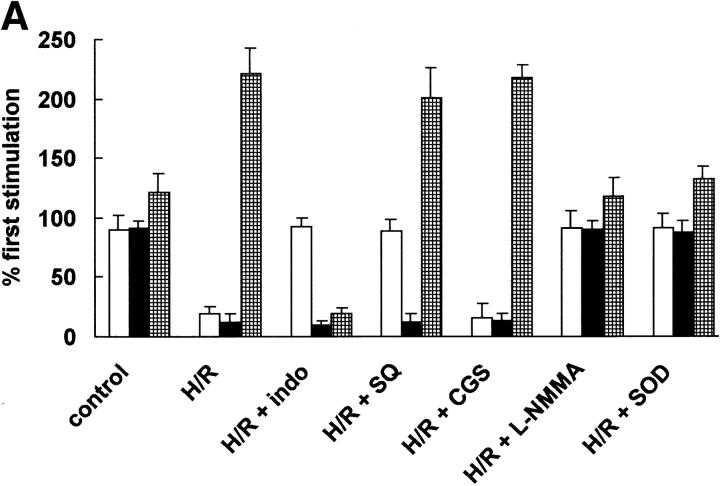
Figure 1
Figure 1
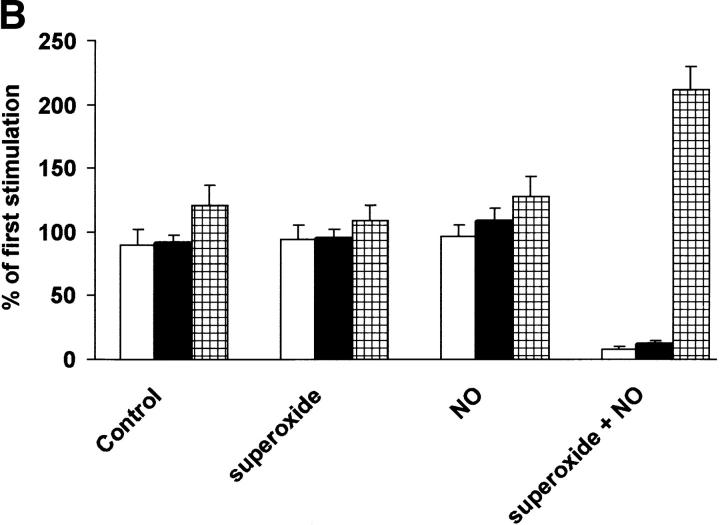
Hypoxia–reoxygenation on angiotensin II–triggered relaxation and eicosanoid metabolism in BCA. (A) Effects of indomethacin, SQ 29548, CGS13080, SOD, L-NMMA, and L-NAME on angiotensin II–triggered relaxation (white bars) and the release of 6-keto-PGF (black bars) and PGE2 (hatched bars) in hypoxia–reoxygenated BCA. After having obtained a reference response to angiotensin II, the coronary strip was exposed to hypoxia for 40 min after 40-min reoxygenation in presence of indomethacin (10 μM), CGS13080 (10 μM), SQ-29548 (10 μM), PEG-SOD (500 U/ml), L-NMMA (10−4 M), or L-NAME (10−4 M). PGE2 and 6-keto-PGF in the media were analyzed by ELISA. Data represent means ± SEM from 10 experiments. (B) Effects of superoxide, NO, and concurrent administration of superoxide and NO on angiotensin II–induced vasorelaxation and prostaglandin release in BCA. After having obtained a reference response to angiotensin II, the coronary strip was exposed to superoxide generated from 10 mU/ml xanthine oxidase/100 μM hypoxanthine or to NO generated from 20 μM DEA-NO or superoxide plus NO. PGE2 (hatched bars) and 6-keto-PGF (black bars) in the media were analyzed by ELISA. Data represent means ± SEM from 12 experiments. White bars, relaxation.
Figure 1
Figure 1
Hypoxia–reoxygenation on angiotensin II–triggered relaxation and eicosanoid metabolism in BCA. (A) Effects of indomethacin, SQ 29548, CGS13080, SOD, L-NMMA, and L-NAME on angiotensin II–triggered relaxation (white bars) and the release of 6-keto-PGF (black bars) and PGE2 (hatched bars) in hypoxia–reoxygenated BCA. After having obtained a reference response to angiotensin II, the coronary strip was exposed to hypoxia for 40 min after 40-min reoxygenation in presence of indomethacin (10 μM), CGS13080 (10 μM), SQ-29548 (10 μM), PEG-SOD (500 U/ml), L-NMMA (10−4 M), or L-NAME (10−4 M). PGE2 and 6-keto-PGF in the media were analyzed by ELISA. Data represent means ± SEM from 10 experiments. (B) Effects of superoxide, NO, and concurrent administration of superoxide and NO on angiotensin II–induced vasorelaxation and prostaglandin release in BCA. After having obtained a reference response to angiotensin II, the coronary strip was exposed to superoxide generated from 10 mU/ml xanthine oxidase/100 μM hypoxanthine or to NO generated from 20 μM DEA-NO or superoxide plus NO. PGE2 (hatched bars) and 6-keto-PGF (black bars) in the media were analyzed by ELISA. Data represent means ± SEM from 12 experiments. White bars, relaxation.
Figure 2
Figure 2
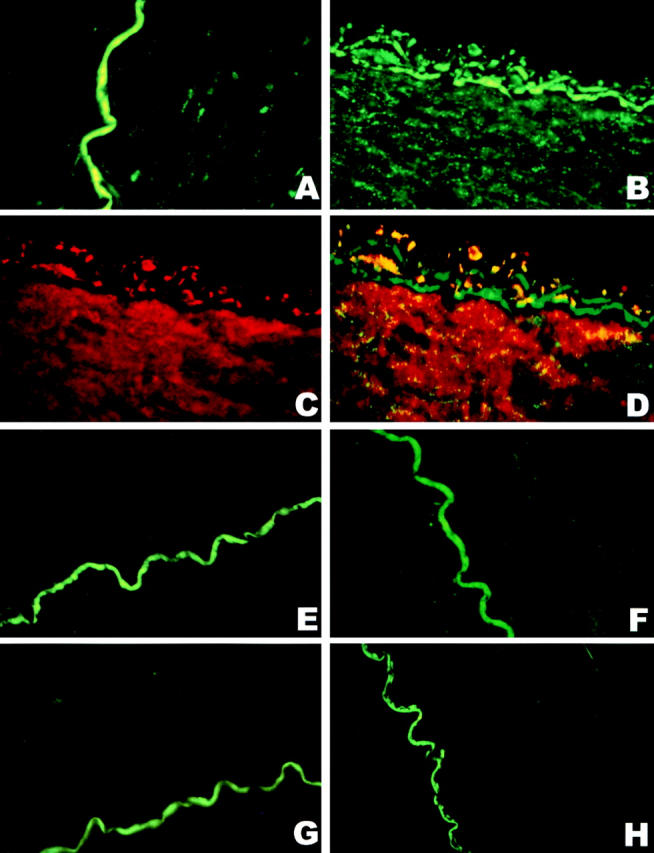
Immunohistochemical colocalization of a polyclonal anti–PGI2 synthase Ab and an mAb against 3-nitrotyrosine in hypoxia-reoxygenated BCA. The yellow coloring resulting from a computer-generated overlay of green (3-nitrotyrosine) and red (PGI2 synthase) fluorescence indicates areas of the colocalization of antinitrotyrosine and anti–PGI2 synthase Abs in BCA with or without hypoxia–reoxygenation treatment. All pictures were obtained under 400-fold magnification with identical camera and print settings. (A) 3-nitrotyrosine staining in a sham-treated artery (green), where 3-nitrotyrosine staining is very weak and the endothelium is intact. The green wiggly line is due to endogenous fluorescence of the lamina and not specific immunostaining for 3-nitrotyrosine. (B) 3-nitrotyrosine staining in a hypoxia-reoxygenated artery; both endothelium and vascular smooth muscle cells are strongly immunopositive for 3-nitrotyrosine (green). (C) The staining of PGI2 synthase Ab in a hypoxia-reoxygenated artery. Dense staining with anti–PGI2 synthase Ab was visible in both endothelium and smooth muscle (red). (D) A computer-generated overlay of the stainings with the Abs against 3-nitrotyrosine (B) and PGI2 synthase (C) in a hypoxia-reoxygenated artery. Yellow indicates the colocalization of the binding with both Abs. (E) An hypoxia-reoxygenated artery was stained for antinitrotyrosine Ab in the presence of 10 mM free 3-nitrotyrosine. Only the autofluorescence of the lamina is visible. (F) 3-nitrotyrosine stainings in a hypoxia-reoxygenated artery in the presence of L-NMMA, where the staining for 3-nitrotyrosine is only weakly visible in both endothelium and vascular smooth muscle. (G) 3-nitrotyrosine stainings in a hypoxia-reoxygenated artery in the presence of PEG-SOD, where 3-nitrotyrosine staining is weakly visible in vascular smooth muscle. (H) An hypoxia-reoxygenated artery was stained for 3-nitrotyrosine when the Ab against 3-nitrotyrosine was omitted, where only the autofluorescence of the lamina is visible.
Figure 3
Figure 3
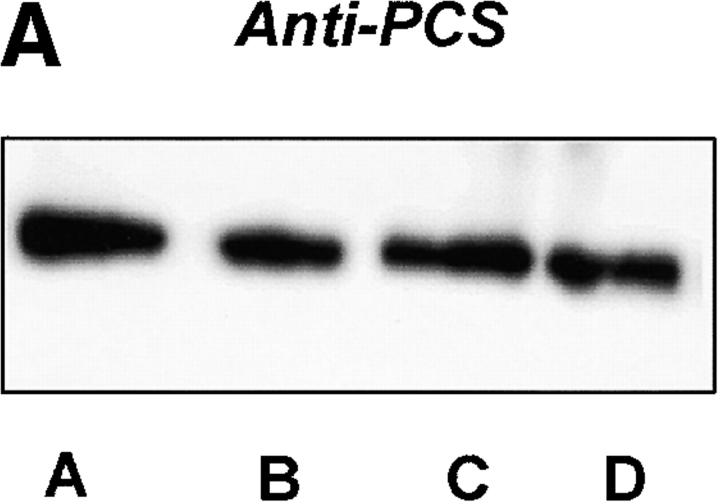
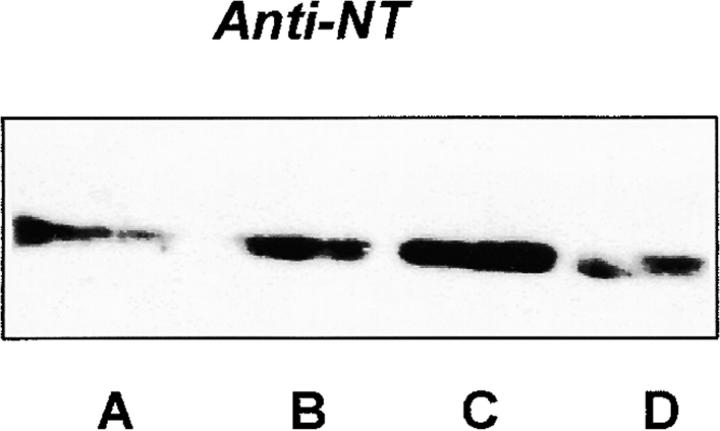
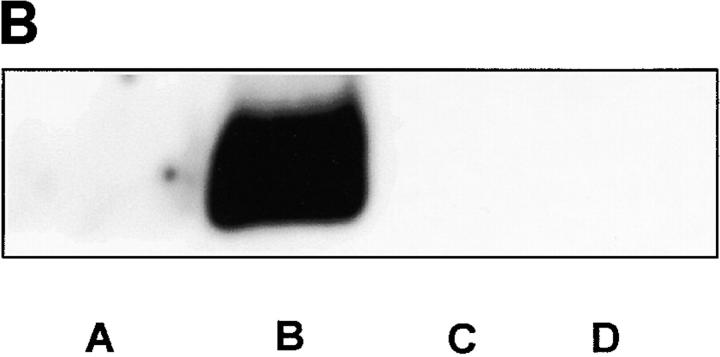
Immunoprecipitation of nitrated proteins and PGI2 synthase in hypoxia-reoxygenated BCA. (A) Proteins from normal or hypoxia-reoxygenated BCA were immunoprecipitated with a polyclonal Ab against PGI2 synthase (α-PGI2 synthase) after hypoxia–reoxygenation. As described in Materials and Methods, proteins precipitated by α-PGI2 synthase were separated electrophoretically and immunostained with a monoclonal α-PGI2 synthase (left) or a monoclonal α-nitrotyrosine (right). Lane A, hypoxia–reoxygenation + L-NMMA; lane B, hypoxia–reoxygenation + SOD; lane C, hypoxia–reoxygenation; lane D, control. (B) 3-nitrotyrosine–positive proteins were precipitated by an mAb against 3-nitrotyrosine. Proteins were separated similarly and analyzed by immunoblots with polyclonal Ab against PGI2 synthase. Lane A, control; lane B, hypoxia–reoxygenation; lane C, hypoxia–reoxygenation + L-NMMA; lane D, hypoxia–reoxygenation + SOD.
Figure 3
Figure 3
Immunoprecipitation of nitrated proteins and PGI2 synthase in hypoxia-reoxygenated BCA. (A) Proteins from normal or hypoxia-reoxygenated BCA were immunoprecipitated with a polyclonal Ab against PGI2 synthase (α-PGI2 synthase) after hypoxia–reoxygenation. As described in Materials and Methods, proteins precipitated by α-PGI2 synthase were separated electrophoretically and immunostained with a monoclonal α-PGI2 synthase (left) or a monoclonal α-nitrotyrosine (right). Lane A, hypoxia–reoxygenation + L-NMMA; lane B, hypoxia–reoxygenation + SOD; lane C, hypoxia–reoxygenation; lane D, control. (B) 3-nitrotyrosine–positive proteins were precipitated by an mAb against 3-nitrotyrosine. Proteins were separated similarly and analyzed by immunoblots with polyclonal Ab against PGI2 synthase. Lane A, control; lane B, hypoxia–reoxygenation; lane C, hypoxia–reoxygenation + L-NMMA; lane D, hypoxia–reoxygenation + SOD.
Figure 3
Figure 3
Immunoprecipitation of nitrated proteins and PGI2 synthase in hypoxia-reoxygenated BCA. (A) Proteins from normal or hypoxia-reoxygenated BCA were immunoprecipitated with a polyclonal Ab against PGI2 synthase (α-PGI2 synthase) after hypoxia–reoxygenation. As described in Materials and Methods, proteins precipitated by α-PGI2 synthase were separated electrophoretically and immunostained with a monoclonal α-PGI2 synthase (left) or a monoclonal α-nitrotyrosine (right). Lane A, hypoxia–reoxygenation + L-NMMA; lane B, hypoxia–reoxygenation + SOD; lane C, hypoxia–reoxygenation; lane D, control. (B) 3-nitrotyrosine–positive proteins were precipitated by an mAb against 3-nitrotyrosine. Proteins were separated similarly and analyzed by immunoblots with polyclonal Ab against PGI2 synthase. Lane A, control; lane B, hypoxia–reoxygenation; lane C, hypoxia–reoxygenation + L-NMMA; lane D, hypoxia–reoxygenation + SOD.

References

    1. Vane J.R., Anggard E.E., Botting R.M. Regulatory function of the vascular endothelium. N. Engl. J. Med. 1990;323:27–36. - PubMed
    1. Moncada S., Palmer R.M., Higgs E.A. Nitric oxidephysiology, pathophysiology, and pharmacology. Pharmacol. Rev. 1991;43:109–142. - PubMed
    1. Moncada S., Vane J.R. Pharmacology and endogenous roles of endoperoxide prostaglandins, thromboxane A2 and prostacyclin. N. Engl. J. Med. 1979;300:1142–1147. - PubMed
    1. Zou M.H., Ullrich V. Peroxynitrite formed by simultaneous generation of nitric oxide and superoxide selectively inhibits bovine aortic prostacyclin synthase. FEBS Lett. 1996;382:101–104. - PubMed

    1. Beckman J.S., Beckman T.W., Chen J., Marshall P.A., Freeman B. Apparent hydroxyl radical production by peroxynitriteimplications for endothelial injury from nitric oxide and superoxide. Proc. Natl. Sci. USA. 1990;87:1620–1624. - PMC - PubMed

Publication types

MeSH terms