


Review
doi: 10.1073/pnas.96.16.8804.
Reverse genetics of negative-strand RNA viruses: closing the circle
Affiliations
- PMID: 10430844
- PMCID: PMC33685
- DOI: 10.1073/pnas.96.16.8804
Item in Clipboard
Review
Reverse genetics of negative-strand RNA viruses: closing the circle
Proc Natl Acad Sci U S A.
.
No abstract available
Figures
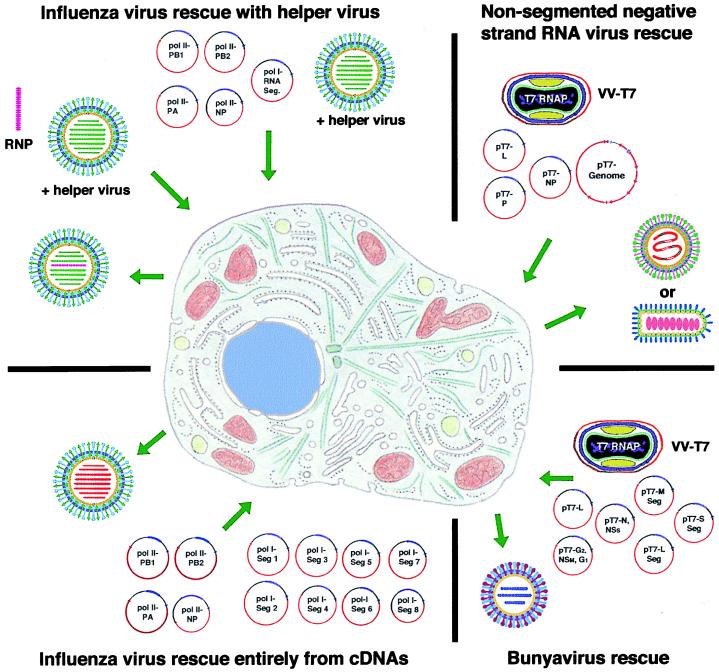
Methods used to recover negative-strand RNA
viruses from plasmid DNA. Several methodologies have been used to
rescue negative-strand RNA viruses from plasmid-derived DNA. The
initial replacement of individual RNA segments of influenza virus
involved either (i) the in vitro
reconstitution of RNPs or (ii) the in
vivo assembly of RNPs after transfection of a cell with
plasmids that use pol II promoters driving the expression of the PA,
PB1, PB2, and NP proteins, and pol I promoters and terminators
controlling viral genome synthesis. In either case, transfection was
followed by infection with a helper influenza virus. Nonsegmented
negative-strand virus rescue involves the transfection of plasmids
encoding the viral P, N, and L proteins (and sometimes other viral
proteins depending on the virus), as well as the viral antigenome, all
under control of the bacteriophage T7 RNAP promoter. The T7 RNAP is
provided by either infection with vv-T7, a recombinant vaccinia virus
that expresses T7 RNAP or by transfecting into cell lines that stably
express the protein. Bunyavirus rescue requires the transfection of
plasmids encoding the three RNA segments in the antigenomic sense,
along with three plasmids encoding the viral proteins, all under
control of the T7 RNAP promoter. Influenza virus rescue entirely from
plasmid DNA involves the transfection of plasmids encoding each of the
eight RNA segments (under control of the pol I promoter and terminator)
and plasmids encoding the four proteins that make up the polymerase
complex (under control of the pol II promoter).
Comment on
-
Generation of influenza A viruses entirely from cloned cDNAs.Proc Natl Acad Sci U S A. 1999 Aug 3;96(16):9345-50. doi: 10.1073/pnas.96.16.9345. Proc Natl Acad Sci U S A. 1999. PMID: 10430945 Free PMC article.
References
Publication types
MeSH terms
Substances
LinkOut - more resources
Full Text Sources
Other Literature Sources
