


Review
doi: 10.1073/pnas.96.16.8819.
Biological clocks
Affiliations
- PMID: 10430850
- PMCID: PMC33693
- DOI: 10.1073/pnas.96.16.8819
Item in Clipboard
Review
Biological clocks
Proc Natl Acad Sci U S A.
.
Erratum in
- Proc Natl Acad Sci U S A 2000 Aug 1;97(16):9347
Abstract
Circadian rhythms describe biological phenomena that oscillate with an approximately 24-hour cycle. These rhythms include blood pressure, body temperature, hormone levels, the number of immune cells in blood, and the sleep-wake cycle. In this paper, we will focus on common genes between species that are responsible for determining the circadian behavior, especially some transcription factors (i.e., switch genes) that serve to regulate many circadian rhythm genes. The intent of this summary is to introduce the common molecular mechanism of biological clocks between flies and humans and then to describe the research from three laboratories that was presented in the session.
Figures
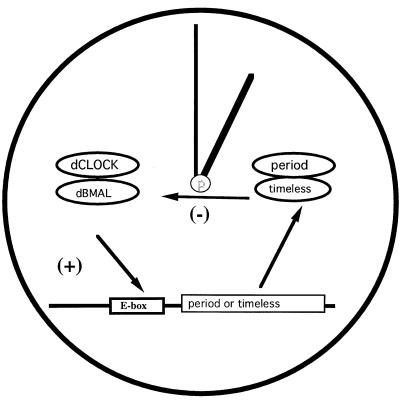
The negative feedback model of molecular
biological clock. Recent studies from both mammals and flies suggest
that the protein partners of clock are also evolutionary conserved
(named BMAL). CLOCK-BMAL dimers were shown to transactivate the
expression of period and timeless genes.
Furthermore, PER-TIM plays a role as the repressor of
CLOCK-BMAL-mediated reporter induction.
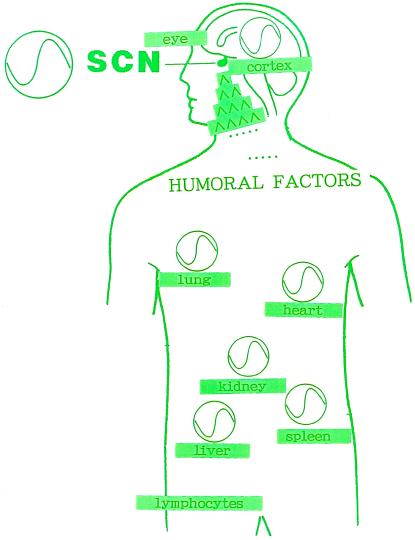
The master clock (SCN) governs the peripheral
tissue rhythm in mammals. The fact that the rhythmic expression of
RPER2 mRNA in several tissues completely depends on the SCN suggests
that some signals (Humoral Factors) are needed to maintain coordinately
the rhythm of the whole body.
References
-
- Bünning E. The Physiological Clock. New York: Springer; 1967.
-
- Sehgel A, Price J L, Man B, Young M. Science. 1994;263:1603–1606. - PubMed
Publication types
MeSH terms
Substances
LinkOut - more resources
Full Text Sources
Other Literature Sources
Molecular Biology Databases
