. 1999 Aug 3;96(16):9196-200.
doi: 10.1073/pnas.96.16.9196.

Early hominid biogeography

Affiliations

Early hominid biogeography

D S Strait et al. Proc Natl Acad Sci U S A. .

Abstract

We examined the biogeographic patterns implied by early hominid phylogenies and compared them to the known dispersal patterns of Plio-Pleistocene African mammals. All recent published phylogenies require between four and seven hominid dispersal events between southern Africa, eastern Africa, and the Malawi Rift, a greater number of dispersals than has previously been supposed. Most hominid species dispersed at the same time and in the same direction as other African mammals. However, depending on the ages of critical hominid specimens, many phylogenies identify at least one hominid species that dispersed in the direction opposite that of contemporaneous mammals. This suggests that those hominids may have possessed adaptations that allowed them to depart from continental patterns of mammalian dispersal.


Figures
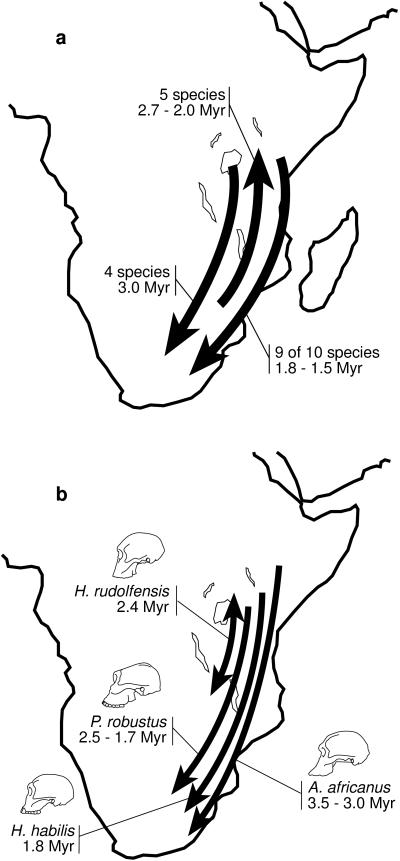
Figure 1
Figure 1
Plio-Pleistocene dispersals of African mammals. (a) Three waves of mammalian dispersal (1), including a southward dispersal at 3.0 Myr of Canis, Diceros, Australopithecus, and Metridiochoerus, a northward dispersal between 2.7 and 2.0 Myr of Cercopithecoides, Connochaetes, Parmularius, Tragelaphus, and Antidorcas, and a southward dispersal between 1.8 and 1.5 Myr of Theropithecus, Nyctereutes, Equus, Metridiochoerus, Homo, Kobus, Hippotragus, and two species of Tragelaphus. Hipparion disperses northward at 1.7 Myr when other mammals are dispersing southward. Each wave of dispersals is either significantly or nearly significantly different from random. Other studies have placed H. habilis in the northward event (2) and P. robustus in the late southward event (3), and H. rudolfensis may have dispersed with other eastern African mammals into the Corridor at ≈2.4 Myr (2). (b) Early hominid dispersals implied by Fig. 2 b, c, and e (29, 30), under the assumption that H. habilis originated in eastern Africa (see Table 1). The direction of the H. rudolfensis dispersal is unclear. Different patterns are implied if H. habilis originated in southern Africa. Fig. 2b also includes a northward migration at ≈2.7 Myr of the common ancestor of Homo and Paranthropus (not shown).
Figure 2
Figure 2
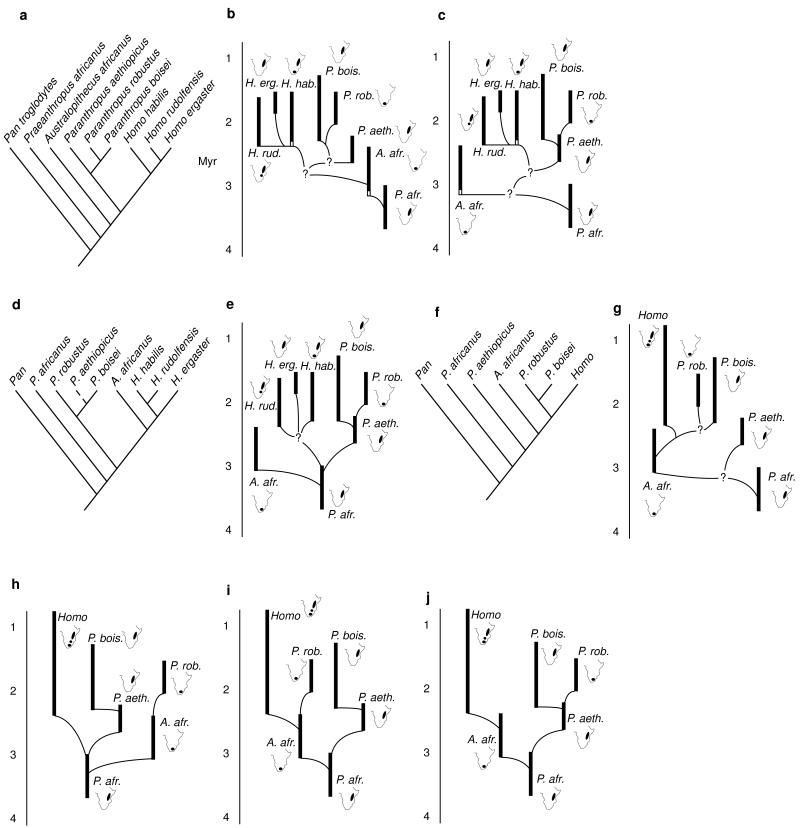
Early hominid phylogenies. (ac) Cladogram and phyletic trees of Strait et al. (30). (d and e) Cladogram and phyletic tree of Wood (29). (f and g) Cladogram and phyletic tree of Skelton and McHenry (24). (h and i) Phyletic trees consistent with Walker et al. (14). (j) Phyletic tree of Delson (25) and Grine (26). For each taxon in the phyletic trees, a map of Africa is shown indicating the regions in which its fossils are found. Dashed line in d represents an implied relationship. Black vertical bars indicate the known time ranges of hominid species. White vertical bars in b and c indicate inferred time ranges. Time scale in millions of years (Myr) is given to the left of each phyletic tree. All phylogenies are depicted by using the alpha taxonomy of Strait et al. (30). Note that the Pliocene hominids traditionally attributed to Australopithecus afarensis are here referred to Praeanthropus africanus because the inclusion of this hypodigm within Australopithecus has the effect of making that genus paraphyletic [see Strait et al. (30) for a more complete review].

References

    1. Turner A, Wood B A. J Hum Evol. 1993;24:147–168.
    1. Bromage T G, Schrenk F. J Hum Evol. 1995;28:109–114.
    1. Foley R A. Another Unique Species. New York: Longman; 1987.
    1. Foley, R. A., in African Biogeography, Climate Change, and Human Evolution, eds. Bromage, T. G. & Schrenk, F. (Oxford Univ. Press, New York), in press.
    1. Vrba E S. J Mammal. 1992;73:1–28.

Publication types

LinkOut - more resources