Comparative Study
. 1999 Aug 3;96(16):9224-9.
doi: 10.1073/pnas.96.16.9224.

A phenotype for enigmatic DNA polymerase II: a pivotal role for pol II in replication restart in UV-irradiated Escherichia coli

Affiliations
Comparative Study

A phenotype for enigmatic DNA polymerase II: a pivotal role for pol II in replication restart in UV-irradiated Escherichia coli

S Rangarajan et al. Proc Natl Acad Sci U S A. .

Abstract

DNA synthesis in Escherichia coli is inhibited transiently after UV irradiation. Induced replisome reactivation or "replication restart" occurs shortly thereafter, allowing cells to complete replication of damaged genomes. At the present time, the molecular mechanism underlying replication restart is not understood. DNA polymerase II (pol II), encoded by the dinA (polB) gene, is induced as part of the global SOS response to DNA damage. Here we show that pol II plays a pivotal role in resuming DNA replication in cells exposed to UV irradiation. There is a 50-min delay in replication restart in mutant cells lacking pol II. Although replication restart appears normal in DeltaumuDC strains containing pol II, the restart process is delayed for >90 min in cells lacking both pol II and UmuD'(2)C. Because of the presence of pol II, a transient replication-restart burst is observed in a "quick-stop" temperature-sensitive pol III mutant (dnaE486) at nonpermissive temperature. However, complete recovery of DNA synthesis requires the concerted action of both pol II and pol III. Our data demonstrate that pol II and UmuD'(2)C act in independent pathways of replication restart, thereby providing a phenotype for pol II in the repair of UV-damaged DNA.


Figures

Figure 1
Figure 1
UV survival of ΔpolB and ΔumuDC strains. ●, AB1157 (polB+umuDC+); ○, STL1336 (ΔpolB); ▾, SR1157U (ΔumuDC); ▿, SR1336U (ΔpolBΔumuDC). The data represent the mean of three experiments. Error bars show the standard error of the mean.
Figure 2
Figure 2
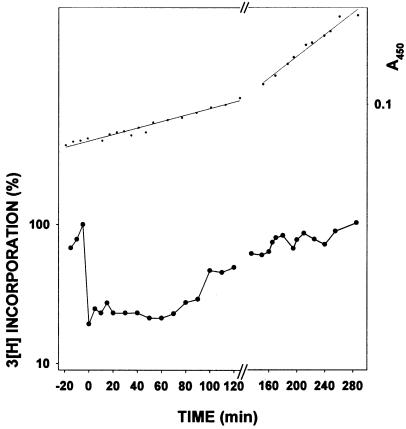
Comparison of the rates of post-UV DNA synthesis in wild-type, ΔpolB, and ΔumuDC strains. Experiments were performed as described in Materials and Methods. In the lower portion, the rate of 3H thymidine incorporation (both before and after UV) is plotted on a logarithmic scale as a percentage of the rate of incorporation at the time of UV irradiation. In the upper portion, the linear regressions are determined from an average of A450 values for the two strains in each plot. (A) ○, AB1157 (polB+umuDC+); ■, SR1157U (ΔumuDC). (B) ○, AB1157 (polB+umuDC+); ▾, STL1336 (ΔpolB). The experiment from which the data were plotted was repeated six times and is reproducible. The delay before resumption of replication in the ΔpolB strain, shown in B, is occurring between 50 and 60 min post-irradiation.
Figure 3
Figure 3
Rates of post-UV DNA synthesis in strains deleted for both pol II and UmuDC. Replication restart DNA synthesis rates were measured as described in Materials and Methods using SR1336U (ΔpolBΔumuDC). The data were plotted as described in Fig. 2. The experiment from which the data were plotted was repeated four times.
Figure 4
Figure 4
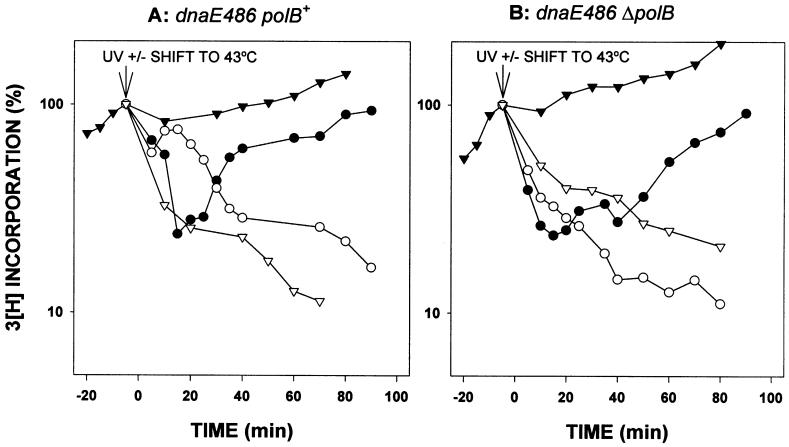
Rates of DNA synthesis in dnaE486 polB+polB strains. The ability of cells to replicate their DNA was measured essentially as described in Fig. 2. The only difference is that the initial DNA synthesis was at 30°C. Where noted, some cells were shifted to the nonpermissive temperature of 43°C. (A) RW620 (dnaE486polB+) unirradiated at 30°C (▾); irradiated at 30°C (●); unirradiated at 43°C (▿); and irradiated at 43°C (○). (B) RW622 (dnaE486ΔpolB) unirradiated at 30°C (▾); irradiated at 30°C (●); unirradiated at 43°C (▿); and irradiated at 43°C (○). The experiment from which the data were plotted was repeated four times and is reproducible. The rapid resumption of replication followed by the steep decline in incorporation observed at nonpermissive temperature in the dnaE486polB+ strain, shown in A, was observed in each of the repeat experiments.

References

    1. Bonner C A, Randall S K, Rayssiguier C, Radman M, Eritja R, Kaplan B E, McEntee K, Goodman M F. J Biol Chem. 1988;263:18946–18952. - PubMed
    1. Bonner C A, Hays S, McEntee K, Goodman M F. Proc Natl Acad Sci USA. 1990;87:7663–7667. - PMC - PubMed
    1. Iwasaki H, Nakata A, Walker G, Shinagawa H. J Bacteriol. 1990;172:6268–6273. - PMC - PubMed
    1. Qiu Z, Goodman M F. J Biol Chem. 1997;272:8611–8617. - PubMed
    1. Knippers R. Nature (London) 1970;228:1050–1053. - PubMed

Publication types

MeSH terms

LinkOut - more resources