Role of tachykinin NK2-receptor activation in the allergen-induced late asthmatic reaction, airway hyperreactivity and airway inflammatory cell influx in conscious, unrestrained guinea-pigs
- PMID: 10433512
- PMCID: PMC1566098
- DOI: 10.1038/sj.bjp.0702628
Role of tachykinin NK2-receptor activation in the allergen-induced late asthmatic reaction, airway hyperreactivity and airway inflammatory cell influx in conscious, unrestrained guinea-pigs
Abstract
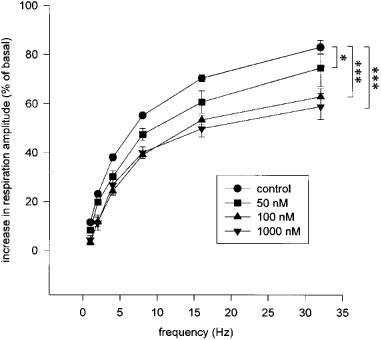
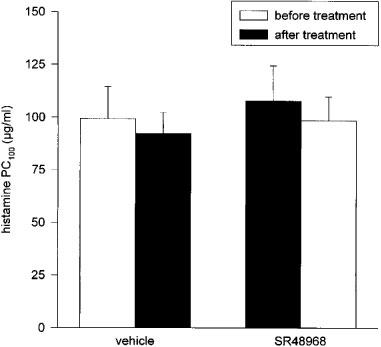
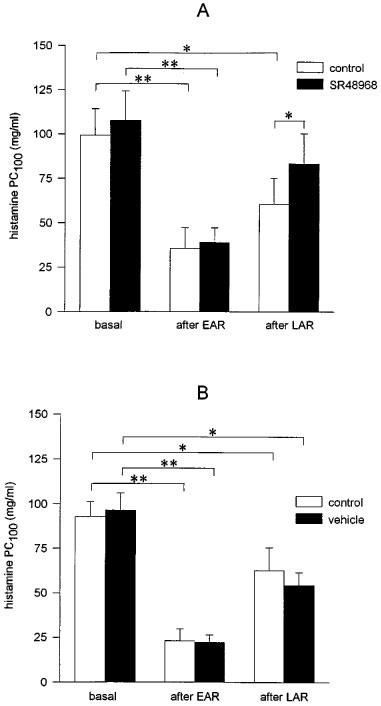
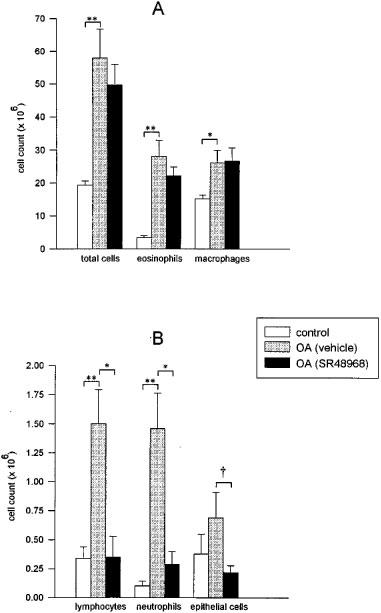
1. In a guinea-pig model of allergic asthma, we investigated the involvement of the tachykinin NK2 receptors in allergen-induced early (EAR) and late (LAR) asthmatic reactions, airway hyperreactivity (AHR) after these reactions and inflammatory cell influx in the airways, using the selective non-peptide NK2 receptor antagonist SR48968. 2. On two different occasions, separated by a 1 week interval, ovalbumin (OA)-sensitized guinea-pigs inhaled either vehicle (3 min) or SR48968 (100 nM, 3 min) at 30 min before as well as at 5.5 h after OA provocation (between the EAR and LAR) in a random crossover design. 3. SR48968 had no significant effect on the EAR, but significantly attenuated the LAR by 44.2+/-16.4% (P<0.05) compared to saline control. 4. The NK2 receptor antagonist did not affect the OA-induced AHR to histamine after the EAR at 5 h after OA challenge (3.59+/-0.59 fold increase in histamine reactivity vs 3.79+/-0.61 fold increase in the controls, NS), but significantly reduced the AHR after the LAR at 23 h after OA challenge (1.59+/-0.24 fold increase vs 1.93+/-0.15 fold increase, respectively, P<0.05). 5. Bronchoalveolar lavage studies performed at 25 h after the second OA provocation showed that SR48968 significantly inhibited the allergen-induced infiltration of neutrophils (P<0.05) and lymphocytes (P<0.01) in the airways. 6. These results indicate that NK2 receptor activation is importantly involved in the development of the allergen-induced late (but not early) asthmatic reaction and late (but not early) AHR to histamine, and that NK2 receptor-mediated infiltration of neutrophils and lymphocytes in the airways may contribute to these effects.
Figures
References
-
- ADCOCK I.M., PETERS M., GELDER C., SHIRASAKI H., BROWN C.R., BARNES P.J. Increased tachykinin receptor gene expression in asthmatic lung and its modulation by steroids. J. Mol. Endocrinol. 1993;11:1–7. - PubMed
-
- ADVENIER C., LAGENTE V., BOICHOT E. The role of tachykinin receptor antagonists in the prevention of bronchial hyperresponsiveness, airway inflammation and cough. Eur. Respir. J. 1997;10:1892–1906. - PubMed
-
- ADVENIER C., ROUISSI N., NGUYEN Q.T., EMONDS ALT X., BRELIERE J.C., NELIAT G., NALINE E., REGOLI D. Neurokinin A (NK2) receptor revisited with SR 48968, a potent non-peptide antagonist. Biochem. Biophys. Res. Commun. 1992;184:1418–1424. - PubMed
-
- BAI T.R., ZHOU D., WEIR T., WALKER B., HEGELE R., HAYASHI S., MCKAY K., BONDY G.P., FONG T. Substance P (NK1)- and neurokinin A (NK2)-receptor gene expression in inflammatory airway diseases. Am. J. Physiol. 1995;269:L309–L317. - PubMed
-
- BARNES P.J. Reactive oxygen species and airway inflammation. Free Radic. Biol. Med. 1990;9:235–243. - PubMed
Publication types
MeSH terms
Substances
LinkOut - more resources
Full Text Sources
Medical
Miscellaneous