


Ovarian hormone dependence of alpha(1)-adrenoceptor activation of the nitric oxide-cGMP pathway: relevance for hormonal facilitation of lordosis behavior
- PMID: 10436072
- PMCID: PMC6782854
- DOI: 10.1523/JNEUROSCI.19-16-07191.1999
Ovarian hormone dependence of alpha(1)-adrenoceptor activation of the nitric oxide-cGMP pathway: relevance for hormonal facilitation of lordosis behavior
Abstract
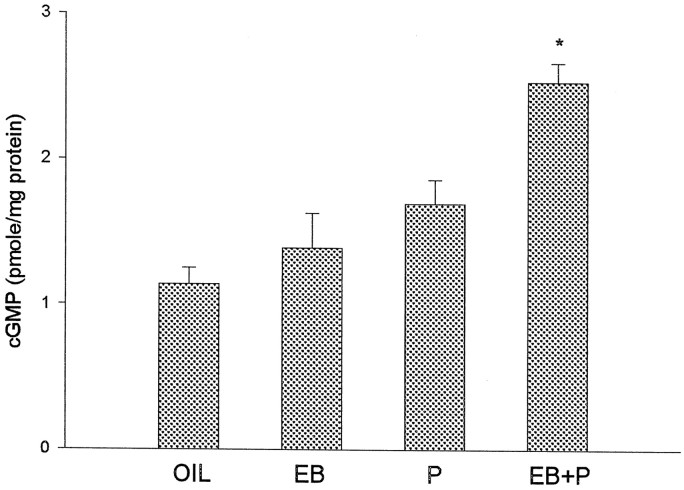
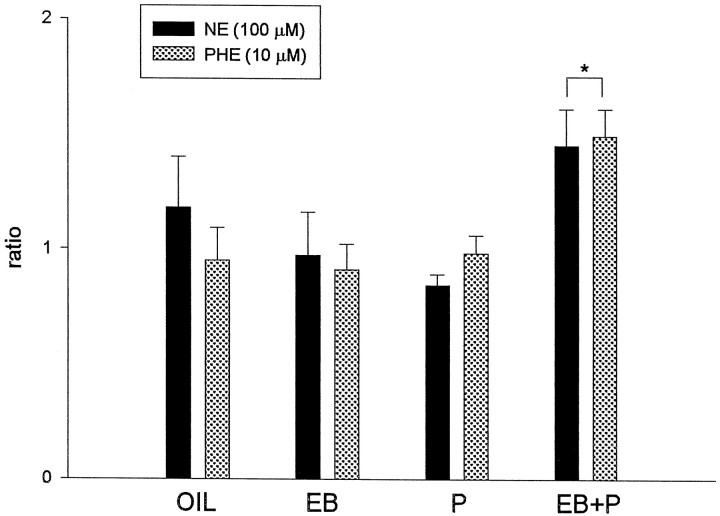
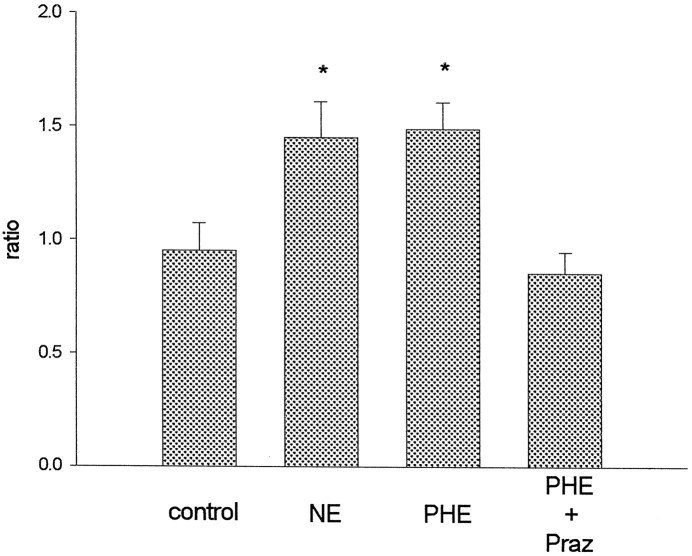
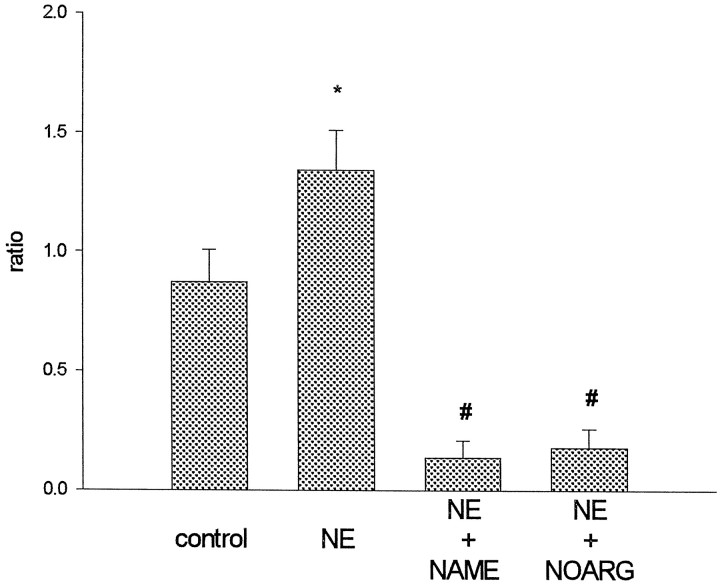
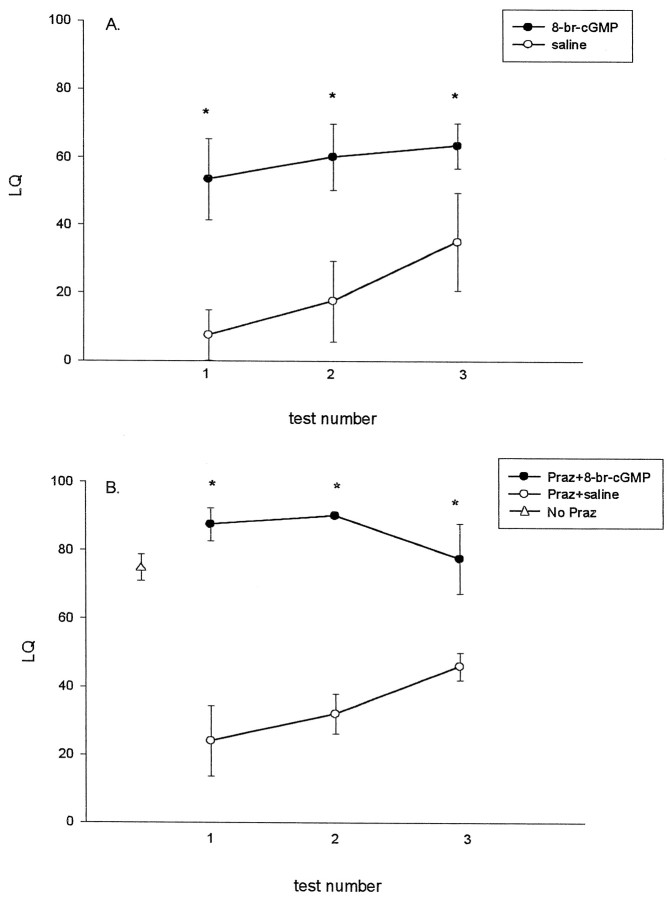
The ovarian hormones estradiol (E(2)) and progesterone (P) facilitate rat lordosis behavior in part by regulating the expression of and signal transduction by adrenoceptors in the hypothalamus (HYP) and preoptic area (POA). The major adrenoceptor subtype mediating E(2) and P facilitation of lordosis is the alpha(1)-adrenoceptor. In the present studies, we tested the hypotheses that (1) alpha(1)-adrenoceptors in the HYP enhance lordosis responses by activating the nitric oxide (NO)-cGMP signaling pathway, and (2) coupling of alpha(1)-adrenoceptors to this signal transduction pathway is hormone-dependent. Basal levels of cGMP were significantly higher in HYP and POA slices from animals treated with E(2) and P when compared with slices from ovariectomized controls or females treated with only E(2) or P. When slices of HYP and POA from ovariectomized female rats were incubated with norepinephrine or the selective alpha(1)-adrenoceptor agonist phenylephrine, cGMP accumulation was observed only if slices had been derived from females treated with both E(2) and P before experimentation. Moreover, alpha(1)-adrenoceptor stimulation of cGMP synthesis was blocked by an inhibitor of NO synthase, confirming that these receptors act by NO-mediated stimulation of soluble guanylyl cyclase. Behavioral studies demonstrated further that the cell-permeable cGMP analog 8-bromoadenosine-cGMP reverses the inhibitory effects of the alpha(1)-adrenoceptor antagonist prazosin on lordosis behavior in E(2)- and P-treated female rats. Thus, the NO-cGMP pathway mediates the facilitatory effects of alpha(1)-adrenoceptors on lordosis behavior in female rats, and previous exposure of the HYP and POA to both E(2) and P are required to link alpha(1)-adrenoceptors to this pathway.
Figures
References
-
- Ari IL, Schwarz L, Atlas D. Cholinergic-induced [3H] noradrenaline release in rat brain cortical slices is mediated via a pertussis toxin sensitive GTP binding protein and involves activation of protein kinase C. Cell Signal. 1989;1:461–470. - PubMed
-
- Beyer C, Gonzalez-Flores O, Gonzalez-Mariscal G. Progesterone receptor participates in the stimulatory effect of LHRH, prostaglandin E2, and cyclic AMP on lordosis and proceptive behaviours in rats. J Neuroendocrinol. 1997;9:609–614. - PubMed
-
- Bhat GK, Mahesh VB, Lamar CA, Ping L, Aguan K, Brann DW. Histochemical localization of nitric oxide neurons in the hypothalamus: association with gonadotropin-releasing hormone neurons and co-localization with N-methyl-d-aspartate receptors. Neuroendocrinology. 1995;62:187–197. - PubMed
-
- Bonavera JJ, Sahu A, Kalra PS, Kalra SP. Evidence that nitric oxide may mediate the ovarian steroid-induced luteinizing hormone surge: involvement of excitatory amino acids. Endocrinology. 1993;133:2481–2487. - PubMed
-
- Brann DW, Bhat GK, Lamar CA, Mahesh VB. Gaseous transmitters and neuroendocrine regulation. Neuroendocrinology. 1997;65:385–395. - PubMed
Publication types
MeSH terms
Substances
Grants and funding
LinkOut - more resources
Full Text Sources
