


Antibody-independent protection against rotavirus infection of mice stimulated by intranasal immunization with chimeric VP4 or VP6 protein
- PMID: 10438847
- PMCID: PMC104284
- DOI: 10.1128/JVI.73.9.7574-7581.1999
Antibody-independent protection against rotavirus infection of mice stimulated by intranasal immunization with chimeric VP4 or VP6 protein
Abstract
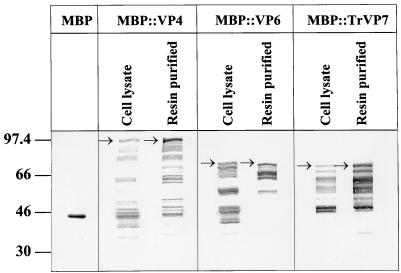
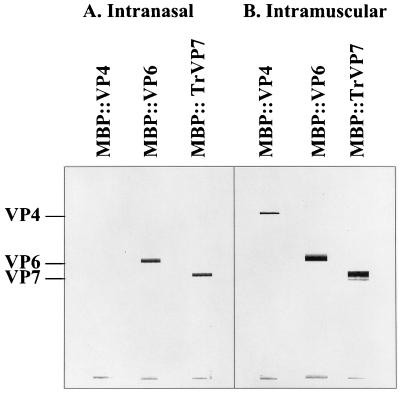
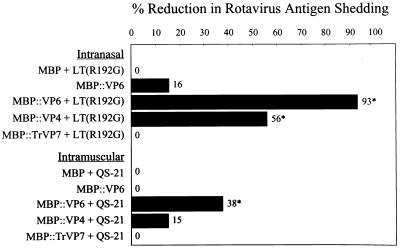
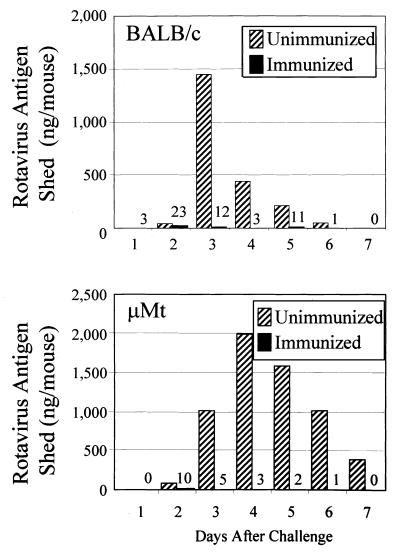
This study was to determine whether individual rotavirus capsid proteins could stimulate protection against rotavirus shedding in an adult mouse model. BALB/c mice were intranasally or intramuscularly administered purified Escherichia coli-expressed murine rotavirus strain EDIM VP4, VP6, or truncated VP7 (TrVP7) protein fused to the 42.7-kDa maltose-binding protein (MBP). One month after the last immunization, mice were challenged with EDIM and shedding of rotavirus antigen was measured. When three 9-microg doses of one of the three rotavirus proteins fused to MBP were administered intramuscularly with the saponin adjuvant QS-21, serum rotavirus immunoglobulin G (IgG) was induced by each protein. Following EDIM challenge, shedding was significantly (P = 0.02) reduced (i.e., 38%) in MBP::VP6-immunized mice only. Three 9-micrograms doses of chimeric MBP::VP6 or MBP::TrVP7 administered intranasally with attenuated E. coli heat-labile toxin LT(R192G) also induced serum rotavirus IgG, but MBP::VP4 immunization stimulated no detectable rotavirus antibody. No protection against EDIM shedding was observed in the MBP::TrVP7-immunized mice. However, shedding was reduced 93 to 100% following MBP::VP6 inoculation and 56% following MBP::VP4 immunization relative to that of controls (P = <0.001). Substitution of cholera toxin for LT(R192G) as the adjuvant, reduction of the number of doses to 1, and challenge of the mice 3 months after the last immunization did not reduce the level of protection stimulated by intranasal administration of MBP::VP6. When MBP::VP6 was administered intranasally to B-cell-deficient microMt mice that made no rotavirus antibody, shedding was still reduced to <1% of that of controls. These results show that mice can be protected against rotavirus shedding by intranasal administration of individual rotavirus proteins and that this protection can occur independently of rotavirus antibody.
Figures
References
-
- Andrew M E, Boyle D B, Coupar B E, Reddy D, Bellamy A R, Both G W. Vaccinia-rotavirus VP7 recombinants protect mice against rotavirus-induced diarrhoea. Vaccine. 1992;10:185–191. - PubMed
-
- Bernstein D I, Glass R I, Rodgers G, Davidson B L, Sack D A. Evaluation of rhesus rotavirus monovalent and tetravalent reassortant vaccines in US children. US Rotavirus Vaccine Efficacy Group. JAMA. 1995;273:1191–1196. - PubMed
-
- Bernstein D I, Smith V E, Sander D S, Pax K A, Schiff G M, Ward R L. Evaluation of WC3 rotavirus vaccine and correlates of protection in healthy infants. J Infect Dis. 1990;162:1055–1062. - PubMed
-
- Both G W, Lockett L J, Janardhana V, Edwards S J, Bellamy A R, Graham F L, Prevec L, Andrew M E. Protective immunity to rotavirus-induced diarrhoea is passively transferred to newborn mice from naive dams vaccinated with a single dose of a recombinant adenovirus expressing rotavirus VP7sc. Virology. 1993;193:940–950. - PubMed
Publication types
MeSH terms
Substances
Grants and funding
LinkOut - more resources
Full Text Sources
Other Literature Sources
Medical
Miscellaneous
