


FcepsilonRI-mediated antigen endocytosis turns interferon-gamma-treated mouse mast cells from inefficient into potent antigen-presenting cells
- PMID: 10447750
- PMCID: PMC2326822
- DOI: 10.1046/j.1365-2567.1999.00789.x
FcepsilonRI-mediated antigen endocytosis turns interferon-gamma-treated mouse mast cells from inefficient into potent antigen-presenting cells
Abstract
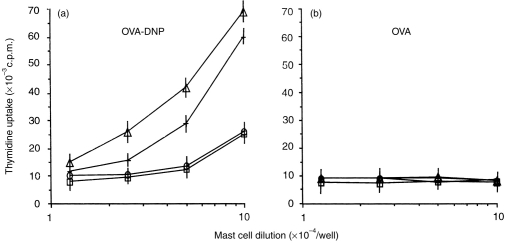
Previous studies in our laboratory have shown that bone-marrow-derived mast cells (BMMC) could present immunogenic peptides, from soluble antigens endocytosed through fluid phase, only if they were subjected to a 48-hr treatment with interleukin-4 (IL-4) and granulocyte-macrophage colony-stimulating factor (GM-CSF). In contrast to GM-CSF, interferon-gamma (IFN-gamma) which highly upregulates major histocompatibility complex (MHC) class II expression, completely inhibits the generation of immunogenic peptides. We have used this model to study the role of FcepsilonRI-mediated antigen internalization in the regulation of the antigen-presenting function of IFN-gamma-treated mast cells. Here, we report that FcepsilonRI can reverse the IFN-gamma-treated mast cells from inefficient to highly efficient antigen-presenting cells. Inhibition of the antigen presenting capacity by piceatannol, a protein tyrosine kinase (PTK) syk inhibitor, indicates that this is an active process resulting from immunoglobulin E (IgE)-antigen-FcepsilonRI engagement which involves tyrosines found in the immunoreceptor tyrosine-based activation motif (ITAM) embedded in the cytoplasmic tail of the FcepsilonRI beta and gamma chains. Antigen-presenting function was also shown to require the activation of phosphatidyl inositol 3 (PI3) kinase, downstream of PTK syk phosphorylation, since this activity was completely blocked by wortmannin, a PI3 kinase inhibitor. These data suggest that signalling generated by FcepsilonRI provides mast cells with IgE-mediated enhanced antigen presentation to T cells and emphasize a so far unknown immunoregulatory mast-cell function that might take place in inflammatory sites.
Figures




References
-
- Pirron U, Schlunck T, Prinz JC, Rieber EP. IgE-dependent antigen focusing by human B lymphocytes is mediated by the low-affinity receptor for IgE. Eur J Immunol. 1990;20:1547. - PubMed
-
- Squire MC, Studer EJ, Lees A, Finkelman FD, Conrad DH. Antigen presentation is enhanced by targeting antigen to FcεRII by antigen-anti-FcεRII conjugates. J Immunol. 1994;152:4388. - PubMed
-
- Heyman B, Tianmin L, Gustavsson S. In vivo enhancement of the specific antibody response via the low-affinity receptor for IgE. Eur J Immunol. 1993;23:1739. - PubMed
-
- Gustavsson S, Hjulstrom S, Liu T, Heyman B. CD23/IgE-mediated regulation of the specific antibody response in vivo. J Immunol. 1994;152:4793. - PubMed
MeSH terms
Substances
LinkOut - more resources
Full Text Sources
Research Materials
Miscellaneous
