. 1999 Aug 17;96(17):9797-802.
doi: 10.1073/pnas.96.17.9797.

Functional characterization of B lymphocytes generated in vitro from embryonic stem cells

Affiliations

Functional characterization of B lymphocytes generated in vitro from embryonic stem cells

S K Cho et al. Proc Natl Acad Sci U S A. .

Abstract

To study molecular events involved in B lymphocyte development and V(D)J rearrangement, we have established an efficient system for the differentiation of embryonic stem (ES) cells into mature Ig-secreting B lymphocytes. Here, we show that B lineage cells generated in vitro from ES cells are functionally analogous to normal fetal liver-derived or bone marrow-derived B lineage cells at three important developmental stages: first, they respond to Flt-3 ligand during an early lymphopoietic progenitor stage; second, they become targets for Abelson murine leukemia virus (A-MuLV) infection at a pre-B cell stage; third, they secrete Ig upon stimulation with lipopolysaccharide at a mature mitogen-responsive stage. Moreover, the ES cell-derived A-MuLV-transformed pre-B (EAB) cells are phenotypically and functionally indistinguishable from standard A-MuLV-transformed pre-B cells derived from infection of mouse fetal liver or bone marrow. Notably, EAB cells possess functional V(D)J recombinase activity. In particular, the generation of A-MuLV transformants from ES cells will provide an advantageous system to investigate genetic modifications that will help to elucidate molecular mechanisms in V(D)J recombination and in A-MuLV-mediated transformation.


Figures
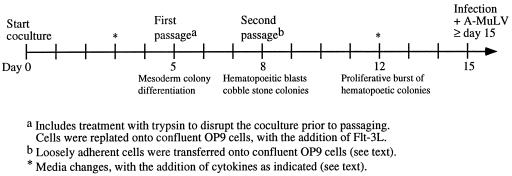
Figure 1
Figure 1
Outline of the standard protocol used for the differentiation of ES cells into B-lineage lymphocytes. ES cells were induced to differentiate into hematopoietic cells on the BM-derived stromal cell line OP9. To generate mature, functional B cells, hematopoietic cells were maintained on OP9 cells. To generate EAB cells, cocultures were infected with A-MuLV on or after day 15. Flt-3L was added for all media changes after day 5.
Figure 2
Figure 2
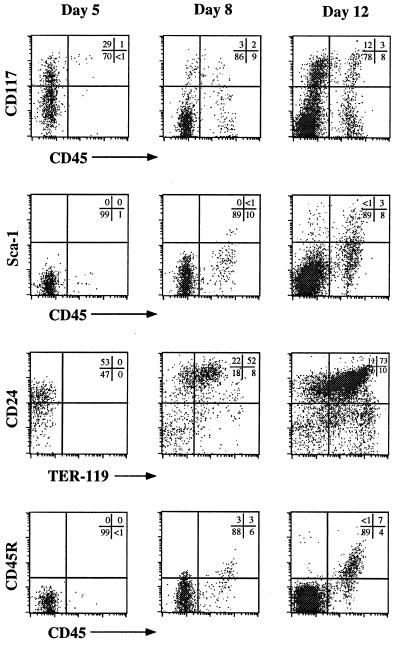
Temporal kinetics of hematopoietic induction in ES/OP9 cocultures. Representative flow cytometric analysis of various surface markers are shown for days 5, 8, and 12 of coculture. These results represent cocultures without exogenous addition of Flt-3L.
Figure 3
Figure 3
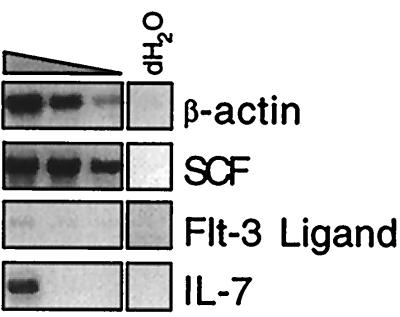
Cytokine expression in the OP9 cell line. Total RNA from OP9 cells was analyzed for the expression of several cytokines by RT–PCR. cDNAs were prepared from 1 μg of total RNA. OP9 cDNAs were diluted in a 1:5 series and then amplified simultaneously by PCR with gene-specific primer pairs as indicated.
Figure 4
Figure 4
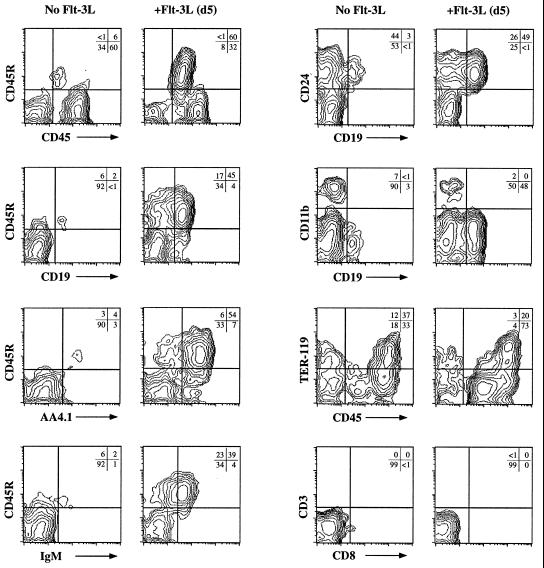
Flt-3L enhances the in vitro generation of ES cell-derived B lymphocytes. Flow cytometric analysis for various cell surface markers expressed on ES cell-derived B lineage cells from day-19 ES/OP9 cocultures. The addition of Flt-3L to the cocultures on day 5 resulted in a dramatic increase in the generation of B lymphocytes. Flt-3L was added each time the culture medium was replaced, as indicated in Fig. 1.
Figure 5
Figure 5
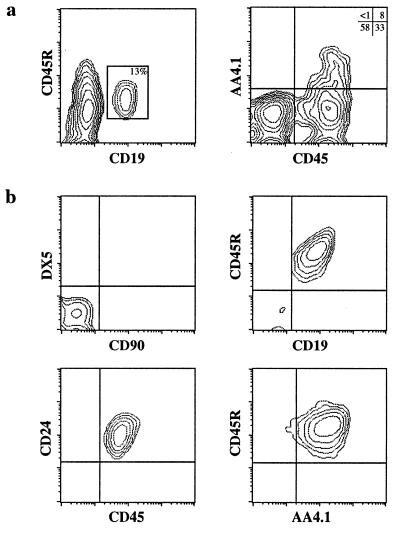
Characterization of EAB cells. (a) Flow cytometric analysis of day-15 ES/OP9 coculture for surface expression of CD19 vs. CD45R, and CD45 vs. AA4.1. The generation of ES cell-derived B lineage cells is clearly evident after 15 days of coculture. (b) Flow cytometric analysis of a representative EAB cell line shows nearly 100% homogeneity of pre-B cell-associated phenotype. Control staining with T and NK lineage mAbs is shown (Upper Left). The other panels show a composite phenotype, CD45R+ CD19+ CD24+ AA4.1+, consistent with the EAB cells designation as transformed pre-B cells.
Figure 6
Figure 6
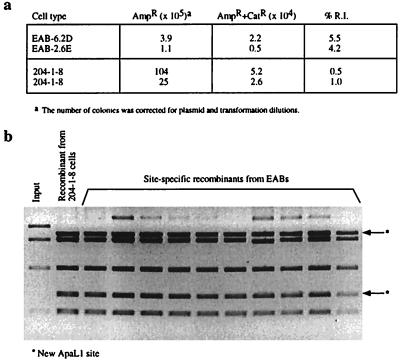
Recombination analysis in EAB cells. Site-specific recombination of the transfected V(D)J-containing plasmid pWTSJΔ results in transcription of the chloramphenicol-resistant gene and creates a new ApaLI restriction endonuclease site. (a) Recombination index (R.I.) of two EAB cell lines vs. a standard Abelson line, 204-1-8. %R.I. is the ratio of double-resistant AmpR+CatR colonies over AmpR colonies. (b) Inverted EtBr gel image of site-specific recombination products in the extrachromosomal V(D)J recombination assay, showing the two bands generated by a new ApaLI site.
Figure 7
Figure 7
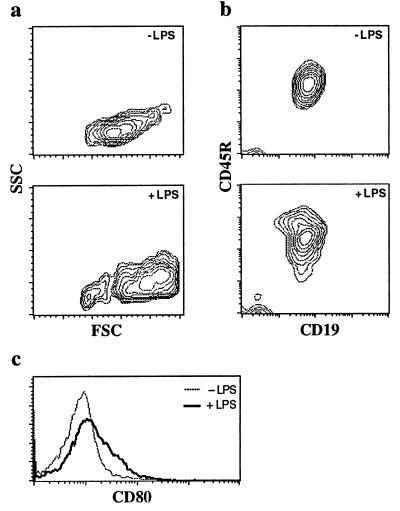
In vitro generation of ES-derived mature functional B cells. (a) Flow cytometric analysis for forward-scatter (FSC) by side-scatter (SSC). (b) CD19 by CD45R of ES/OP9 coculture with and without LPS treatment for 4 days. ELISA analysis of the culture supernatant collected 4 days after LPS stimulation showed high titer for secreted IgM (≈16 μg/ml). (c) Flow cytometric analysis for CD80 (B7-1) with and without LPS treatment for 48 hours. Mean fluorescence intensities: 10.25 for −LPS, and 21.81 for +LPS.

References

    1. Hardy R R, Carmack C E, Shinton S A, Kemp J D, Hayakawa K. J Exp Med. 1991;173:1213–1225. - PMC - PubMed
    1. Li Y S, Wasserman R, Hayakawa K, Hardy R R. Immunity. 1996;5:527–535. - PubMed
    1. Ikuta K, Uchida N, Friedman J, Weissman I L. Annu Rev Immunol. 1992;10:759–783. - PubMed
    1. Veiby O P, Lyman S D, Jacobsen S E W. Blood. 1996;88:1256–1265. - PubMed
    1. Lyman S D, Jacobsen S E. Blood. 1998;91:1101–1134. - PubMed

Publication types