. 1999 Aug 17;96(17):9867-72.
doi: 10.1073/pnas.96.17.9867.

Retroviral vectors preloaded with a viral receptor-ligand bridge protein are targeted to specific cell types

Affiliations

Retroviral vectors preloaded with a viral receptor-ligand bridge protein are targeted to specific cell types

A L Boerger et al. Proc Natl Acad Sci U S A. .

Abstract

Successful targeting methods represent a major hurdle to the use of retroviral vectors in cell-specific gene-delivery applications. We recently described an approach for retroviral targeting with a retroviral receptor-ligand bridge protein that was bound to the cognate cell-surface ligand receptors before viral challenge. We now report a significant improvement made to this viral targeting method by using a related bridge protein, designated TVB-EGF, comprised of the extracellular domain of the TVB receptor for subgroup B avian leukosis virus fused to epidermal growth factor (EGF). The most important activity of TVB-EGF was that it allowed specific viral entry when preloaded onto virions. Furthermore, virions preloaded with TVB-EGF were thermostable and could be produced directly from virus- packaging cells. These data suggest an approach for targeting retroviral vectors to specific cell types by using virions preloaded with a retroviral receptor-ligand bridge protein and indicate that these types of bridge proteins may be useful reagents for studying the normal mechanism of retroviral entry.


Figures
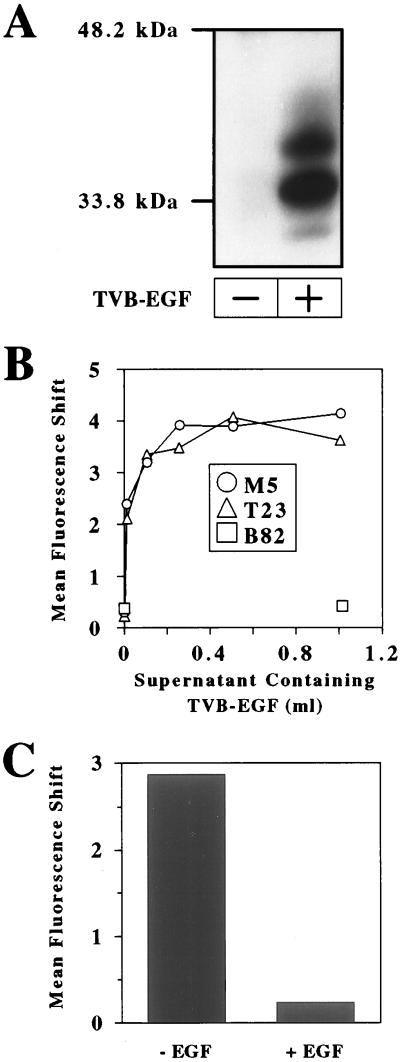
Figure 1
Figure 1
TVB-EGF binds specifically to cell surface EGFR. (A) Aliquots of extracellular supernatants from nontransfected 293 cells (−) and transfected 293 cells expressing TVB-EGF (+) were subjected to SDS/PAGE and to immunoblotting by using an EGF-specific antibody. (B) Mouse M5 cells expressing kinase-deficient EGFR, T23 cells expressing wild-type EGFR, and B82 cells, which lack EGFR, were incubated with increasing amounts of TVB-EGF. (C) M5 cells were incubated with TVB-EGF in the presence or absence of a recombinant EGF protein. (B–C) After each of these incubations, the cells were incubated with ALV-B SU-Ig and a FITC-conjugated secondary antibody and analyzed by flow cytometry as described (20).
Figure 2
Figure 2
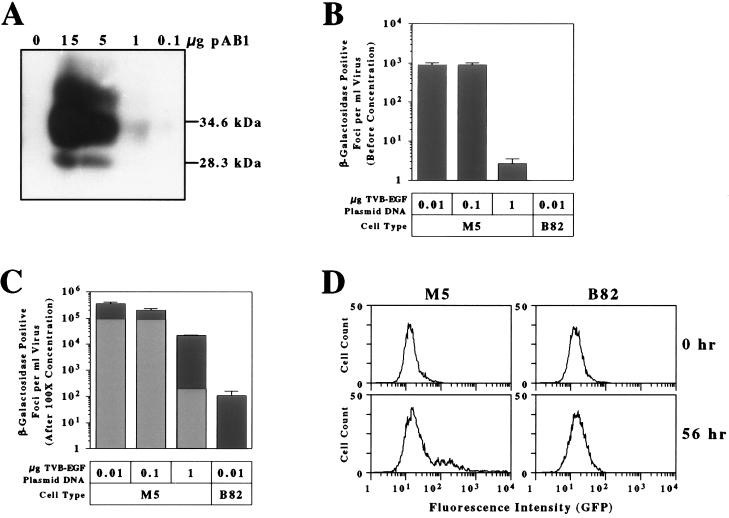
TVB-EGF-loaded virions produced directly from virus packaging cells infect M5 cells specifically. Human 293 cells were transfected with fixed amounts of plasmids encoding MLV-lacZ (ALV-B) and with variable amounts of plasmid pAB1 encoding TVB-EGF. (A) Aliquots of extracellular supernatants taken from these cells were monitored for TVB-EGF production by immunoblotting analysis by using a subgroup B ALV SU-Ig fusion protein (22) and a horseradish peroxidase-coupled secondary antibody. (B) M5 and B82 cells were challenged with MLV-lacZ (ALV-B) virions produced from cells that were cotransfected with the amounts of pAB1 plasmid DNA indicated, and the resultant numbers of infected cells were measured by lacZ staining. (C) MLV-lacZ (ALV-B)/TVB-EGF complexes shown in B were purified from unbound TVB-EGF and concentrated 100-fold before infection. Gray bars represent the expected infectious viral titer based on the 100-fold concentration effect (as compared with those numbers obtained in B). Black bars represent the actual infectious titers observed with the purified virion/TVB-EGF complexes. (D) M5 cells or B82 cells were cocultivated with human 293 cells that produce MLV-GFP (ALV-B)/TVB-EGF complexes. Flow cytometric profiles for M5 (Left) and B82 (Right) are shown after 0 or 56 h of cocultivation.
Figure 3
Figure 3
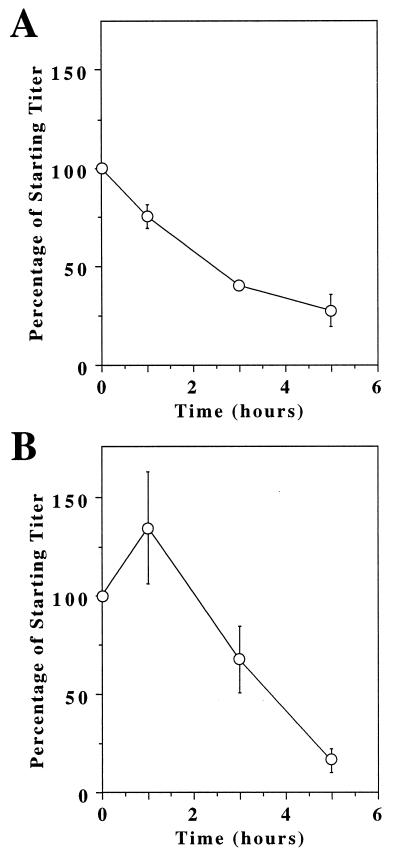
MLV-lacZ (ALV-B)/TVB-EGF complexes are stable at 37oC. MLV-lacZ (ALV-B) (A) or MLV-lacZ (ALV-B Env)/TVB-EGF (B) complexes were incubated at 37°C for different time intervals before addition to M5:S3/T cells or to M5 cells, respectively. The number of infected cells was measured by lacZ staining. The results shown reflect the percentage remaining of the starting virus titer (at t = 0). The starting titer of MLV-lacZ (ALV-B) was approximately 2 × 10⁵ lacZ-positive colonies per ml and that of the virion/TVB-EGF complexes was approximately 3 × 10⁴ lacZ-positive colonies per ml.

References

    1. Neda H, Wu C H, Wu G Y. J Biol Chem. 1991;266:14143–14146. - PubMed
    1. Roux P, Jeanteur P, Piechaczyk M. Proc Natl Acad Sci USA. 1989;86:9079–9083. - PMC - PubMed
    1. Etienne-Julan M, Roux P, Carillo S, Jeanteur P, Piechaczyk M. J Gen Virol. 1992;73:3251–3255. - PubMed
    1. Valsesia-Wittmann S, Drynda A, Deleage G, Aumailley M, Heard J M, Danos O, Verdier G, Cosset F L. J Virol. 1994;68:4609–4619. - PMC - PubMed
    1. Valsesia-Wittmann S, Morling F J, Nilson B H, Takeuchi Y, Russell S J, Cosset F L. J Virol. 1996;70:2059–2064. - PMC - PubMed

Publication types

MeSH terms

LinkOut - more resources