. 1999 Aug 17;96(17):9903-8.
doi: 10.1073/pnas.96.17.9903.

Blocking taste receptor activation of gustducin inhibits gustatory responses to bitter compounds

Affiliations

Blocking taste receptor activation of gustducin inhibits gustatory responses to bitter compounds

D Ming et al. Proc Natl Acad Sci U S A. .

Abstract

Gustducin, a transducin-like guanine nucleotide-binding regulatory protein (G protein), and transducin are expressed in taste receptor cells where they are thought to mediate taste transduction. Gustducin and transducin are activated in the presence of bovine taste membranes by several compounds that humans perceive to be bitter. We have monitored this activation with an in vitro assay to identify compounds that inhibited taste receptor activation of transducin by bitter tastants: AMP and chemically related compounds inhibited in vitro responses to several bitter compounds (e.g., denatonium, quinine, strychnine, and atropine). AMP also inhibited behavioral and electrophysiological responses of mice to bitter tastants, but not to NaCl, HCl, or sucrose. GMP, although chemically similar to AMP, inhibited neither the bitter-responsive taste receptor activation of transducin nor the gustatory responses of mice to bitter compounds. AMP and certain related compounds may bind to bitter-responsive taste receptors or interfere with receptor-G protein coupling to serve as naturally occurring taste modifiers.


Figures
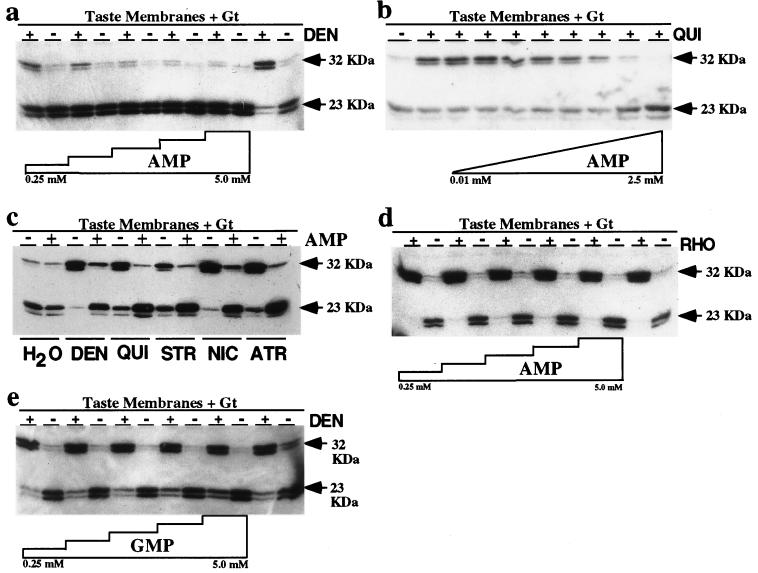
Figure 1
Figure 1
AMP inhibits activation of transducin by bitter stimuli in the presence of bovine taste receptor cell membranes. (a) Inactive (GDP-bound) transducin (rightmost lane) generates a 23 kDa fragment on digestion with trypsin. Active (GTPγS-bound) transducin (second from right lane) activated by DEN plus taste membranes generates a 32-kDa fragment on treatment with trypsin. Increasing concentrations of AMP (0.25, 0.5, 1.25, 2.5, and 5.0 mM) inhibit activation of transducin by DEN plus bovine taste receptor membranes, as determined by the shift from 32-kDa to 23-kDa fragments. (b) Increasing concentrations of AMP (0.01, 0.05, 0.10, 0.50, 1.0, 1.5, 2.0, and 2.5 mM) inhibit activation of transducin by 1.0 mM QUI plus bovine taste membranes. (c) AMP (2.5 mM) inhibits the taste membrane-dependent activation of transducin by DEN (5.0 mM), QUI (1.0 mM), strychnine hydrochloride (STR, 5.0 mM), nicotine hemisulfate (NIC, 5.0 mM), and atropine hydrochloride (ATR, 5.0 mM). (d) AMP (0.25, 0.5, 1.25, 2.5, and 5.0 mM) does not inhibit activation of transducin by 0.001 mM rhodopsin. (e) GMP (0.25. 0.5, 1.25, 2.5, and 5.0 mM) does not inhibit activation of transducin by DEN (5.0 mM) plus bovine taste membranes.
Figure 2
Figure 2
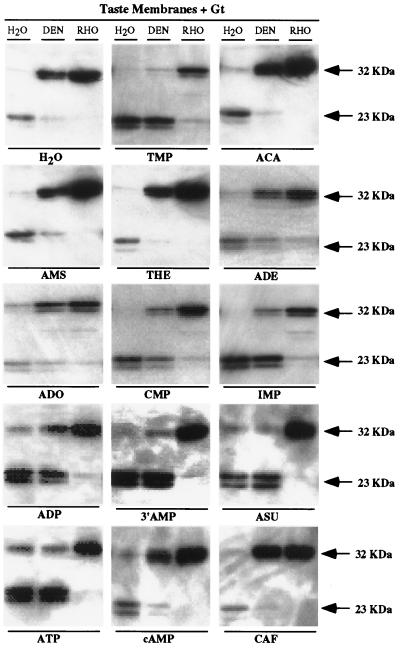
Only certain AMP analogues block activation of transducin by DEN plus taste membranes. Taste membrane-dependent activation of transducin by DEN (5.0 mM) is not inhibited by adenosine 5′-carboxylate (ACA, 5.0 mM), adenosine 5′-monosulfate (AMS, 5.0 mM), theophylline (THE, 5.0 mM), adenine hydrochloride (ADE, 5.0 mM), adenosine hydrochloride (ADO, 5.0 mM), cAMP (5.0 mM), or caffeine (CAF, 5.0 mM). DEN/taste membrane activation of transducin is inhibited by thymidine 5′-monophosphate (TMP, 5.0 mM), 5′-cytidylic acid (CMP, 5.0 mM), inosinic acid (IMP, 5.0 mM), ADP (5.0 mM), 3′AMP (5.0 mM), adenosine 5′-succinate (ASU, 5.0 mM) and ATP (5.0 mM). H2O and rhodopsin (RHO) lanes control for nonspecific receptor-independent effects.
Figure 3
Figure 3
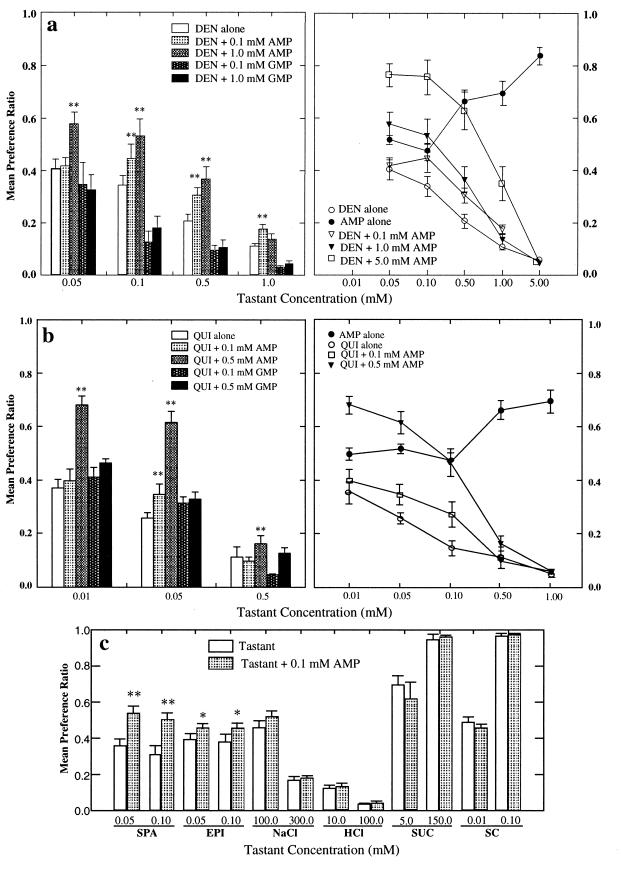
AMP blocks aversive responses of mice to several bitter compounds. (a) (Left) Forty-eight-hour two-bottle preference responses of C57BL/6J mice (n = 10) to DEN alone, AMP alone, DEN plus AMP (0.1 and 1.0 mM), and DEN plus GMP (0.1 and 1.0 mM). AMP (0.1 and 1.0 mM) inhibited the aversive responses to DEN at 0.05, 0.10, 0.50, and 1.0 mM (P < 0.001). GMP (0.1 and 1.0 mM) did not inhibit the aversive responses to DEN. **P < 0.001. Right: increasing concentrations of AMP (0.1, 1.0, 5.0 mM) shifted the dose-aversiveness curve to the right. AMP alone did not elicit behavioral responses until its concentration reached 0.5 mM. (b) (Left) Preference responses of C57BL/6J mice (n = 10) to QUI alone, AMP alone, QUI plus AMP (0.1 and 0.5 mM), and QUI plus GMP (0.1 and 0.5 mM). AMP (0.1 and 0.5 mM) inhibited the aversive responses to QUI at 0.05, 0.10, and 0.50 mM (P < 0.001). GMP (0.1 and 0.5 mM) did not inhibit the aversive responses to QUI. **P < 0.001. (Right) Increasing concentrations of AMP shifted the dose-aversiveness curve to the right. (c) Preference responses of C57BL/6J mice (n = 10) exposed to two different concentrations of tastants ± 0.1 mM AMP. AMP inhibited the aversive responses to the bitter tastants sparteine (SPA) at 0.05 and 0.10 mM (P < 0.001); and (−)-epicatechin (EPI) at 0.05 mM and 0.10 mM (P < 0.01). AMP did not alter the behavioral responses to NaCl (0.1 and 0.3 M), HCl (0.01 and 0.10 mM), sucrose (SUC) (5.0 and 150 mM), or the high-potency artificial sweetener SC45647 (SC) (0.01 and 0.10 mM). **P < 0.001; *P < 0.01.
Figure 4
Figure 4
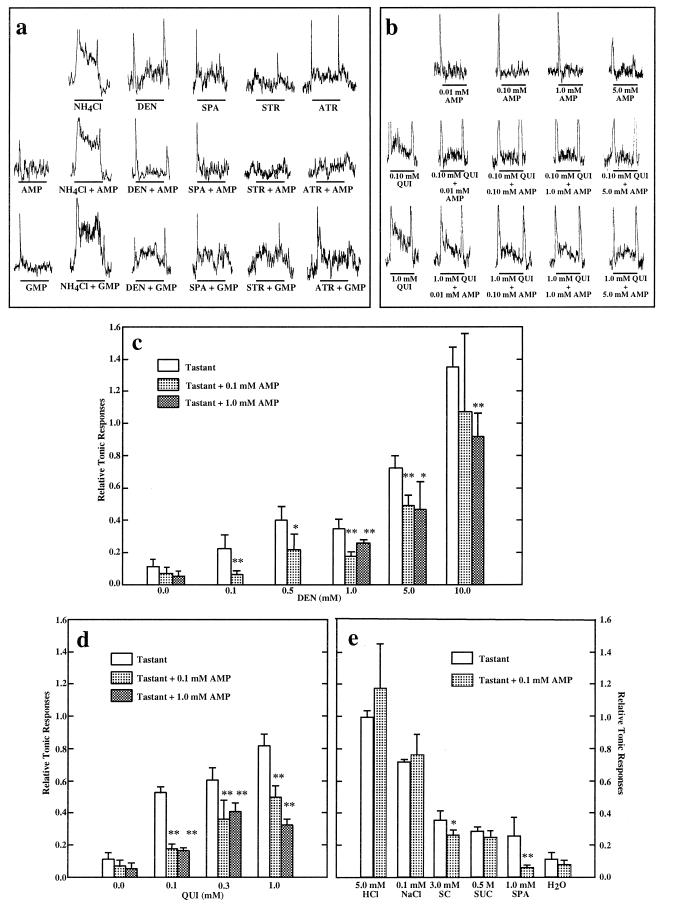
AMP diminishes the glossopharyngeal nerve responses of mice to lingual stimulation with bitter tastants. (a) (Top) Glossopharyngeal responses to 0.1 M NH4Cl, 5.0 mM DEN, 1.0 mM sparteine (SPA), 1.0 mM strychnine (STR), and 1.0 mM atropine (ATR). (Middle) Glossopharyngeal responses to the above compounds mixed with 0.1 mM AMP. (Bottom) Glossopharyngeal responses to the above compounds mixed with 0.1 mM GMP. (b) Glossopharyngeal responses to a series of concentrations of AMP (0.01, 0.1, 1.0, 5.0 mM) alone (Top), and in combination with QUI (0.1 mM and 1.0 mM) (Middle and Bottom, respectively). (c) Relative tonic responses recorded from glossopharyngeal nerves of mice (n = 5 to 7) stimulated by lingual application of DEN (0.1, 0.5, 1.0, 5.0, and 10.0 mM) ± AMP (0.1 and 1.0 mM). **P < 0.001; *P < 0.01. (d) Relative tonic responses recorded from glossopharyngeal nerves of mice (n = 6 to 8) stimulated by lingual application of QUI (0.1, 0.3, and 1.0 mM) and its mixtures with AMP (0.1 and 1.0 mM). **P < 0.001. (e) Relative tonic responses recorded from glossopharyngeal nerves of mice (n = 4 to 7) stimulated by lingual application of 5.0 mM HCl, 0.1 M NaCl, 3.0 mM SC45647, 0.5 M sucrose (SUC), 1.0 mM SPA, or water with or without 0.1 mM AMP. AMP inhibits the relative tonic responses of 1.0 mM SPA (P < 0.001) and 3.0 mM SC45647 (P < 0.01), but not of the other compounds. **P < 0.001; *P < 0.01.

References

    1. Kinnamon S C, Margolskee R F. Curr Opin Neurobiol. 1996;6:506–513. - PubMed
    1. Lindemann B. Physiol Rev. 1996;76:719–766. - PubMed
    1. McLaughlin S K, McKinnon P J, Margolskee R F. Nature (London) 1992;357:563–569. - PubMed
    1. Ruiz-Avila L, McLaughlin S K, Wildman D, McKinnon P J, Robichon A, Spickofsky N, Margolskee R F. Nature (London) 1995;376:80–85. - PubMed
    1. Wong G T, Gannon K S, Margolskee R F. Nature (London) 1996;381:796–800. - PubMed

Publication types

MeSH terms

LinkOut - more resources