


Differential induction of long-term synaptic facilitation by spaced and massed applications of serotonin at sensory neuron synapses of Aplysia californica
- PMID: 10454368
- PMCID: PMC313806
Differential induction of long-term synaptic facilitation by spaced and massed applications of serotonin at sensory neuron synapses of Aplysia californica
Abstract
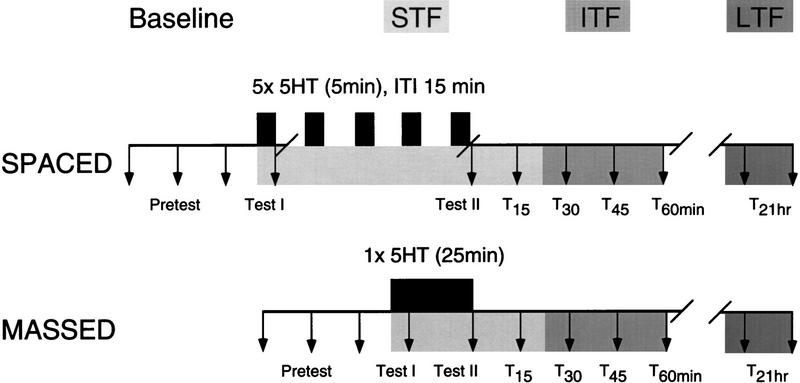
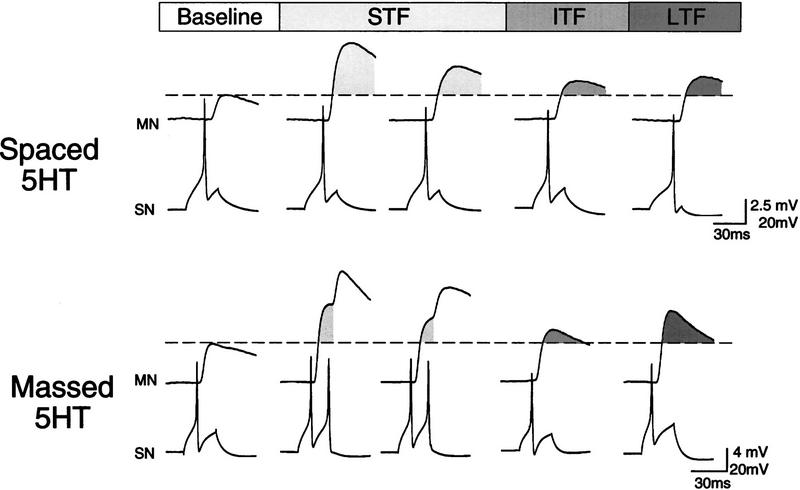
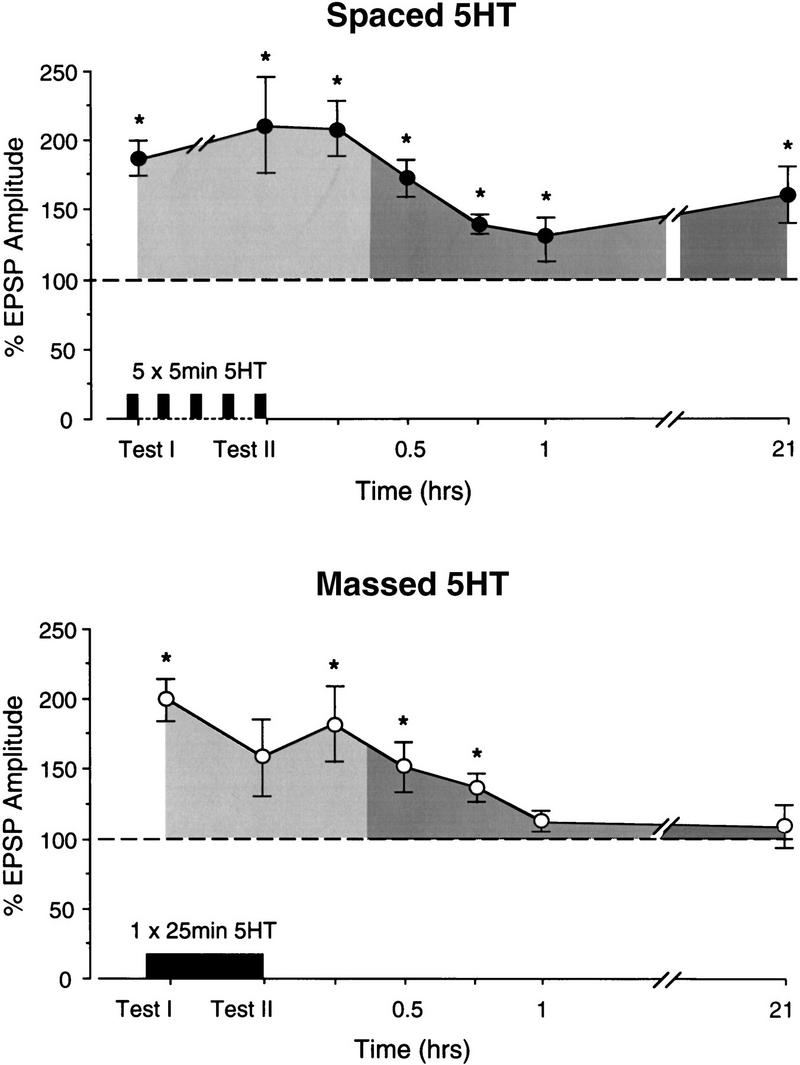
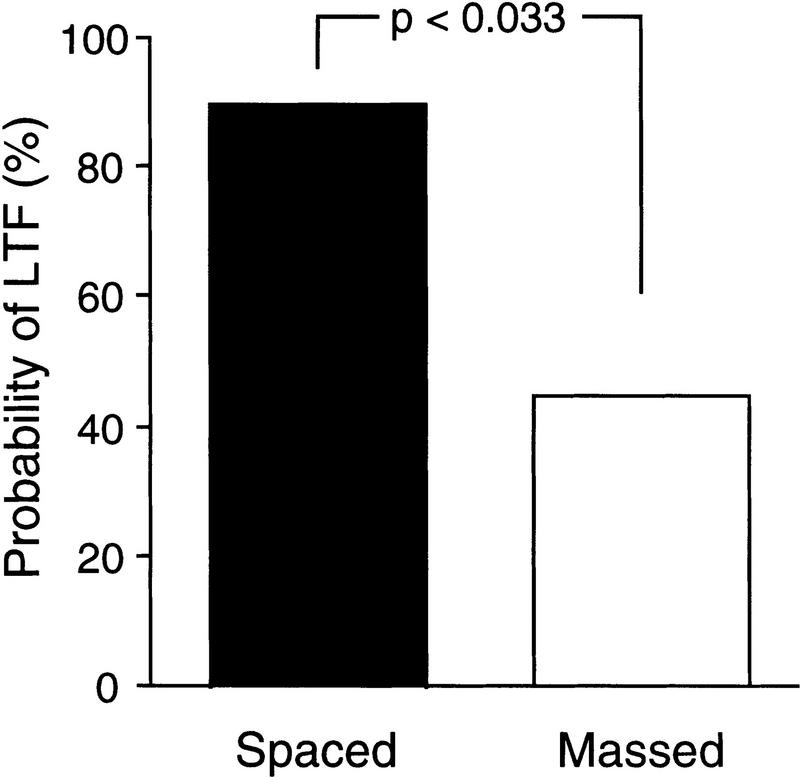
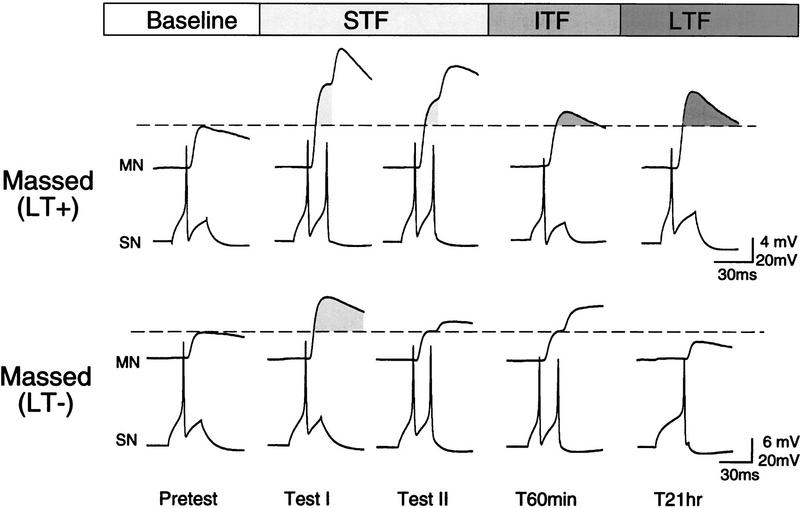
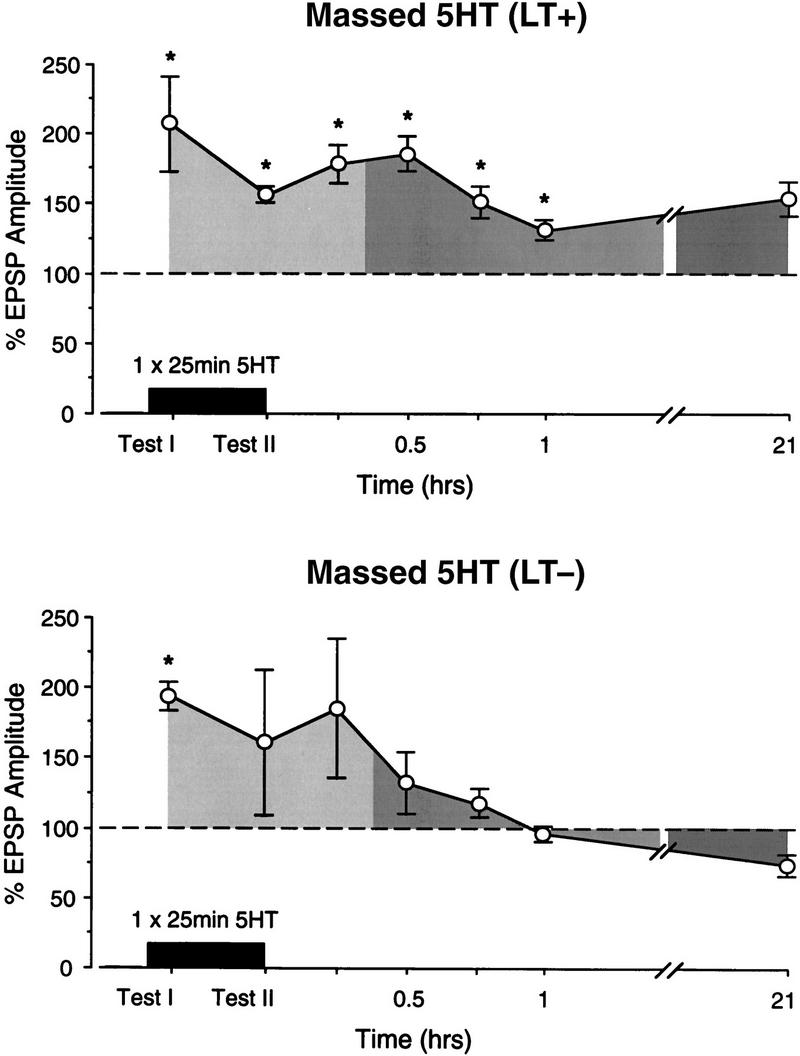
Serotonin (5HT)-induced facilitation of synaptic transmission from tail sensory neurons (SNs) to motor neurons (MNs) in the marine mollusc Aplysia provides a cellular model of short- and long-term memory for behavioral sensitization of the tail withdrawal reflex. Synaptic facilitation at these synapses occurs in three temporal phases: short-term (STF, lasting minutes), intermediate-term (ITF, lasting more than an hour), and long-term (LTF, lasting >24 hr). STF, ITF, and LTF differ in their induction requirements: A single brief exposure of 5HT induces STF, whereas five applications are required for ITF and LTF. Moreover, STF and LTF can be induced independently. Different forms of memory often show differential sensitivity to the pattern of training trials. To begin to explore this effect at a cellular level, we examined ITF and LTF induced by one of two patterns of 5HT application: a spaced pattern (five 5-min exposures with an interval of 15 min) or a massed pattern (one continuous 25-min application). The spaced and massed patterns both induced ITF; however, spaced 5HT application was significantly more reliable at inducing LTF than was massed application. Thus, whereas induction of ITF and LTF require similar amounts of 5HT, the cellular mechanisms underlying the induction of LTF are more sensitive to the pattern of the induction trials. In the massed group, further analysis revealed a relationship between the expression of ITF and the subsequent expression of LTF, suggesting that these two processes may be mechanistically related.
Figures
References
-
- Abrams TW, Castellucci VF, Camardo JS, Kandel ER, Lloyd PE. Two endogenous neuropeptides modulate the gill and siphon withdrawal reflex in Aplysia by presynaptic facilitation involving cAMP-dependent closure of a serotonin-sensitive potassium channel. Proc Natl Acad Sci. 1984;81:7956–7960. - PMC - PubMed
-
- Alberini CM, Ghirardi M, Metz R, Kandel ER. C/EBP is an immediate-early gene required for the consolidation of long-term facilitation in Aplysia. Cell. 1994;76:1099–1114. - PubMed
-
- Bacskai BJ, Hochner B, Mahaut-Smith M, Adams SR, Kaang BK, Kandel ER, Tsien RY. Spatially resolved dynamic of cAMP and protein kinase A subunits in Aplysia sensory neurons. Science. 1993;260:222–226. - PubMed
-
- Bartsch D, Ghirardi M, Skehel PA, Karl KA, Herder SP, Chen M, Bailey CH, Kandel ER. Aplysia CREB2 represses long-term facilitation: Relief of repression converts transient facilitation into long-term functional and structural change. Cell. 1995;83:979–992. - PubMed
Publication types
MeSH terms
Substances
Grants and funding
LinkOut - more resources
Full Text Sources
Miscellaneous